Articles

Enterprise Resource Planning 101: Definition, Benefits, and Key Components

Enterprise resource planning (ERP) software connects financial management and business operations. This guide explains how ERP works, which capabilities businesses use, and how connected workflows support everyday decisions with practical examples from Acumatica.
Enterprise Resource Planning 101: Definition, Benefits, and Key Components

What is Enterprise Resource Planning (ERP)?


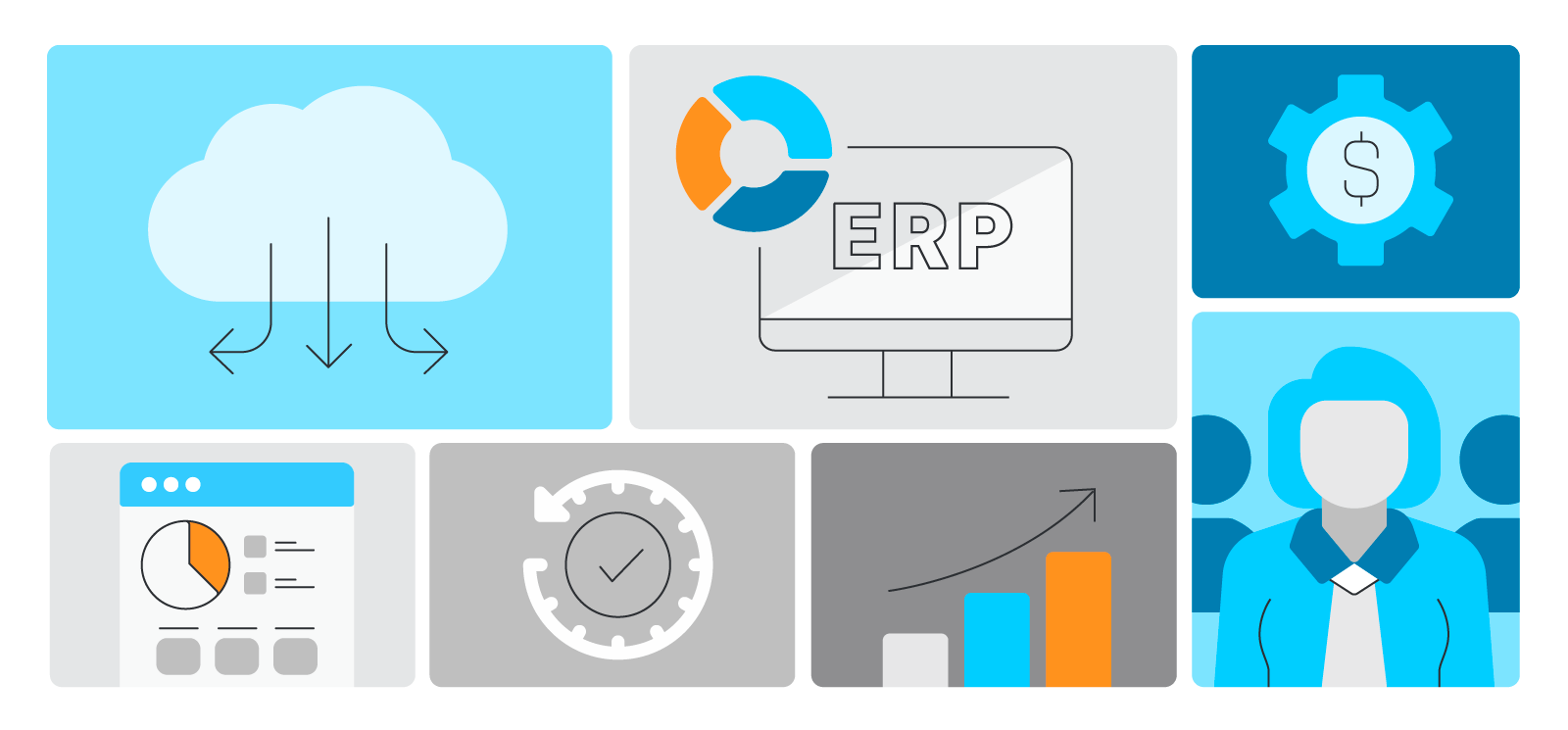
Enterprise resource planning (ERP) is business management software that connects functions such as accounting, purchasing, inventory, sales, and project or production management. Its integrated applications share business records, helping departments coordinate work without repeatedly entering the same information into separate systems.


For example, a distributor can connect a customer’s sales order with inventory availability, shipment details, invoicing, and financial reporting. Employees across departments can follow the transaction using shared information.

The capabilities included in an ERP system depend on the software, selected applications, integrations, and configuration.


How does an ERP system work?

An ERP system connects business applications through shared records and defined workflows. Information entered during one activity can become available to other authorized teams, while approvals, transaction processing, and reporting follow the organization’s configuration.

Consider a distributor processing a customer order:

  1. Sales records the order. The order identifies the customer, products, quantities, and agreed prices.
  2. The team checks inventory. Stock availability helps determine whether the order can be fulfilled or requires replenishment.
  3. Warehouse staff fulfill the order. Picking and shipping activities connect the physical movement of goods with order records.
  4. Finance manages billing. Invoices and payments are recorded through the connected financial applications.
  5. Managers review performance. Reports bring together sales, inventory, and financial information.


This is an illustrative workflow. The exact steps, automation, and posting timing depend on the ERP system and its configuration.


Explore the Distribution Solution

What are the main ERP modules?

ERP modules are connected applications that support particular business functions. Organizations select modules based on their financial, operational, and industry requirements. Not every ERP system includes the same capabilities, and some functions require additional applications or integrations.

ERP_Components_Chart-

 
ERP module or capability What it helps teams manage Example business question
Financial management General ledger, payables, receivables, cash, and financial reporting What do we owe, what are customers paying, and how are we performing?
Purchasing Suppliers, purchase orders, receipts, and approvals What should we purchase, from whom, and when?
Inventory management Stock quantities, locations, movements, and replenishment What inventory is available across our locations?
Order management Customer orders, fulfillment, and related billing workflows Which orders are ready to ship?
Manufacturing Materials, production orders, scheduling, and production costs What resources are needed to complete production?
Project accounting Project budgets, costs, billing, and profitability How are actual project costs comparing with the budget?
Customer relationship management Prospects, opportunities, customer records, and interactions What is happening with this customer or sales opportunity?
Reporting and analytics Financial and operational performance Which results or exceptions need attention?


The Key Benefits of Enterprise Resource Planning


  1. Increased productivity and efficiency
    Productivity means turning resources into products or services. Efficiency means getting the most output with the least input. Both are key to business success.Using ERP applications can boost productivity and efficiency. These tools connect different systems and help users communicate and work together in real time. They also automate business processes.
  2. Better financial and operational reporting
    Stellar productivity and efficiency drive success, but businesses can’t rest on their laurels. They must constantly monitor their financial and operational health.Enterprise resource planning software creates accurate reports using real-time data from all departments. This gives users easy access to the information they need. They can monitor budgets, track changes, follow financial rules, spot trends, and find potential problems.
  3. Enhanced data accuracy and decision-making
    With an enterprise resource planning system, a business’s data flows seamlessly from across the organization into the system’s repository. This synchronized, up-to-the-minute data guides decision-making, significantly boosting overall performance and the bottom line.
  4. Streamlined supply chain and inventory management
    ERP software has built-in supply chain and inventory management features. These tools help users manage their inventory effectively. They also make it easier to fulfill orders and assess risks.


Users can negotiate better with suppliers too. This is important, especially in a chaotic and uncertain global supply chain.

"Acumatica was attractive as it allowed me to easily integrate with the custom solutions that gave me a strategic advantage and it dealt with the standard ERP transaction processing in a way that could support my global operations."
Vladimir Serafimov, CEO and President
Aimtec

Different Ways to Implement Enterprise Resource Planning Systems

ERP systems can be deployed in many ways, so each business needs to choose which option will work best for it. Here’s a brief comparison of the main deployment options:

Cloud-Based: Cloud-based ERP software is accessed via the internet (software as a service or SaaS). Using a web-enabled device, every user can access the secure software 24/7 from any location. The system’s hardware is managed, maintained, and secured by the ERP vendor in an offsite data center. This is often the most popular deployment option.

Private Cloud: A private cloud is dedicated to the data of one business. It is hosted by a partner, such as Amazon Web Services (AWS).

Organizations that use private cloud ERP are often in regulated industries. This includes pharmaceutical and medical companies. It also covers FDA-regulated food and cosmetics businesses.

Incremental or Fast: Some businesses choose to implement their ERP systems slowly—department by department, branch by branch. With an incremental deployment, they have the flexibility to fit the system to their business processes slowly and methodically. Other companies want their ERP vendors to get the implementation done very quickly—in 90 days or less.


Components of Enterprise Resource Planning

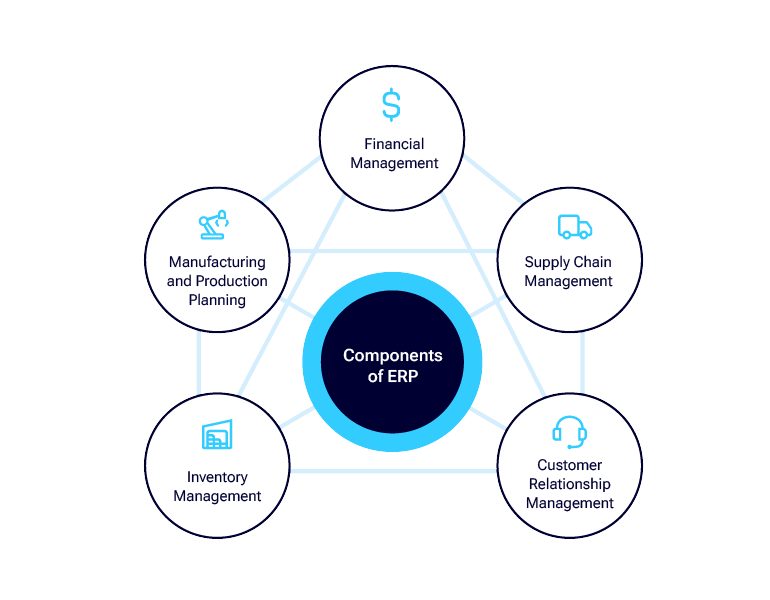
The designers create the parts of enterprise resource planning systems to work well together. This helps businesses meet their front and back office needs effectively. Typically, ERP systems offer the following applications:
Components of ERP
 

  • Financial Management: These modules offer financial and accounting features. They include General Ledger software, cash management, and tax management. They also cover time management, bank feeds, payroll management, and more. This helps businesses simplify their financial workflows. It reduces workloads and gives a clear view of their financial status.
  • Supply Chain Management: Supply chain management modules help users manage their complex sourcing, manufacturing, warehousing, transportation, distribution, and customer service processes. Transforming raw materials into finished products and delivering them to customers is now efficient, flexible, and affordable. This process offers better visibility, lower operating costs, and improved predictability.
  • Customer Relationship Management: CRM modules help improve the customer experience. They let users respond quickly to customers and track performance and spending. Users can also offer a self-service Customer Portal. Additionally, these modules capture all customer data, including marketing, sales, billing, and finance, in one integrated system.
  • Inventory Management: Inventory management modules empower businesses to stay on top of their inventory, whether it’s warehoused in a single location or geographically dispersed. These modules simplify inventory needs with powerful item management, traceability, and replenishment features.
  • Manufacturing and Production Planning: These modules provide strong tools for production, estimating, engineering, material planning, scheduling, and product setup. They make complex, multi-step processes easier to manage.

Human resource management and business intelligence are important parts of modern ERP solutions. Some systems, like Acumatica, provide extra applications for specific industries. These include Construction, Distribution, Manufacturing, Retail, and Professional Services.


Businesses around the world are heavily investing in enterprise resource planning systems, and this trend doesn’t appear to be slowing down any time soon. According to Fortune Business Insights™, the global enterprise resource planning software market is projected to grow from 2024’s USD 81.15 billion to USD 238.79 billion by 2032.

Additional enterprise resource planning trends include the adoption of innovations like AI, machine learning, and the internet of things (IoT). Together, these innovations and the unprecedented access to organizational data ERP solutions provide are giving businesses strategic, business-enhancing insights, immense time and cost savings, increased communication, enhanced collaboration, off-the-charts efficiency, and supersized productivity.

The result? Transformed businesses that are throwing open the door to a thriving future.

“Acumatica gave us a heart to our business. Now if we need to do something, we learn how the system can do it and do it, which has changed our culture.” Schneur Perl, Sr. Technical Project Manager and Business Development Manager, Sunshine Lighting

See what’s possible when you have a future-proof ERP platform that truly puts customers first.

Request a demo