
 Canada (English)
 Colombia
 Caribbean and Puerto Rico
 Ecuador
 India
India
 Indonesia
 Ireland
 Malaysia
 Mexico
 Panama
 Peru
Peru
 Philippines
 Singapore
 South Africa
 Sri Lanka
 Thailand
 United Kingdom
 United States
 AcumatiCares


Deferred Revenue Accounting in an ERP System
Deferred revenue is common in subscription businesses, professional services firms, maintenance providers, and companies selling prepaid or bundled products and services. As contract volume and recognition scenarios grow, spreadsheets and disconnected systems can make the process difficult to control, reconcile, and audit.
This article covers deferred revenue in simple terms, explains why it matters for financial accuracy, and clarifies how ERP systems help automate schedules, postings, audit trails, and recognition workflows.
What Is Deferred Revenue, and Why Is It a Liability?
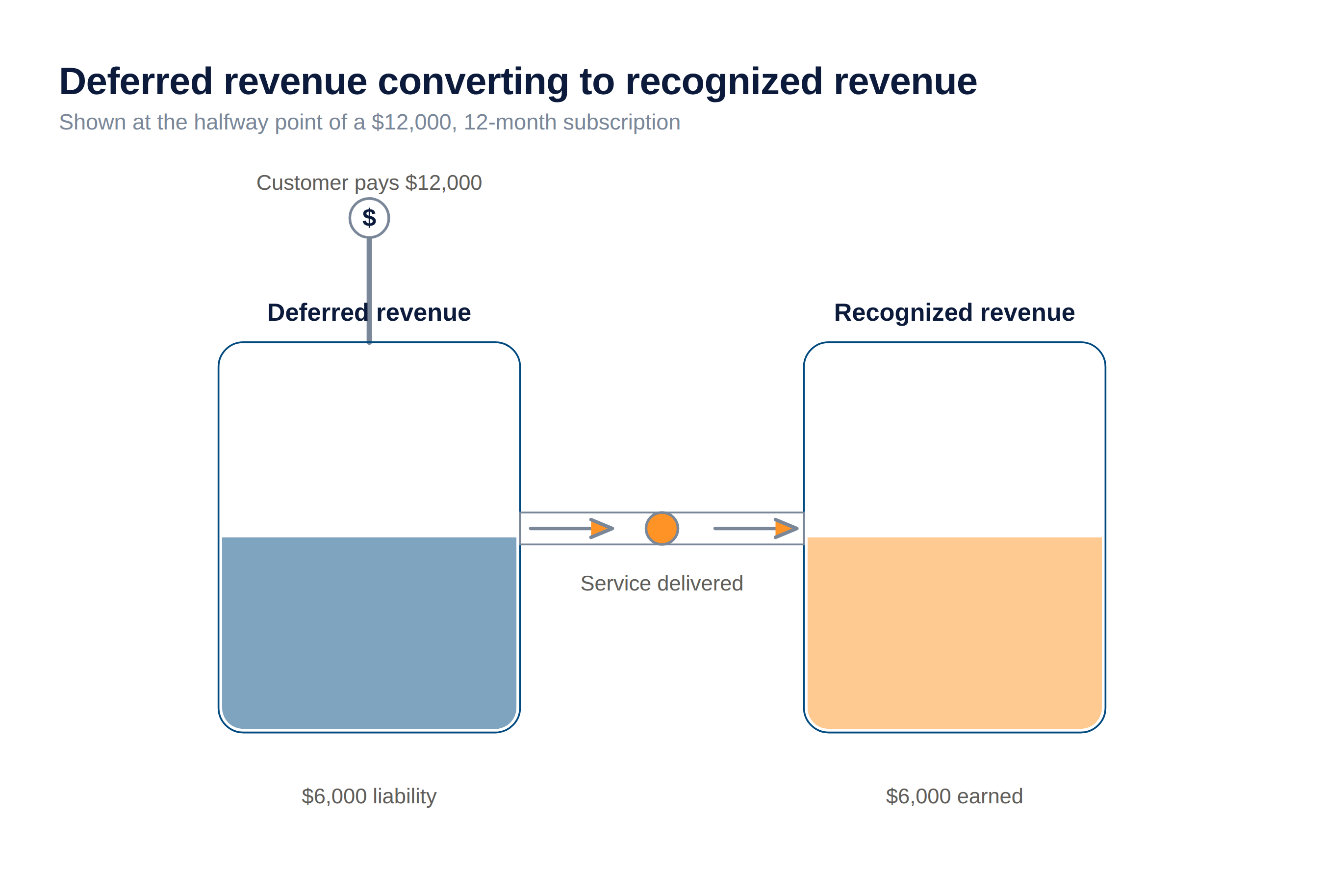
Deferred revenue is money a company receives before it has delivered the related goods or services. Because the company still owes the customer a product, a service, or a performance obligation, that payment is recorded as a liability on the balance sheet, not as income.
Deferred revenue, earned revenue, and accrued revenue reflect different combinations of payment and performance. Deferred revenue generally involves payment received before performance, while accrued revenue involves performance completed before billing or collection.
| Accounting category | Has the company delivered the product or service? | Has payment been received? | Typical financial statement treatment |
|---|---|---|---|
| Deferred revenue | No | Yes | Liability on the balance sheet |
| Accrued revenue | Yes | No | Asset on the balance sheet |
| Recognized revenue | Yes | Either yes or no | Revenue on the income statement |
Under ASC 606, “contract liability” is the more formal term for an obligation to transfer goods or services for which consideration has been received or is due.
Common examples include:
- Annual software subscriptions paid upfront before the service period begins.
- Prepaid service contracts covering maintenance or support over a defined term.
- Customer deposits placed before goods ship.
- Warranty plans sold alongside a product.
- Software upgrades bundled into a license agreement.
Each of these involves cash received in advance. Until the company delivers on its promise, that cash is a liability.
In the United States, revenue recognition is governed by ASC 606 (with IFRS 15 as its international counterpart), which delineates when a company can recognize revenue from customer contracts. Under ASC 606, what is commonly referred to as deferred revenue is generally presented as a contract liability. While the terms are often used interchangeably in practice, “contract liability” is the formal accounting term used in the ASC 606 standard and in many audited financial statements.
How Deferred Revenue Accounting Works in Practice
Deferred revenue accounting follows a consistent flow: receive payment, record a liability, deliver the product or service, then recognize revenue as obligations are fulfilled. The process is straightforward in theory, but deferred revenue accounting can become significantly more complex in practice.
Deferred Revenue Example
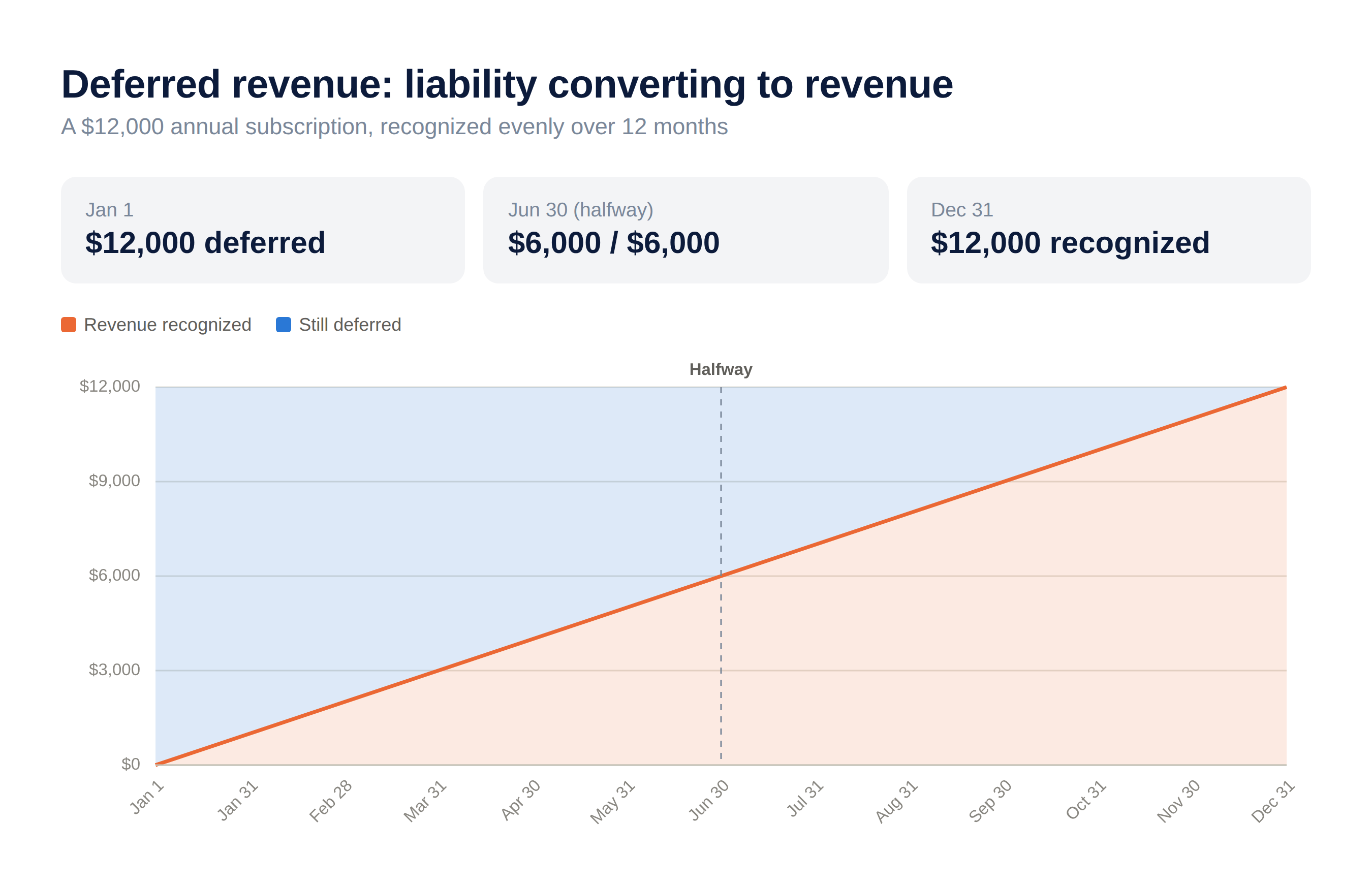
Suppose a customer pays $12,000 on January 1 for a 12-month software subscription. The company initially records the full $12,000 as deferred revenue because it has not yet provided the subscription service. If the service is delivered evenly throughout the year, the company recognizes $1,000 of revenue each month.
| Date or stage | Cash received | Revenue recognized | Remaining deferred revenue |
|---|---|---|---|
| January 1 | $12,000 | $0 | $12,000 |
| January 31 | — | $1,000 | $11,000 |
| February 28 | — | $1,000 | $10,000 |
| After six months | — | $6,000 cumulative | $6,000 |
| End of subscription | — | $12,000 cumulative | $0 |
This straight-line example assumes the performance obligation is satisfied evenly over the subscription period. Different contract terms may require a different recognition pattern.
That same logic applies across dozens or hundreds of contracts simultaneously. When partial periods, contract modifications, bundled offerings, cancellations, or multi-currency activity enter the picture, the complexity multiplies. Finance teams must track not just the original payment but every change that affects when and how much revenue can be recognized.
Recognition also varies by industry. A professional services firm on a long-term engagement typically recognizes revenue over time as work is delivered, rather than all at once. Warranties are another nuance. An assurance-type warranty that simply guarantees the product meets agreed specifications is generally not treated as a separate performance obligation, whereas a separately priced or service-type extended warranty typically is.
What Journal Entries Help Teams Track Deferred Revenue?
Finance teams track deferred revenue through two key journal entries: one when payment is received and one when revenue is earned. The table below outlines the basic lifecycle, labeled as illustrative and not as professional accounting advice.
Illustrative Journal Entry Example
| Event | Debit | Credit |
|---|---|---|
| Customer prepays for the annual subscription | Cash: $12,000 | Deferred revenue: $12,000 |
| One month of service is delivered | Deferred revenue: $1,000 | Subscription revenue: $1,000 |
The monthly recognition entry repeats as the service is delivered, reducing the liability and increasing recognized revenue. The actual accounts and timing should follow the company’s accounting policies and applicable professional guidance.
The exact accounts, recognition timing, and entry structure should follow the company’s accounting policy and the guidance of qualified accounting professionals. The right approach will vary based on contract terms, billing model, and applicable standards.
For companies managing many contracts, even this simple two-step cycle can generate significant volume. Tracking it manually, period after period, creates real risk.
Where Does Deferred Revenue Appear on the Balance Sheet?
Deferred revenue appears as a liability on the balance sheet. Amounts expected to be recognized within the company’s normal operating cycle or the next 12 months are generally classified as current liabilities. Amounts associated with obligations extending beyond that period may be classified as noncurrent liabilities, depending on the applicable accounting framework and the company’s reporting policies.
Deferred revenue, earned revenue, and accrued revenue reflect different combinations of payment and performance. Deferred revenue generally involves payment received before performance, while accrued revenue involves performance completed before billing or collection.
| Accounting Category | Has the Company Delivered the Product or Service? |
Has Payment Been Received? |
Typical Financial Statement Treatment |
|---|---|---|---|
|
Deferred Revenue |
No | Yes | Liability on the balance sheet |
|
Accrued Revenue |
Yes | No | Asset on the balance sheet |
|
Recognized Revenue |
Yes | Either yes or no | Revenue on the income statement |
Under ASC 606, “contract liability” is the more formal term for an obligation to transfer goods or services for which consideration has been received or is due.
Common examples include:
- Annual software subscriptions paid upfront before the service period begins.
- Prepaid service contracts covering maintenance or support over a defined term.
- Customer deposits placed before goods ship.
- Warranty plans sold alongside a product.
- Software upgrades bundled into a license agreement.
Each of these involves cash received in advance. Until the company delivers on its promise, that cash is a liability.
In the United States, revenue recognition is governed by ASC 606 (with IFRS 15 as its international counterpart), which delineates when a company can recognize revenue from customer contracts. Under ASC 606, what is commonly referred to as deferred revenue is generally presented as a contract liability. While the terms are often used interchangeably in practice, “contract liability” is the formal accounting term used in the ASC 606 standard and in many audited financial statements.
How Accrual Accounting Shapes Revenue Recognition Timing
Accrual accounting recognizes revenue when it is earned, not simply when cash changes hands. This principle is what makes deferred revenue accounting necessary in the first place.
Without accrual-based timing, a company could record a full annual subscription payment as revenue in the month it arrives, overstating income for that period and understating it in every subsequent month. Proper timing protects the income statement from this distortion and gives leadership a more accurate picture of financial performance.
ASC 606 uses a five-step revenue recognition model:
- Identify the contract with the customer.
- Identify the distinct performance obligations.
- Determine the transaction price.
- Allocate the transaction price to the performance obligations.
- Recognize revenue when or as each performance obligation is satisfied.
Deferred revenue is essentially what sits on the balance sheet between the earlier steps and the last one. The company has been paid, but revenue can’t be recognized until the related obligation is satisfied.
Finance teams should align their deferred revenue practices with applicable accounting standards and seek professional guidance on how those standards apply to their specific contracts, industries, and reporting requirements. Obligation tracking and recognition timing are areas where accounting judgment matters.
Why Manual Deferred Revenue Processes Become Risky
Spreadsheet-based deferred revenue tracking often works well when a company is small and contract volume is low. As the business grows, that same spreadsheet becomes a fragile foundation.
Common risks in manual processes include:
- Missed recognition schedules when contract dates are tracked inconsistently.
- Inconsistent postings across periods or entities.
- Hard-to-trace adjustments that make audits difficult to support.
- Unclear obligation tracking when contract terms change mid-term.
- Month-end close delays driven by manual reconciliation work.
| Process Area | Manual or Spreadsheet-Based Process | ERP-Based Process |
|---|---|---|
|
Schedule Creation |
Schedules are created and updated individually | Rules and templates generate schedules |
|
Journal Entries |
Finance enters recurring entries manually | The system generates due recognition transactions |
|
Contract Changes |
Changes must be updated across separate files | Adjustments can flow through connected records |
|
Reconciliation |
Schedules are compared manually with the general ledger | Recognition activity is connected to financial records |
|
Audit Support |
Evidence may be distributed across files and emails | Source documents, schedules, entries, and changes are traceable |
|
Reporting |
Reports require spreadsheet consolidation | Current and projected balances can be reported from connected data |
|
Scalability |
Work increases with every contract | Repeatable processes accommodate higher transaction volume |
ERP automation does not remove the need for accounting judgment, but it can reduce the manual work required to apply approved recognition policies consistently.
These risks are especially pronounced for subscription revenue recognition. SaaS companies, maintenance providers, and recurring service businesses often manage hundreds or thousands of active contracts simultaneously. A single spreadsheet error in one contract can cascade across multiple periods and distort recurring revenue metrics that leadership relies on to make decisions.
For finance professionals, the concern is not just accuracy at the transaction level. It is confidence in the financial statements, readiness for audits, and clarity about cash flow relative to earned versus unearned revenue.
When Should a Small to Mid-Market Company Improve Its Deferred Revenue Process?
A small to midsized business (SMB) should improve its deferred revenue process when finance teams can no longer reliably connect invoices, recognition schedules, revenue postings, and reporting in a consistent and auditable way.
The trigger is not company size alone. It is operational maturity. Signs that improvement is warranted include:
- Growing subscription or recurring billing volume.
- Multi-element arrangements with different recognition timing per component.
- Transactions in multiple currencies.
- Increasing friction during audits or financial reviews.
- Manual close work that expands each period as contract volume grows.
Improvement may involve policy cleanup, process redesign, ERP solution configuration, or some combination of all three. The goal is a deferred revenue process that scales with the business and supports financial accuracy without requiring a proportional increase in manual effort.
How ERP Systems Help with Deferred Revenue Accounting
An ERP system can connect deferred revenue schedules with customer contracts, sales orders, invoices, inventory items, accounts receivable, and the general ledger. This reduces the need to maintain separate schedules and reconcile them manually with financial records.
Acumatica Cloud ERP supports deferred revenue calculations and postings, configurable deferral schedules, multiple recognition methods, and integration with financial management workflows. These capabilities allow finance teams to manage deferred revenue as part of a connected accounting workflow rather than as a standalone, manual process.
For contracts that bundle multiple deliverables, Acumatica supports allocating a bundled contract’s transaction price across distinct performance obligations, helping finance teams manage more complex, multi-element revenue recognition scenarios. Under ASC 606, the transaction price for contracts with multiple performance obligations is generally allocated based on each obligation’s standalone selling price (SSP), rather than divided evenly across the contract.
Keeping the revenue recognition process integrated with the broader financial system also means that changes, such as contract modifications or cancellations, can be reflected consistently across all relevant records.
How Finance Teams Reduce Manual Work with Automation
Automation helps finance teams apply recognition schedules, generate recognition transactions, and reduce the repetitive period-end work that accumulates as contract volume grows.
In an ERP solution, this typically involves:
- Deferral codes and templates that define how revenue should be recognized for specific items or contract types.
- Schedule generation that calculates recognition amounts across periods based on the chosen method.
- Automated posting workflows that process due recognition transactions without manual recalculation.
Acumatica provides the capabilities to configure deferral codes, assign them to inventory items or document lines, and run recognition to post transactions that are due in a given period. These features are most valuable when finance teams are managing a high volume of recurring contracts and need the recognition process to run consistently and traceably, period after period. For decision-makers evaluating ERP solutions, the key question is whether automation supports the recognition logic the business actually uses, not just a simplified version of it.
What Deferred Revenue Accounting Features Matter Most in an ERP System?
Finance professionals evaluating ERP solutions for deferred revenue accounting should look for a core set of capabilities that support operational accuracy, audit readiness, and reporting. The right ERP solution should address the full recognition lifecycle, not just initial posting.
A practical evaluation checklist includes:
- Automated schedule calculation based on configurable rules, not manual input.
- Customizable deferral schedules that can handle partial periods, contract changes, and complex billing arrangements.
- Multiple recognition methods to match different revenue models.
- Transaction-level traceability linking each recognition entry back to its originating document.
- Integration with sales, billing, accounts receivable, and the general ledger, so revenue schedules and financial postings remain connected.
- Multi-currency support for companies operating across borders.
- Reporting and dashboards that give leadership visibility into deferred and recognized revenue balances.
- Role-based access controls to maintain data integrity and support internal governance.
- Multi-element allocation that can split a transaction price across its distinct performance obligations.
On ASC 606 and IFRS 15: Acumatica provides capabilities that can support revenue recognition workflows designed around ASC 606 and IFRS 15, including multiple recognition methods and allocation across performance obligations. Organizations remain responsible for configuring these capabilities according to their contracts, accounting policies, professional judgment, and reporting requirements.
Which Recognition Methods Support Different Revenue Models?
Recognition methods determine how deferred amounts are distributed across periods, and the right method depends on the specific revenue model and contract terms.
Common approaches include:
| Recognition method | Common use case | How it works |
|---|---|---|
| Evenly by period | Fixed annual subscriptions | Allocates the deferred amount evenly across accounting periods |
| Prorated by day | Contracts beginning or ending mid-period | Recognizes revenue according to the number of service days |
| Evenly by days in period | Terms spanning months of different lengths | Adjusts each period’s amount based on its number of days |
| Specific-date schedule | Contractually defined recognition dates | Recognizes specified amounts on scheduled dates |
| Event- or milestone-based | Deliverables satisfied at defined points | Recognizes revenue when the applicable obligation is satisfied |
For businesses managing a mix of subscription types, maintenance agreements, and bundled contracts, having access to multiple recognition methods within the same ERP solution is a meaningful operational advantage.
What Finance Leaders Should Know Before Choosing an ERP System
There are many factors to consider when choosing the right ERP system, but a successful deferred revenue implementation starts with financial clarity before configuration begins. Finance teams need clearly defined revenue policies, documented obligation structures, clean item setup, and established ownership of the review process.
Documenting revenue scenarios before configuring an ERP solution matters because automation reflects the rules it is given. If those rules are ambiguous, the resulting schedules and postings will be, too. Leaders should map their actual revenue models, including subscription tiers, multi-element arrangements, contract modification scenarios, and cancellation terms, before vendor conversations begin.
Deferred revenue accounting often involves accounting judgment that software cannot make independently. This is particularly true for companies operating in subscription, multi-element, multi-entity, multi-currency, multi-regulatory, or complex-contract environments. Deferred revenue policies, recognition methods, obligation tracking, and reporting practices should be adapted to the company’s accounting policies, internal controls, and industry and tax requirements, and reviewed with qualified accounting, audit, and tax professionals.
How to Implement Deferred Revenue Automation
- Document every major revenue model and contract type.
- Identify performance obligations and recognition triggers.
- Define approved recognition methods and accounting policies.
- Standardize customers, items, contracts, and deferral codes.
- Configure schedules and posting rules in a test environment.
- Test standard transactions, contract changes, cancellations, and exceptions.
- Reconcile test results with expected journal entries and balances.
- Assign schedule review, approval, and exception-management responsibilities.
- Migrate open deferred revenue balances.
- Monitor reports and reconcile deferred revenue to the general ledger after launch.
Finance teams should have qualified accounting professionals approve policies and test results before relying on automated postings in production.
Building a More Reliable Deferred Revenue Process
Accurate deferred revenue accounting helps finance teams distinguish cash received from revenue earned, maintain reliable financial statements, and track obligations that remain outstanding. As contract volume and complexity grow, spreadsheets can make schedules, adjustments, reconciliations, and audit support increasingly difficult to manage.
ERP software can bring billing, recognition schedules, journal entries, and financial reporting into a connected workflow. The strongest results come from combining that automation with clearly documented accounting policies, reliable contract data, appropriate controls, and professional review.
Acumatica Deferred Revenue Management helps growing businesses automate recognition schedules and postings while maintaining visibility into deferred and recognized revenue. Explore Acumatica’s deferred revenue accounting capabilities or schedule a demonstration to see how they can support your financial workflows.
Frequently Asked Questions
What is deferred revenue in simple terms?
Deferred revenue is payment received before a company has delivered the related goods or services. It is recorded as a liability until the company satisfies the obligation and earns the revenue.
How do you calculate deferred revenue?
Begin with the amount received or due for obligations that have not yet been satisfied. Reduce that balance by the revenue recognized as the related goods or services are delivered. For example, after three months of a $12,000 annual subscription recognized evenly at $1,000 per month, $9,000 remains deferred.
What is the journal entry for deferred revenue?
When an advance payment is received, the company generally debits cash and credits deferred revenue. When the related revenue is earned, it debits deferred revenue and credits revenue. The exact entry and timing depend on the contract and the company’s accounting policies.
Is deferred revenue a current or noncurrent liability?
Deferred revenue expected to be recognized within the normal operating cycle or 12 months is generally classified as a current liability. Amounts related to obligations extending beyond that period may be classified as noncurrent.
What is the difference between deferred and accrued revenue?
Deferred revenue generally involves payment received before the company delivers the product or service. Accrued revenue involves revenue already earned before the company invoices or receives payment.
What can ERP software automate in deferred revenue accounting?
ERP software can generate recognition schedules, calculate period amounts, create recognition transactions, maintain links to source documents, apply configured allocation rules, and produce reports showing deferred and recognized balances.
Does ERP software guarantee ASC 606 or IFRS 15 compliance?
No. ERP software can support revenue recognition processes, but compliance depends on the organization’s contracts, policies, configuration, controls, accounting judgment, and professional review.


