
 Canada (English)
 Colombia
 Caribbean and Puerto Rico
 Ecuador
 India
India
 Indonesia
 Ireland
 Malaysia
 Mexico
 Panama
 Peru
Peru
 Philippines
 Singapore
 South Africa
 Sri Lanka
 Thailand
 United Kingdom
 United States
 AcumatiCares


Procure-to-pay and order-to-cash can represent opposite sides of the same transaction. For example, when a distributor purchases inventory from a manufacturer, the distributor manages the transaction through its P2P process. The manufacturer manages that same transaction through its O2C cycle. One company records a supplier obligation and cash outflow, while the other records a customer receivable and cash inflow.
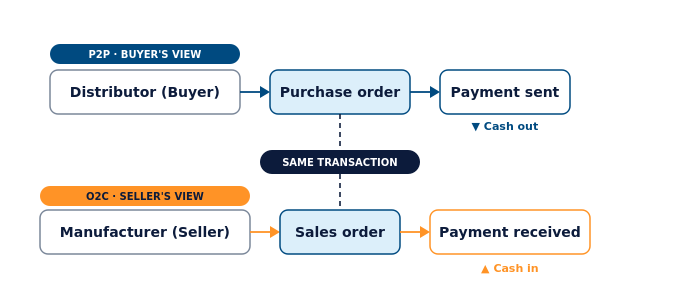
Procure-to-pay and order-to-cash are two connected business cycles that show how cash moves into and out of an organization. P2P connects purchasing, receiving, accounts payable, and supplier payments. O2C connects sales orders, fulfillment, invoicing, accounts receivable, and customer payments.
Understanding the differences between P2P and O2C helps finance and operations leaders assign process ownership, identify bottlenecks, evaluate ERP requirements, and improve working-capital visibility. This article compares the two cycles and explains how connected ERP data can reduce manual work across both.
Key Takeaways:
- P2P manages purchases, supplier obligations, and cash outflows; O2C manages customer orders, receivables, and cash inflows.
- A transaction may be part of the buyer’s P2P process and the seller’s O2C process.
- P2P usually involves procurement, receiving, AP, and finance; O2C involves sales, fulfillment, AR, and finance.
- DPO helps measure P2P payment timing, while DSO helps measure O2C collection timing.
- An integrated ERP system connects both cycles through shared records, automated workflows, and current financial reporting.
How Do Procure-to-Pay and Order-to-Cash Work Together?
P2P and O2C work together by connecting expected cash outflows with expected cash inflows. P2P data shows upcoming purchasing commitments, supplier invoices, and payment obligations. O2C data shows open customer orders, outstanding invoices, expected collections, and received payments.
Evaluating these processes together gives finance leaders a more complete view of liquidity and working capital. When the cycles operate in disconnected systems or spreadsheets, cash forecasting depends on manually combining AP, AR, purchasing, sales, and inventory information.
Connecting that data through ERP helps finance teams identify timing gaps, anticipate cash requirements, and investigate process bottlenecks earlier.
How the Procure-to-Pay Process Controls Spend and Supplier Risk
Procure-to-pay is the process a business uses to request, purchase, receive, verify, and pay for goods and services. It connects procurement, receiving, accounts payable, and finance. The process generally begins when the organization identifies a purchasing need and ends when the supplier payment is issued, recorded, and reconciled.
Depending on the organization, supplier sourcing and contract negotiation may occur before the P2P cycle. These activities are generally part of the broader source-to-pay process.
What Are the Steps in the Procure-to-Pay Process?
The Procure-to-Pay Process
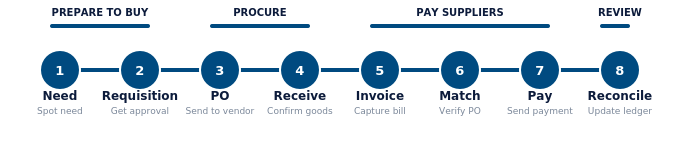
A typical procure-to-pay cycle includes the following steps:
- Identify a purchasing need. An employee, department, or inventory-planning process identifies a requirement for goods or services.
- Create and approve a purchase requisition. The request is reviewed against budgets, purchasing policies, and authorization limits.
- Create and issue a purchase order. An approved requisition is converted into a purchase order and sent to the supplier.
- Receive the goods or services. The organization records the quantity and condition of the items received or confirms that the service was completed.
- Capture the supplier invoice. Accounts payable records the invoice and verifies the supplier, amount, terms, taxes, and other details.
- Match and approve the invoice. The invoice may be compared with the purchase order and receiving record through two-way or three-way matching.
- Issue payment. The organization pays the approved invoice according to its payment terms and cash-management policies.
- Reconcile and report the transaction. Finance records the payment, updates the general ledger, and monitors purchasing and AP performance.
Viewed end to end, P2P moves through four broad phases: preparing to buy, procuring goods and services, paying suppliers, and reviewing performance to improve the cycle. Leaders should assign clear ownership and controls at each stage.
Common pain points in P2P include:
- Manual approval routing that delays purchase orders and payments.
- Mismatched invoices that create exceptions and rework in accounts payable.
- Weak purchasing controls that allow spend outside approved suppliers or processes.
- Duplicate data entry between procurement, receiving, inventory, and finance systems.
- Limited visibility into open commitments and outstanding liabilities.
Connecting purchasing, receiving, inventory, AP, and reporting data in an ERP system can reduce duplicate entry and improve control across the P2P cycle. Acumatica supports electronic vendor invoice capture, while paper invoices can be captured through optical character recognition. The system identifies information such as the vendor, terms, currency, line items, and invoice amount, reducing the need to enter these details manually.
What Is the Order-to-Cash Process?
Order-to-cash is the process a business uses to receive and fulfill customer orders, invoice customers, collect payment, and apply the received cash. It connects sales, order management, inventory or service delivery, accounts receivable, payments, and finance. The process generally begins when a customer places an order and ends when the payment is applied and the receivable is reconciled.
What Are the Steps in the Order-to-Cash Process?
The Order-to-Cash Process
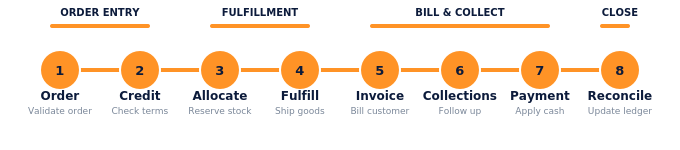
A typical order-to-cash cycle includes the following steps:
- Receive and validate the customer order. The business confirms the products or services, quantities, prices, delivery requirements, and payment terms.
- Review customer credit and terms. The organization verifies the customer’s credit status and determines whether the order requires additional approval.
- Allocate inventory or schedule delivery. Available inventory is reserved, production is planned, or services are scheduled.
- Fulfill the order. Products are picked, packed, and shipped, or the agreed services are delivered.
- Generate the customer invoice. The business creates an accurate invoice based on the order and fulfillment information.
- Manage collections. Accounts receivable monitors open invoices, communicates with customers, and resolves disputes.
- Receive and apply payment. Customer payments are matched with the correct invoices and recorded in the accounting system.
- Reconcile and report the transaction. Finance updates the general ledger and monitors receivables, collections, and cash-flow performance.
When order management, payments, and accounts receivable (AR) processes are disconnected, delays accumulate at each handoff point. A sales order that does not flow automatically into fulfillment and invoicing creates gaps that slow cash collection and increase the risk of billing errors. Connecting these steps in a shared system supports more consistent O2C execution. Acumatica’s order management software includes AI-assisted item substitution, up-sell, and cross-sell suggestions within sales order management. This helps sales teams surface relevant add-on options without manual lookups. For multi-entity or cross-border businesses, consistent O2C processes across locations and legal entities are especially important for accurate, consolidated reporting.
What Is the Difference Between Procure-to-Pay and Order-to-Cash?
The main difference between procure-to-pay and order-to-cash is the direction and purpose of the transaction. P2P manages purchases, supplier obligations, and cash leaving the business. O2C manages customer orders, receivables, and cash entering the business. The processes also involve different owners, documents, risks, controls, and ERP capabilities.
Procure-to-Pay vs. Order-to-Cash Comparison
The table below summarizes the most important structural differences between P2P and O2C. Keeping these distinctions clear helps leaders assign ownership, evaluate ERP requirements, and prioritize process improvements.
| Comparison Area | Procure-to-Pay (P2P) | Order-to-Cash (O2C) |
|---|---|---|
|
Primary Purpose |
Purchase goods and services and pay suppliers accurately | Fulfill customer orders, invoice customers, and collect payment |
|
Process Trigger |
Internal purchasing need, requisition, or inventory-replenishment signal | Customer purchase order, online order, contract, or sales order |
|
Starting Point |
Purchasing need or approved requisition | Accepted customer order |
|
Ending Point |
Supplier payment is recorded and reconciled | Customer payment is applied and reconciled |
|
Primary Relationship |
Supplier-facing from the buyer’s perspective | Customer-facing from the seller’s perspective |
|
Teams Involved |
Procurement, receiving, accounts payable, and finance | Sales, order management, fulfillment, accounts receivable, and finance |
|
Core Documents |
Requisitions, purchase orders, receipts, supplier invoices, and payment records | Sales orders, fulfillment records, customer invoices, collection records, and cash receipts |
|
Financial Direction |
Cash outflow and accounts payable | Cash inflow and accounts receivable |
|
Main Risks |
Unauthorized spending, invoice mismatches, duplicate payments, fraud, and delayed approvals | Credit risk, billing errors, fulfillment delays, disputes, late payments, and inaccurate cash application |
|
Core ERP Capabilities |
Requisition management, purchasing, receiving, invoice capture, AP, and supplier payments | Sales order management, inventory and fulfillment, invoicing, AR, collections, and customer payments |
|
Common KPIs |
PO cycle time, invoice exception rate, on-time payment rate, and DPO | Order-fulfillment time, DSO, overdue receivables, collection effectiveness, and cash-application accuracy |
How Do P2P and O2C Affect Working Capital?
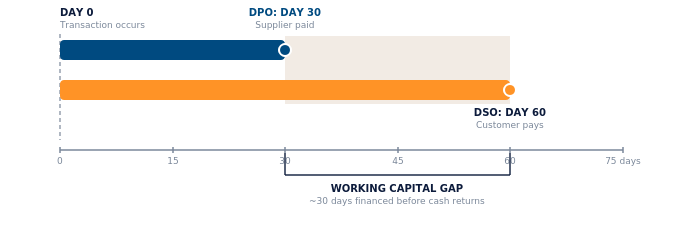
P2P affects working capital by determining when supplier obligations are created and paid. One related metric is days payable outstanding (DPO), which measures the average time a company takes to pay suppliers. O2C affects working capital by determining how quickly customer orders become collected cash. Days sales outstanding (DSO) measures the average time required to collect payment after a sale.
The Working Capital Gap: DPO vs. DSO
Example only: actual DPO and DSO vary by industry and company
Managing DPO and DSO together helps finance leaders understand the timing difference between cash entering and leaving the business. However, the goal is not simply to maximize DPO or minimize DSO. Companies must balance liquidity with contractual requirements, supplier relationships, customer experience, available discounts, and credit risk.
When AP and AR information resides in separate systems, finance teams may need to reconcile multiple reports before evaluating working capital. An integrated ERP system can provide a more current view of open purchase commitments, supplier invoices, customer receivables, and expected payments.
How ERP Connects Payables, Receivables, and Cash Flow Data
ERP connects P2P and O2C by maintaining purchasing, receiving, inventory, sales, fulfillment, AP, AR, payments, and general ledger information in a shared system. Transactions can move between departments without being recreated manually, while dashboards and reports provide a consolidated view of supplier obligations, customer receivables, and cash activity.
How Shared Data Reduces Delays, Errors, Rework, and Costs
Finance teams that still manually rekey data between procurement, receiving, finance, and fulfillment systems face avoidable exceptions at every handoff. Rekeying vendor invoices into AP after they have already been entered in procurement creates duplicate records. Sales order data that does not flow automatically into invoicing requires manual intervention before billing can happen. Three-way matching (comparing an invoice against its originating PO and receiving record) is a core P2P control that becomes far more manageable when all three documents live in the same system. Purchase order management features that link sales orders directly to purchase orders, support blanket purchase orders and drop-shipments sent from the vendor directly to the customer, automatically allocate received items, and route exceptions to the right approver reduce the manual effort that creates bottlenecks across both cycles. Automated approvals preserve governance while eliminating the delays that come from chasing signatures via email.
Real-Time Visibility for Cash and Operational Control
Leaders need current visibility into open POs, vendor bills, customer invoices, collections status, and payment timing to make informed decisions. Dashboards and reporting tools serve as practical decision-support instruments for finance, operations, and management teams. As companies grow, adding more transactions, locations, entities, and users makes spreadsheet-based tracking progressively harder to maintain accurately. Multi-location and multi-entity businesses face additional complexity. Consolidated cash visibility across legal entities requires data to be structured consistently and updated in real time. ERP solutions that surface this data through configurable dashboards give finance leaders a current view of working capital, liabilities, and receivables—no manual hunting required.
What P2P and O2C Features Matter Most in an ERP System?
The P2P and O2C features that matter most in an ERP system depend on where the business experiences the most friction: purchasing control, invoice processing, order fulfillment, collections, or cash forecasting. The goal is to identify which capabilities address the specific gaps causing cash, control, or operational problems. No single feature list applies to every company, but certain capabilities consistently support both P2P and O2C performance. Key evaluation criteria include:
| ERP Capability | How It Supports P2P | How It Supports O2C |
|---|---|---|
|
Workflow Automation |
Routes requisitions, POs, invoices, and payments for approval | Routes orders, credit exceptions, adjustments, and refunds for review |
|
Document Matching |
Compares supplier invoices with purchase orders and receipts | Connects customer invoices with orders, shipments, and payments |
|
Order and Inventory Management |
Provides visibility into purchasing requirements and received inventory | Supports product availability, allocation, fulfillment, and shipment tracking |
|
AP and AR Management |
Tracks supplier invoices, due dates, and payment status | Tracks customer balances, aging, collections, and payment status |
|
Integrated Payments |
Supports controlled supplier-payment processing | Supports customer-payment collection and cash application |
|
Dashboards and Analytics |
Monitors open POs, exceptions, liabilities, and DPO | Monitors open orders, receivables, collections, and DSO |
|
Permissions and Audit Trails |
Documents purchasing and payment approvals | Documents credit, billing, adjustment, and collection activity |
|
Integrations |
Connects suppliers, banks, logistics providers, and purchasing systems | Connects commerce, CRM, banks, logistics, and customer-payment systems |
Prioritize Workflow Automation, Approvals, and Matching Rules
Automated approval workflows are foundational to both P2P and O2C control. P2P requires approval routing for requisitions, purchase orders, invoices, and payment steps, while O2C requires approval and review workflows for sales orders, credit decisions, and adjustments. In Acumatica, embedded Requisition Management lets employees submit stock and non-stock requests and managers approve them from mobile devices, with requests validated against defined budgets before they convert to a purchase order.
Three-way matching also reduces overbilling and duplicate payment risk, and exception routing ensures that mismatches go to the right person for resolution rather than stalling in a queue.
The goal of automation in these contexts is to reduce manual effort while preserving the governance and internal controls that finance and audit teams rely on. See Acumatica’s procure-to-pay process in distribution article for practical examples of how these controls apply in high-volume environments.
Pay Special Attention to Reporting, Audit Trails, Dashboards, and Integrations
Reporting and audit trails matter to finance leaders because they support risk management, compliance, and month-end close accuracy. An ERP system that maintains a complete, time-stamped record of who approved what, when, and at what amount simplifies internal reviews and external audits. Dashboards that surface aging balances, open POs, outstanding customer invoices, and payment status give operations and finance teams the information they need to act before issues escalate. Integrations with commerce platforms, integrated payment processing systems, bank feeds, and inventory management tools ensure that P2P and O2C data stays current across all connected systems.
When Should Growing Companies Improve Their P2P and O2C Cycles?
Growing SMBs don’t always need to overhaul both P2P and O2C at once. The right starting point depends on which workflow is causing the greatest cash, control, or customer impact. Common signals that P2P needs attention include:
| Business signal | Improve P2P first | Improve O2C first | Consider both |
|---|---|---|---|
| Purchase approvals regularly delay orders | ✓ | ||
| Invoice exceptions require extensive AP work | ✓ | ||
| Supplier payments are late or duplicated | ✓ | ||
| Open purchasing commitments are difficult to track | ✓ | ||
| Billing errors frequently delay customer payments | ✓ | ||
| DSO and overdue receivables are increasing | ✓ | ||
| Collection and cash-application work is heavily manual | ✓ | ||
| Order and fulfillment information is disconnected | ✓ | ||
| Cash forecasting requires separate AP and AR spreadsheets | ✓ | ||
| The company operates across multiple entities, locations, or currencies | ✓ | ||
| Growth is increasing transaction volume across departments | ✓ |
How Finance Teams Can Reduce Manual Work Across Both Cycles
Finance teams can reduce manual work across procure-to-pay and order-to-cash cycles by making targeted, strategic improvements rather than overhauling everything at once. Practical starting points include:
- Standardizing approval rules for purchases, invoices, and sales orders so that policies are applied consistently rather than case by case.
- Cleaning vendor and customer master data to reduce mismatches, duplicate records, and manual corrections.
- Automating invoice capture using tools that recognize vendor, currency, line items, and amounts without manual keying.
- Connecting order and payment workflows so that sales orders flow into invoicing and payment collection without manual handoffs.
- Monitoring shared KPIs across both cycles to identify bottlenecks before they affect cash. KPIs to track across P2P and O2C include:
- PO cycle time.
- Invoice exception rate.
- On-time payment rate.
- DSO (days sales outstanding).
- DPO (days payable outstanding).
- Aging balances (both AP and AR).
- Cash application accuracy.
- Order fulfillment cycle time.
Acumatica’s cloud ERP software and accounts payable module are designed to support these improvements for SMBs, connecting the data, workflows, and reporting that finance teams need to operate with greater consistency and control.
Conclusion: Connect P2P and O2C for Better Cash Visibility
Procure-to-pay and order-to-cash manage opposite but connected sides of business activity. P2P controls how the organization purchases goods and services and pays suppliers. O2C controls how it fulfills customer orders, generates invoices, collects payments, and applies cash.
Improving either cycle can reduce manual work and process delays, but connecting both provides a more complete view of working capital. Shared ERP data helps finance and operations teams monitor purchasing commitments, supplier obligations, customer receivables, order status, and cash activity without manually reconciling information from separate systems.
Acumatica connects financial management with purchasing, inventory, order management, fulfillment, reporting, and integrated payments. Explore how ERP for accounts payable and receivable can support more consistent processes and better cash-flow visibility.
A note on professional guidance: Finance, accounting, tax, and compliance requirements vary by organization. P2P and O2C process design, internal controls, KPI definitions, and reporting practices should be adapted to your company’s accounting policies and reviewed with qualified accounting, audit, tax, and compliance professionals before process or system changes are finalized. This is especially important for multi-entity, multi-location, or cross-border businesses.
Frequently Asked Questions
What is the difference between procure-to-pay and order-to-cash?
Procure-to-pay manages how a business purchases goods and services and pays suppliers, making it primarily a cash-outflow and accounts-payable process. Order-to-cash manages how a business receives and fulfills customer orders, issues invoices, collects payments, and applies cash, making it primarily a cash-inflow and accounts-receivable process.
Are procure-to-pay and order-to-cash opposite processes?
Yes. P2P represents the purchasing and payment side of a commercial transaction, while O2C represents the sales and collection side. The same transaction may be part of the buyer’s P2P process and the seller’s O2C process.
What are the main steps in procure-to-pay?
The main P2P steps are identifying a need, approving a requisition, issuing a purchase order, receiving the goods or services, capturing the supplier invoice, matching and approving the invoice, issuing payment, and reconciling the transaction.
What are the main steps in order-to-cash?
The main O2C steps are receiving an order, validating customer credit and terms, allocating inventory or scheduling delivery, fulfilling the order, invoicing the customer, managing collections, applying payment, and reconciling the receivable.
Who owns the P2P and O2C processes?
Procurement, receiving, accounts payable, and finance usually share responsibility for P2P. Sales, order management, fulfillment, accounts receivable, and finance generally share responsibility for O2C. Exact ownership depends on the organization’s structure and processes.
How do P2P and O2C work together?
P2P provides information about purchasing commitments, supplier invoices, and expected cash outflows. O2C provides information about customer orders, receivables, and expected cash inflows. Reviewing both cycles together helps finance teams improve cash forecasting and working-capital decisions.
Is procure-to-pay the same as source-to-pay?
No. Procure-to-pay generally covers the transactional process from a purchasing request through supplier payment. Source-to-pay is broader and may also include supplier discovery, strategic sourcing, contract negotiation, and supplier management.
Should a company improve P2P or O2C first?
A company should begin with the process creating the greatest financial or operational impact. Late supplier payments, invoice exceptions, and weak purchasing controls indicate that P2P may need attention. Slow collections, billing disputes, fulfillment delays, and poor AR visibility indicate that O2C may be the higher priority.


