
 Canada (English)
 Colombia
 Caribbean and Puerto Rico
 Ecuador
 India
India
 Indonesia
 Ireland
 Malaysia
 Mexico
 Panama
 Peru
Peru
 Philippines
 Singapore
 South Africa
 Sri Lanka
 Thailand
 United Kingdom
 United States
 AcumatiCares


Month-End Close Checklist for Growing Finance Teams in ERP Systems
The checklist commonly covers bank and credit card reconciliations, accounts payable and receivable, payroll, inventory, fixed assets, accruals, deferrals, intercompany activity, financial statement review, and period locking. The exact tasks will vary based on the company’s industry, accounting policies, entity structure, and reporting requirements.
A reliable month-end close process helps finance teams produce timely financial statements, maintain internal controls, prepare for audits, and give leaders dependable information for decision-making. As companies add entities, locations, inventory, projects, payroll requirements, or industry-specific processes, informal spreadsheets and email-based approvals become increasingly difficult to manage.
A scalable accounting close checklist does more than list tasks. It defines the order in which tasks should occur, identifies dependencies, assigns responsibility, specifies the evidence required for completion, and documents review and approval. This guide provides a practical checklist that finance teams can adapt to their organization.
Key Takeaways:
- A month-end close checklist should define tasks, owners, deadlines, dependencies, supporting evidence, and approvals.
- The close generally includes pre-close preparation, reconciliations, adjustments, financial review, reporting, and period locking.
- A completed task should be reconciled, documented, reviewed, and approved—not merely marked finished.
- Finance teams can reduce close delays by completing high-volume work throughout the month and addressing exceptions early.
- Connected financial management software can reduce manual transfers, improve close visibility, and strengthen financial controls.
Month-End Close Checklist for Finance Teams
The following checklist provides a starting point for a growing finance team. The suggested owners are examples and should be adjusted based on the company’s organizational structure, accounting policies, materiality thresholds, and segregation-of-duties requirements.
Phase 1: Pre-Close Preparation
| Checklist Item | Suggested Owner | Completion Evidence |
|---|---|---|
|
Confirm the close calendar, deadlines, and reporting date |
Controller | Approved close calendar |
|
Assign an owner and reviewer to every close task |
Controller | Responsibility matrix |
|
Review incomplete tasks and open items from the prior close |
Accounting manager | Updated open-items log |
|
Communicate invoice, expense, payroll, and transaction cutoffs |
Controller | Cutoff notice |
|
Request missing vendor invoices and employee expenses |
AP and expense owners | Submission-status report |
|
Review open purchase orders and receipts not yet invoiced |
AP or procurement | Open-commitment report |
|
Identify recurring and unusual accruals |
Senior accountant | Preliminary accrual schedule |
|
Confirm payroll dates and off-cycle activity |
Payroll owner | Payroll calendar and reports |
|
Reconcile high-volume accounts through the latest available date |
Account owners | Interim reconciliations |
|
Confirm intercompany balances and transactions are recorded by each entity |
Entity accountants | Intercompany activity report |
|
Review recurring journal-entry templates and schedules |
Senior accountant | Updated journal schedule |
Phase 2: Reconciliations and Transaction Review
| Checklist Item | Suggested Owner | Completion Evidence |
|---|---|---|
|
Reconcile all bank accounts to statements |
Cash accountant | Approved bank reconciliations |
|
Reconcile credit card and payment-processor accounts |
Cash or staff accountant | Approved account reconciliations |
|
Reconcile accounts receivable to the general ledger |
AR accountant | AR-to-GL reconciliation |
|
Review AR aging, credits, write-offs, and allowance requirements |
AR manager or controller | Reviewed aging report |
|
Reconcile accounts payable to the general ledger |
AP accountant | AP-to-GL reconciliation |
|
Review unmatched receipts, open purchase orders, and unrecorded liabilities |
AP or procurement | Exception report |
|
Reconcile payroll, benefits, tax, and clearing accounts |
Payroll accountant | Payroll reconciliation |
|
Reconcile inventory and work-in-progress balances, if applicable |
Inventory or cost accountant | Inventory reconciliation |
|
Reconcile fixed-asset additions, disposals, and accumulated depreciation |
Fixed-asset accountant | Fixed-asset rollforward |
|
Reconcile debt, interest, and financing balances |
Senior accountant | Lender-statement reconciliation |
|
Reconcile intercompany accounts between entities |
Entity accountants | Intercompany reconciliation |
|
Review suspense, clearing, and uncategorized accounts |
Staff accountant | Resolved exception list |
|
Reconcile other material balance-sheet accounts |
Assigned account owners | Signed account reconciliations |
Phase 3: Adjusting and Closing Entries
| Checklist Item | Suggested Owner | Completion Evidence |
|---|---|---|
|
Record expenses incurred but not yet invoiced |
Senior accountant | Accrual calculation and entry |
|
Record earned but unbilled revenue, where applicable |
Revenue accountant | Supporting revenue schedule |
|
Record prepaid-expense amortization |
Staff accountant | Prepaid rollforward |
|
Record depreciation and amortization |
Fixed-asset accountant | Depreciation schedule |
|
Record payroll, commission, bonus, and benefit accruals |
Payroll accountant | Accrual schedule |
|
Update deferred-revenue schedules |
Revenue accountant | Deferred-revenue rollforward |
|
Record foreign-currency revaluation, if applicable |
Senior accountant | Revaluation report |
|
Record tax-related adjustments based on established policies |
Tax or senior accountant | Tax schedule |
|
Reverse or clear prior-period accruals as appropriate |
Senior accountant | Accrual-reversal report |
|
Review and approve all material journal entries |
Controller or designated reviewer | Approved journal entries |
|
Confirm supporting documents are attached to material entries |
Journal preparers and reviewers | Complete documentation |
Phase 4: Review, Reporting, and Period Close
| Checklist Item | Suggested Owner | Completion Evidence |
|---|---|---|
|
Review the trial balance for unusual or unexpected balances |
Controller | Reviewed trial balance |
|
Prepare the income statement, balance sheet, and cash flow statement |
Financial reporting team | Draft financial statements |
|
Compare results with the prior period, budget, and forecast |
FP&A or controller | Variance analysis |
|
Investigate and document material variances |
Account owners | Variance commentary |
|
Confirm subledgers reconcile with their general ledger control accounts |
Controller | Reconciliation summary |
|
Complete multi-entity consolidation and eliminations, if applicable |
Consolidation accountant | Consolidated trial balance |
|
Review financial statements and supporting schedules |
Controller or CFO | Documented review |
|
Resolve or document remaining exceptions |
Accounting manager | Open-items report |
|
Obtain final approval for the reporting package |
CFO or finance leader | Final sign-off |
|
Lock the accounting period against unauthorized posting |
Authorized finance administrator | Period-status confirmation |
|
Distribute approved reports to stakeholders |
Controller or reporting team | Distributed reporting package |
|
Archive reconciliations, workpapers, approvals, and reports |
Accounting team | Complete close archive |
|
Conduct a close retrospective and assign improvement actions |
Finance team | Updated improvement log |
How Should Finance Teams Use a Month-End Close Checklist?
For every checklist item, assign a preparer, reviewer, due date, status, dependency, and required supporting documentation. Use consistent status labels such as not started, in progress, blocked, ready for review, and complete.
The checklist should distinguish between completion and approval. A reconciliation is not complete simply because it was prepared; differences must be explained, supporting evidence must be attached, and an authorized reviewer must approve the work.
Finance leaders should also document which tasks apply only to certain entities, industries, or reporting periods. For example, inventory reconciliation may apply to distribution and manufacturing companies, while project-cost and work-in-progress reviews may be more relevant to construction and professional services organizations.
What Makes a Month-End Close Checklist Effective?
An effective month-end close checklist establishes accountability and makes the entire close visible. It identifies what must be completed, who prepares and reviews each task, when the task is due, which tasks depend on it, and what documentation is required.
Finance leaders should be able to determine:
- Which tasks are complete, in progress, or blocked
- Which inputs are late and who owns them
- Which reconciliations contain unresolved differences
- Which journal entries still require approval
- Whether financial statements are ready for review
- Which issues should be carried into the next close cycle
Common signs of an ineffective checklist include unclear ownership, recurring late inputs, uncontrolled spreadsheet versions, unsupported journal entries, unresolved reconciliation differences, and limited visibility into overall close status.
Month-End Close Process Steps Finance Teams Should Standardize
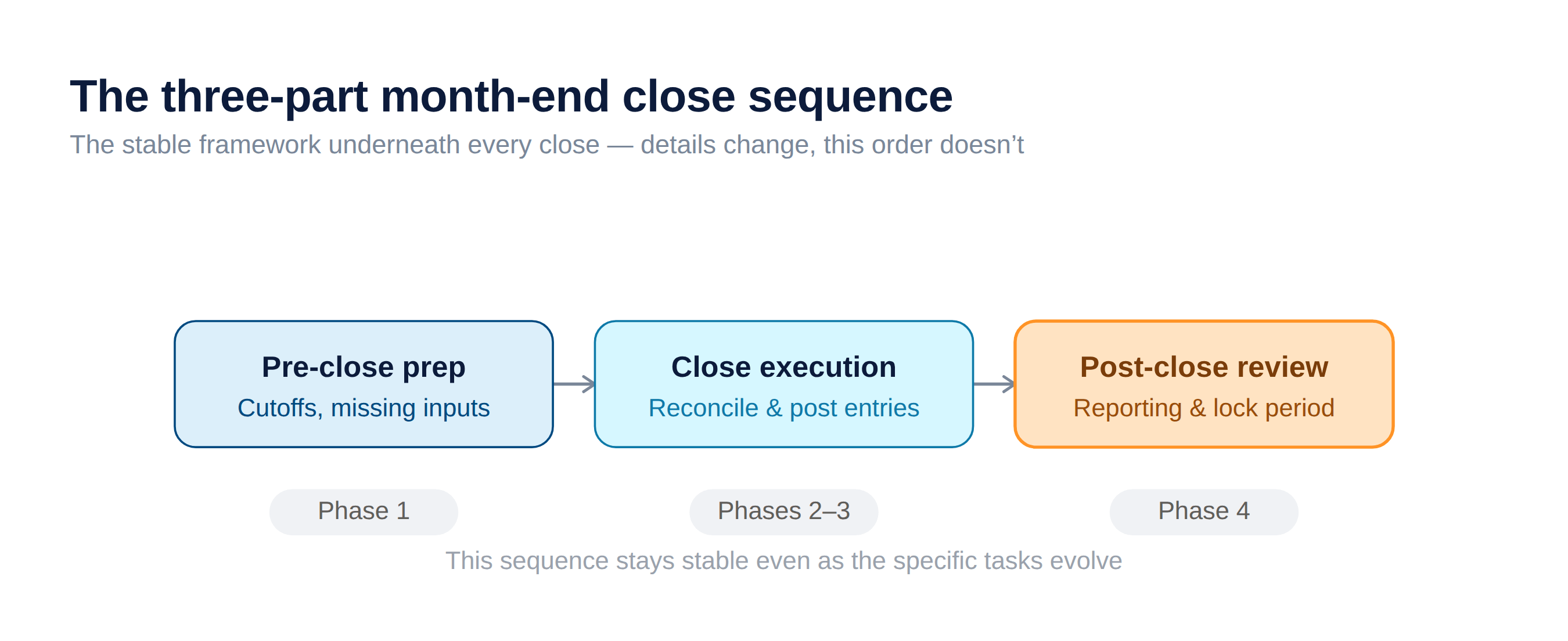
Though specific tasks vary by industry, company size, system setup, and reporting requirements, finance teams that close consistently and accurately follow a defined three-part sequence:
- Pre-close preparation
- Close execution
- Post-close review
This sequence should remain stable even as the details in each step evolve. Business leaders should always align close tasks with applicable accounting policies, tax requirements, and internal control expectations. And, before establishing or updated close processes, they should consult with qualified accounting professionals.
1. Pre-Close Tasks Prepare for a Clean Month-End Close
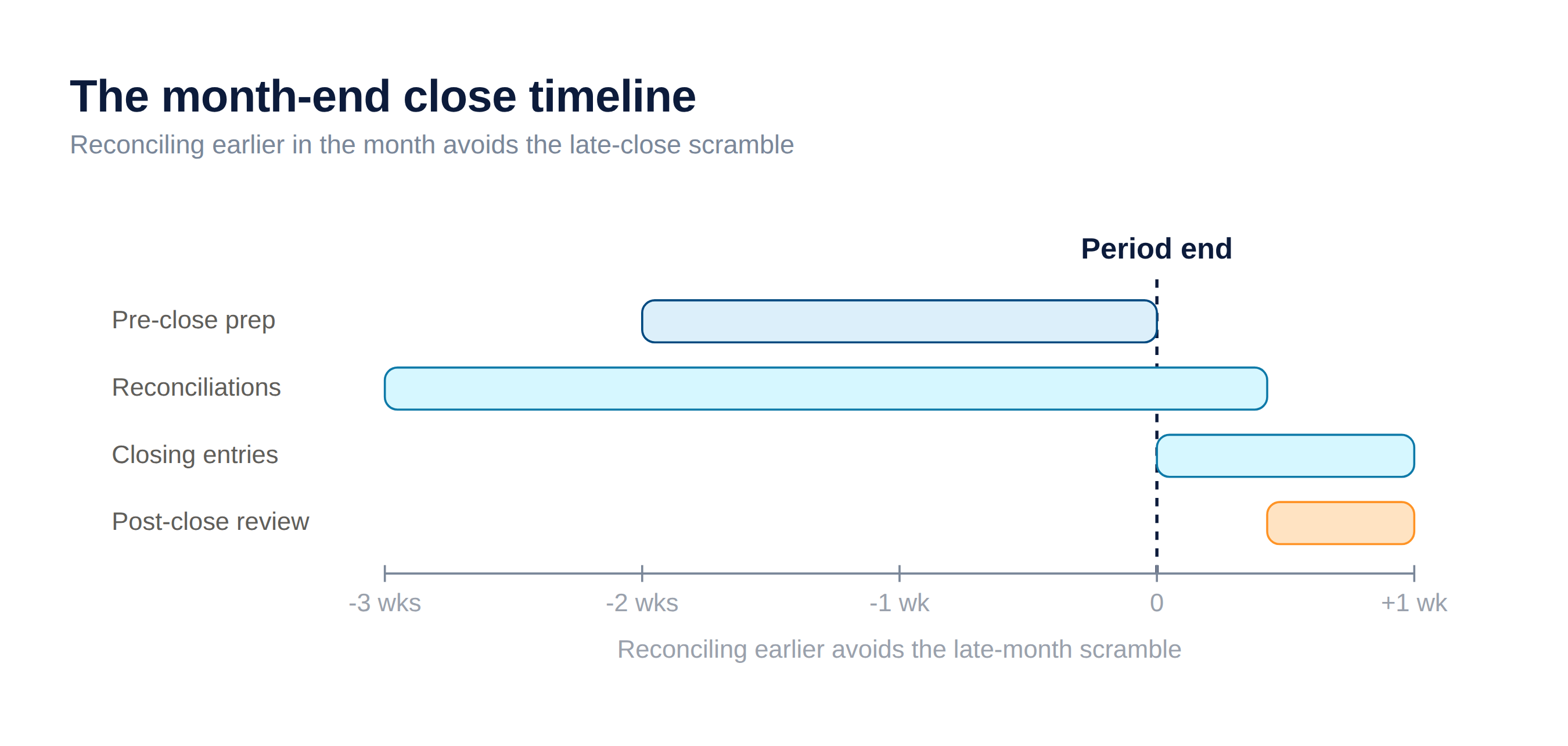
Pre-close work reduces the late-month scramble by surfacing missing inputs before the books are ready to close. Starting one to two weeks before period end, finance teams should update the close calendar, confirm task owners, and send cut-off reminders to all contributing departments. This includes collecting invoices and expense reports, reviewing open purchase orders, checking bank feeds for unposted transactions, and identifying accruals that will need to be recorded.
Growing companies benefit most from standardizing cross-functional deadlines for HR, payroll, procurement, operations, sales, and department managers. When a manufacturing company is tracking work-in-progress (WIP) costs, or a construction firm is reconciling job costs across multiple projects, waiting for operational data late in the cycle creates downstream errors that are difficult to unwind. Pre-close alignment across departments keeps those inputs arriving on time.
2. Close Execution Tasks Cover Reconciliations and Adjustments
The core accounting close checklist covers the tasks that transform raw transaction data into reviewed, supported financial statements. Teams should record revenue and expenses for the period, reconcile bank and credit card accounts, and reconcile accounts payable (AP) and accounts receivable (AR) subledgers to the general ledger. Balance sheet accounts require individual review, and any discrepancies need resolution, not just notation.
Additional execution tasks include posting accruals and deferrals, recording depreciation for fixed assets, validating payroll entries, and preparing preliminary financial statements for leadership review. Industry-specific items add further complexity. Distributors and manufacturers need to reconcile inventory and WIP balances. Construction companies must verify job cost accounting across active projects. Companies with recurring revenue streams need to confirm deferred revenue schedules are current. And multi-entity organizations must complete intercompany eliminations before consolidation can begin.
Every material journal entry should carry supporting documentation and be approved by a reviewer before the period closes. This is the foundation of audit readiness and financial statement integrity. Acumatica’s general ledger software supports period controls, journal entry approvals, and audit trails that help teams enforce these standards consistently.
3. Post-Close Reviews Quickly Turn Financial Data into Insights
Post-close work helps leadership understand what changed, why it changed, and what should improve before the next cycle. After the period locks, finance teams should complete a final review of the financial statements, prepare variance analysis and budget-to-actual commentary, distribute financial reports to stakeholders, archive workpapers and supporting documentation, and update the close calendar for the next period.
A short retrospective at the end of each close cycle is one of the highest-value habits a finance team can build. Recurring bottlenecks, such as late vendor invoices, manual journal entry backlogs, or unresolved reconciliation issues, tend to appear in the same place every month. Documenting and addressing those patterns steadily improves the process over time.
What Month-End Close Controls Reduce Reporting Risk?
Reducing financial reporting risk requires more than completing tasks quickly. Finance teams should define a task as complete only when it has been reconciled, documented, reviewed, approved, and protected from unauthorized changes.
| Close Risk | Recommended Control | Evidence of Completion |
|---|---|---|
|
Incomplete AP or AR Activity |
Enforce transaction cutoffs and reconcile subledgers to the general ledger | Approved subledger reconciliation |
|
Unsupported Journal Entries |
Require documentation and independent approval for material entries | Attached support and approval record |
|
Unreconciled Balance-Sheet Accounts |
Assign each material account to a preparer and reviewer | Signed account reconciliation |
|
Spreadsheet Errors or Version Conflicts |
Use controlled templates, restricted access, and version history | Approved final workpaper |
|
Unclear Task Ownership |
Assign named preparers, reviewers, and deadlines | Close responsibility matrix |
|
Unauthorized Post-Close Activity |
Restrict access and lock the period after approval | Period-lock record |
|
Unresolved Discrepancies |
Maintain an exception log with owners and deadlines | Approved exception report |
|
Inadequate Segregation of Duties |
Separate preparation, approval, posting, and administration where practical | Role and permission review |
|
Missing Supporting Records |
Define documentation requirements for every material task | Complete close archive |
|
Repeated Close Failures |
Conduct a post-close review and track corrective actions | Improvement-action log |
How Does an ERP Solution Help Growing Companies with the Month-End Close Process?
An ERP system can support the month-end close by connecting financial transactions, subledgers, approvals, supporting documents, and reporting in a shared environment. When accounts payable, accounts receivable, cash, inventory, payroll, project, and fixed-asset activity flows into the general ledger, finance teams can reduce manual transfers and focus reconciliation work on exceptions.
Connected financial data does not eliminate the need for account reconciliation, professional judgment, review, or approval. It can make those activities easier to perform and document by giving finance teams more consistent information and clearer transaction history.
Automation and AI-assisted capabilities can reduce repetitive close work when they are applied to defined processes and controls. Examples include importing bank activity, recognizing vendor documents, generating recurring entries, matching transactions, identifying unusual activity, and directing exceptions to reviewers.
These capabilities should support—not bypass—existing accounting policies, approval requirements, segregation of duties, and professional review. Finance teams should evaluate how automated actions are documented, approved, corrected, and included in the audit history.
This shift from reactive fixing to continuous monitoring is where growing companies gain the most ground: reconciling high-volume accounts earlier, attaching supporting documents to transactions, and tracking close status through dashboards instead of status emails. Importantly, an ERP system does not replace accounting judgment or professional review. It gives finance teams better tools to apply that judgment consistently and at scale.
For companies with manufacturing WIP, construction job costs, or complex project accounting, cloud ERP leader Acumatica’s manufacturing management software and construction management software connect operational and financial data in one system, which reduces the manual effort of pulling cost data from separate platforms each period.
What Should Finance Teams Evaluate in Month-End Close Software?
Growing finance teams evaluating ERP systems for the month-end close process should prioritize features that support control, connectivity, and visibility across the full close cycle, not just transaction processing. Key feature categories to assess include:
- Integrated GL and subledgers: AP, AR, inventory, payroll, and project data should reconcile to the general ledger without manual exports.
- AP and AR workflows: Configurable approval routing, aging reports, and exception handling reduce close delays. Acumatica’s accounts payable automation and accounts receivable software both support these workflows.
- Bank feeds and cash reconciliation: Automated bank feeds import and match transactions daily, so accountants review only the exceptions the system flags rather than comparing every line manually.
- Fixed assets and depreciation: Automated depreciation schedules reduce the risk of missed or miscalculated entries at period end.
- Multi-entity consolidation: Teams managing multiple legal entities need the ability to post both sides of intercompany transactions automatically, eliminate intercompany balances, and consolidate multiple currencies into a single reporting view without spreadsheet workarounds.
- Period controls and audit trails: The system should prevent posting to closed periods and maintain a complete, immutable record of all transaction activity.
- Document attachments: Users should be able to attach source invoices, bank statements, and approvals directly to transactions.
- Role-based permissions: Access controls should limit who can post, approve, and view sensitive financial data.
- Reporting and dashboards: Leaders should be able to see close status, financial statements, and exception items without waiting for a manual update.
- AI-assisted detection and automation: The system should flag unusual transactions for review, reduce manual invoice entry through document recognition, automate recurring tasks, and let users ask plain-language questions about close status and financials.
For growing small and midsized companies, tax management, multi-currency support, payroll integration, and entity structure flexibility are also important evaluation criteria. Before selecting software, ask:
- Can leaders see real-time close status?
- Can users attach supporting documents to transactions?
- Can the system prevent posting to closed periods?
- Can reports be filtered by entity, department, project, or location?
When Should a Mid-Market Company Improve Its Month-End Close Process?
A company should improve its month-end close process when recurring delays, reconciliation problems, increasing rework, or poor financial visibility indicate that the existing process cannot keep pace with the business.
Common warning signs include:
- Financial statements are regularly delivered later than planned.
- Employees do not know who owns particular close tasks.
- Finance maintains several versions of the same checklist or reconciliation.
- The close depends heavily on email reminders and individual memory.
- Account reconciliations contain recurring unexplained differences.
- Journal entries lack consistent support or approval.
- Multi-entity consolidation requires substantial spreadsheet work.
- Audit preparation requires recreating documentation.
- The period is frequently reopened for late adjustments.
- Leadership does not trust or receive monthly results promptly.
The goal should not be speed alone. A shorter close that produces unsupported balances, frequent corrections, or post-close adjustments is not an effective close.
Practical Ways Finance Teams Can Reduce Manual Close Work
Finance teams can reduce manual close work by standardizing templates, assigning clear task owners, setting recurring reminders for cross-functional deadlines, and reconciling high-volume accounts earlier in the month rather than waiting until the final days of the close cycle. Centralizing supporting documents in one location in an ERP system reduces the time spent hunting for backup during review.
Automating recurring journal entries (such as prepaid amortization, depreciation, and standard accruals) via recurring schedules, allocation templates, and deferral codes removes low-value manual steps from the close execution phase and frees finance staff to focus on exceptions and analysis.
An ERP-supported process can also reduce duplicate data entry by keeping financial, operational, and reporting data connected across modules. When an invoice recorded in the accounts payable module flows automatically to the general ledger, cash management, and reporting dashboards, finance teams spend less time on data movement and more time on review, variance analysis, and business partnership.
Build a Month-End Close Checklist That Scales
A scalable month-end close checklist gives finance teams a repeatable framework for preparing, reconciling, reviewing, approving, and reporting monthly financial activity. It should make ownership clear, identify missing inputs and unresolved exceptions, preserve supporting documentation, and provide evidence of review.
As the business adds transactions, entities, locations, projects, inventory, or reporting requirements, the checklist should evolve without losing its core controls. Standardized processes and connected financial management software can reduce manual work, but accuracy, documentation, professional judgment, and review remain essential.
Growing companies should evaluate whether their current systems provide the connectivity, controls, and visibility required to support the close. Learn how Acumatica Financial Management connects accounting processes and financial data on a scalable cloud ERP platform.
Frequently Asked Questions
What Is a Month-End Close Checklist?
A month-end close checklist is a structured, repeatable framework that finance teams use to collect, reconcile, review, approve, and report monthly financial activity. It assigns task owners, due dates, and required documentation at each step, covering the full cycle from pre-close preparation through post-close review and financial statement distribution.
How Long Should the Month-End Close Process Take?
The appropriate close timeline varies by company size, industry, entity structure, and system maturity. There is no universal benchmark that applies to all organizations. Companies managing multiple entities, complex inventory, or project-based accounting typically require more time than simpler structures, and the right target should be set in consultation with qualified accounting professionals based on your specific circumstances.
What Is the Difference Between a Soft Close and a Hard Close?
A soft close is a preliminary period-end review that allows teams to produce interim financial reports without fully locking the period. A hard close locks the period against further posting and produces the final financial statements used for management reporting, audit, and compliance purposes. Many companies use soft closes for internal review and reserve hard closes for periods that require final reporting or external distribution.
When Should a Growing Company Consider an ERP System for Month-End Close?
A growing company should evaluate an ERP system for the month-end close process when spreadsheets, email approvals, and disconnected systems can no longer support accurate, timely reporting across the volume and complexity of its operations. Common signals include recurring close delays, multi-entity consolidation challenges, increasing reconciliation errors, and limited visibility into close status for leadership.
How Does an ERP Solution Reduce Manual Work in the Close Process?
An ERP solution reduces manual close work by connecting financial data, subledgers, approvals, and reporting in one system, eliminating the need to move data between separate tools manually. Automated bank feeds, recurring journal entries, approval workflows, period controls, and integrated reporting dashboards all reduce repetitive tasks. However, ERP solutions support and streamline the work of finance teams; they do not replace accounting judgment, professional review, or audit oversight.
What Are the Biggest Risks in the Month-End Close Process?
The biggest risks in the month-end close process include closing with incomplete data, allowing unclear task ownership, failing to reconcile balance sheet accounts individually, relying on uncontrolled spreadsheets, and permitting post-close entries without a formal approval process. These risks increase as companies grow and transaction volumes rise, which is why documented controls, period locks, and audit trails are essential components of a mature accounting close checklist.
What Should Be Included in a Month-End Close Checklist?
A month-end close checklist should include transaction cutoffs, bank and credit card reconciliations, accounts payable and receivable, payroll, fixed assets, inventory, accruals, deferrals, intercompany activity, journal-entry approvals, financial statement review, variance analysis, period locking, reporting, and document archiving. Each applicable task should have an owner, reviewer, due date, status, and required supporting evidence.
What Accounts Should Be Reconciled at Month-End?
Finance teams should reconcile every material balance-sheet account according to the company’s policies and risk assessment. Common accounts include cash, credit cards, accounts receivable, accounts payable, inventory, fixed assets, prepaid expenses, accrued liabilities, payroll liabilities, debt, taxes, deferred revenue, intercompany balances, clearing accounts, and suspense accounts.
What Documents Are Needed for Month-End Close?
aging reports, payroll reports, inventory records, fixed-asset schedules, loan statements, tax reports, intercompany schedules, invoices, expense reports, journal-entry support, reconciliation workpapers, variance explanations, approvals, and the final financial reporting package.
How Can a Company Improve Its Month-End Close Process?
A company can improve month-end close by standardizing tasks, assigning clear owners and reviewers, enforcing transaction cutoffs, reconciling accounts throughout the month, centralizing documentation, automating recurring activities, tracking exceptions, controlling period access, and reviewing recurring bottlenecks after each close.


