
 Canada (English)
 Colombia
 Caribbean and Puerto Rico
 Ecuador
 India
India
 Indonesia
 Ireland
 Malaysia
 Mexico
 Panama
 Peru
Peru
 Philippines
 Singapore
 South Africa
 Sri Lanka
 Thailand
 United Kingdom
 United States
 AcumatiCares


What is Construction Inventory Management?
Construction inventory management is the process of tracking, controlling, and optimizing materials, tools, equipment, and supplies across warehouses, job sites, service vehicles, and projects. It helps contractors prevent shortages, reduce waste, improve cash flow, and keep projects on schedule.
Inventory is not just materials; it is the engine that drives success for construction projects. When poorly managed, it leads to delays, wasted capital, and missed opportunities. This article explores how smarter inventory management helps construction firms gain visibility, improve cash flow, and keep projects moving efficiently.
Why Inventory Management Matters in Construction
Inventory management is important because construction materials often move between multiple job sites, warehouses, and field teams. Without real-time visibility, contractors risk delays, duplicate purchasing, excess stock, theft, and inaccurate job costing.
Effective construction inventory management ensures materials arrive at the right place and time to prevent budget overruns.
When inventory is mismanaged, cash gets trapped in unused materials, project timelines slip, and working capital shrinks. In a highly competitive industry, effective material management is not just operational; it is strategic.


The Inventory-to-Cash-Flow Equation
The inventory-to-cash-flow equation balances material shortages against expensive surpluses to optimize your working capital.
Think of inventory as a finely tuned gauge balancing two extremes. On one side: shortages, which slow down crews and force costly emergency rush orders. On the other: surpluses, which consume resources and tie up working capital.
Achieving balance is an ongoing challenge for construction and engineering leaders, where:
- Complexity grows with each added job site, subcontractor, or specialized project requirement.
- Overstock and stock outs are both expensive, whether through storage costs, theft, or delayed billing.
The goal is clear: Align inventory levels as closely as possible with real project needs, so that projects progress smoothly and firms remain agile.
Project Inventory Lifecycle
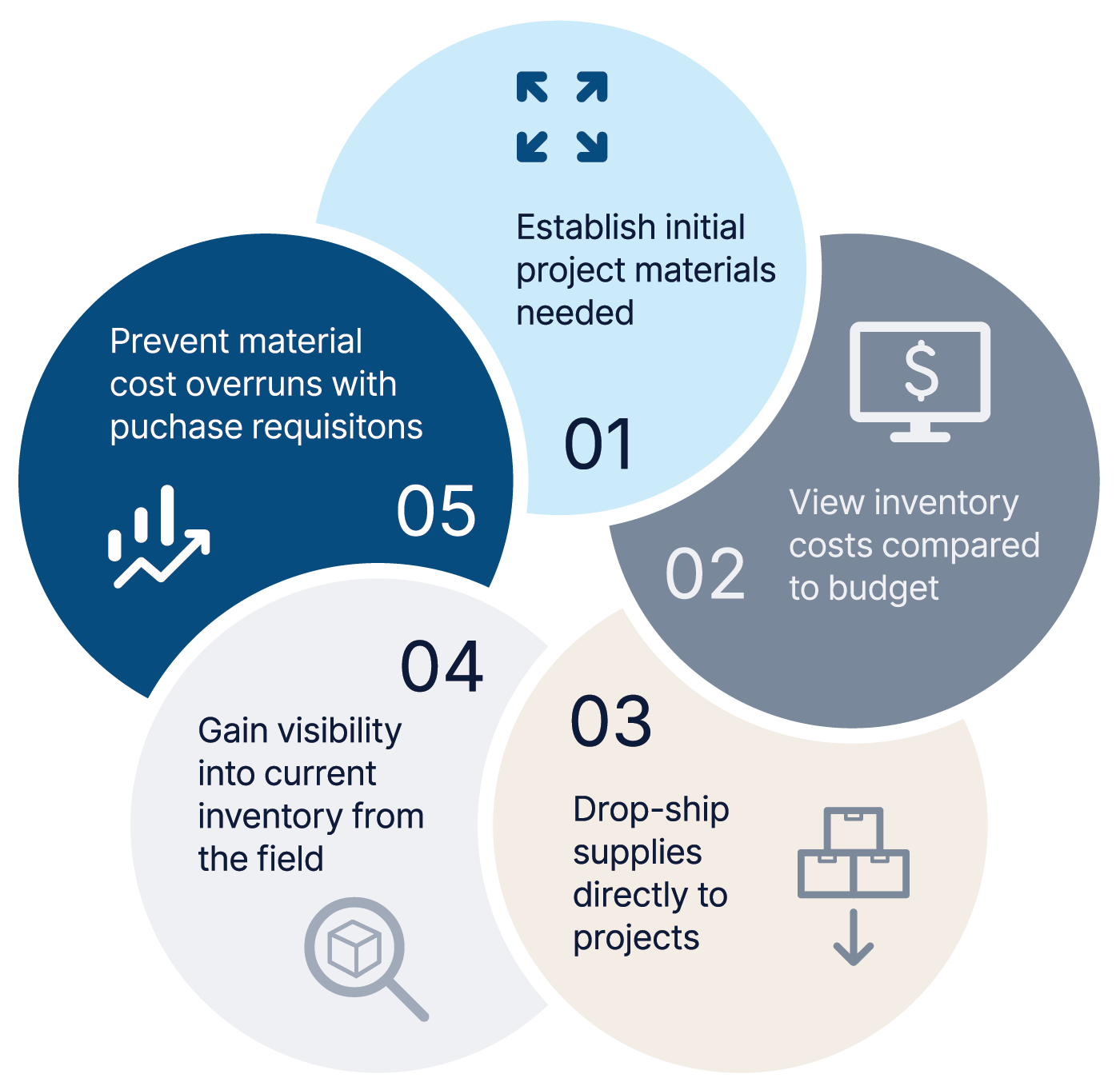
This infographic outlines a five-step process: identifying material needs, comparing costs to budget, drop shipping supplies, tracking inventory in the field, and preventing cost overruns. Its circular design highlights the iterative nature of efficient inventory management.
“Having worked with Acumatica, I can say it’s been a pivotal tool for our business. The platform’s design caters to small and mid-sized companies like ours, making inventory management a breeze. The detailed analytics on production and BOMs is impressive, allowing us to focus more on our core passions. It’s a supportive community driving innovation and growth.”
Why Basic Tools Fall Short
Many construction teams begin with spreadsheets, basic accounting systems, or standalone inventory applications. These tools may work when inventory is limited to one warehouse or a small number of active jobs. But as projects, locations, service trucks, crews, subcontractors, and material requirements multiply, disconnected tools make it harder to see what is available, where it is located, and how it affects job costs.
The issue is not simply whether teams can record inventory. It is whether they can connect inventory decisions to procurement, project schedules, field operations, billing, and financial performance.
| Approach | Best For | Strengths | Limitations |
|---|---|---|---|
|
Spreadsheets |
Very small teams, simple material lists, one-off tracking | Low cost, flexible, familiar to most teams | Manual updates, version-control issues, limited audit trails, no real-time visibility, difficult to connect to job costing, purchasing, or field activity |
|
Standalone construction inventory software |
Teams that need better material tracking but are not ready to connect inventory with finance and operations | Better item tracking, barcode or mobile capabilities, location-level visibility, reorder alerts | May still be disconnected from accounting, project management, procurement, billing, and reporting systems |
|
Cloud ERP with inventory management |
Growing construction firms managing multiple jobs, warehouses, service vehicles, vendors, and financial workflows | Connects inventory, procurement, job costing, project accounting, field teams, reporting, and financial management in one system | Requires a more strategic implementation, process alignment, and user adoption across departments |
Spreadsheets are often the first tool used because they are familiar and easy to customize. But they rely on manual data entry, which means inventory records can quickly become outdated.
A spreadsheet may show that materials are available, while the field team knows they have already been used, moved, damaged, or returned.
Standalone inventory software improves tracking, especially for teams that need item counts, location visibility, barcode scanning, or reorder alerts.
However, if inventory data remains separate from accounting, purchasing, project management, and job costing, teams may still lack a complete view of how materials affect project margins and cash flow.
A cloud ERP system brings inventory into the broader construction workflow. Instead of treating materials as a separate operational task, ERP connects inventory to purchase orders, project budgets, job costs, warehouse activity, service teams, and financial reporting. This gives project managers, procurement teams, warehouse staff, and finance leaders a shared source of truth.

For construction firms managing multiple locations, the difference is significant. ERP helps teams answer practical questions faster:
- What materials are available right now?
- Which job site has excess inventory?
- Which project is waiting on a late delivery?
- Are we buying materials we already own?
- How are material costs affecting project profitability?
- Which inventory items should be transferred, returned, or reordered?
As firms grow, inventory management becomes less about counting materials and more about coordinating decisions across the business. That is where disconnected tools fall short—and where integrated systems create measurable value.
“Acumatica has helped me properly revolve my inventory to and from roofing projects and saves me from having to track costs via separate transactions. I can run my construction operations much like a distribution hybrid, and Acumatica can always adapt to my needs.”
What Modern Inventory Strategy Enables
A modern inventory strategy enables cross-location visibility, proactive planning, and accurate job costing to keep your budgets tight.
Thoughtfully managed inventory converts chaos into control, turning supply chain challenges into a source of competitive advantage.
Key strategies include:
Firms track inventory across every job site, engineering workshop, warehouse, and service truck—unlocking the power to reallocate surplus and prevent double-ordering.
Using historic and real-time data, teams predict needs for each project phase or engineering milestone, reducing dependencies on guesswork or emergency orders.
Teams can manufacture and manage prefabricated components, tracking raw materials.
Teams align procurement to project schedules, ensuring that materials arrive only when needed and reducing the risk of theft, loss, or damage.
Materials are tracked from receipt to installation, giving finance and project leaders insights into bill accuracy to keep budgets tight.
Surplus is identified and reassigned or returned as projects wrap up, promoting sust
Construction Inventory Management FAQs
What are common construction inventory management challenges?
Common challenges include tracking materials across multiple job sites, managing excess inventory, preventing stockouts, coordinating transfers between locations, reducing manual data entry, forecasting material needs, and connecting inventory data with procurement, project accounting, and field operations.
Are spreadsheets enough for construction inventory management?
Spreadsheets may be enough for very small teams with simple inventory needs, but they often become unreliable as construction firms grow. Manual updates, version-control issues, delayed reporting, and disconnected data make spreadsheets difficult to use for real-time inventory visibility, job costing, purchasing, and multi-location material tracking.
How does ERP improve construction inventory management?
ERP improves construction inventory management by creating a shared system for inventory, procurement, job costing, accounting, and reporting. This helps teams see available materials, transfer surplus inventory, reduce duplicate purchasing, track costs by project, improve forecasting, and make better decisions using real-time data.
What are the best practices for construction inventory management?
Best practices include tracking inventory by location, connecting materials to job costs, setting reorder points, using mobile or barcode-enabled workflows, forecasting material needs by project phase, transferring surplus materials between sites, regularly auditing inventory, and using integrated software to connect field, warehouse, procurement, and finance teams.
How can construction firms reduce excess inventory?
Construction firms can reduce excess inventory by improving demand planning, tracking materials across job sites, transferring surplus items before buying new materials, aligning procurement with project schedules, returning unused materials when possible, and using real-time reporting to identify slow-moving or duplicate stock.


