
 Canada (English)
 Colombia
 Caribbean and Puerto Rico
 Ecuador
 India
India
 Indonesia
 Ireland
 Malaysia
 Mexico
 Panama
 Peru
Peru
 Philippines
 Singapore
 South Africa
 Sri Lanka
 Thailand
 United Kingdom
 United States
 AcumatiCares


Is Sage Intacct a full ERP System or an Accounting Software?
Sage Intacct is often marketed as a cloud ERP solution, but most sources describe it as finance-first rather than a full, operations-centric ERP system. It specializes in accounting, reporting, and financial management, but it does not natively cover the operational breadth, including manufacturing, warehouse management, and supply chain, that an ERP solution delivers.
Modern, cloud-based ERP systems are increasingly recognized for the value they bring to growing businesses of all sizes and types. If you’ve been evaluating business software lately, you’ve probably noticed that “ERP” gets used loosely. Vendors apply the label to everything from basic accounting tools to full operational platforms, which makes the category harder to navigate than it needs to be.
Sage Intacct sits somewhere in the middle. It carries the ERP label in some contexts, but, again, analysts and implementation partners consistently describe it as a finance-first or financial-management-led platform. For many growing companies, that distinction may not matter at first. But it starts to matter a lot once inventory, warehousing, manufacturing, or procurement complexity enters the picture.
This post breaks down what Sage Intacct actually does, where it reaches its limits, and how to tell whether a finance-led platform is the right fit for where your business is heading.
What Separates Accounting Software from a Full ERP Solution?
Accounting software primarily manages a company’s financial records and processes. Typical capabilities include general ledger, accounts payable, accounts receivable, cash management, bank reconciliation, financial reporting, and period-end close.
ERP software connects financial management with other business processes, such as purchasing, inventory, order fulfillment, warehouse management, manufacturing, project management, customer management, and payroll. The exact combination varies by vendor and product.
The difference is therefore not simply whether a product has accounting functionality. The more useful question is how broadly the system connects finance with the operational processes a business must manage.
| Evaluation Area | Accounting-Focused Software | Broad ERP Platform |
|---|---|---|
|
Primary Focus |
Financial transactions, controls, and reporting | Financial and operational management |
|
Business Data |
May depend on separate operational applications | Connects data across multiple business functions |
|
Inventory |
May provide financial inventory tracking | May include replenishment, allocation, fulfillment, and warehouse workflows |
|
Manufacturing |
Usually requires another application | May include bills of material, MRP, production, and shop floor functionality |
|
Reporting |
Primarily financial reporting | Financial and operational reporting |
|
Integrations |
Used to extend the financial platform | May reduce the need for separate operational systems |
|
Best Fit |
Finance-led organizations with limited operational complexity | Organizations that need finance and operations managed together |
These categories overlap. A finance-first platform can still qualify as ERP software, while a product marketed as ERP may still require additional modules or integrations for important processes.
What Does “Finance-First ERP” Mean?
A finance-first ERP platform is built around financial management, reporting, controls, and accounting automation. Operational capabilities may also be available, but finance remains the center of the product and its strongest area of functional depth.
This model can work well for professional services firms, nonprofits, SaaS companies, healthcare organizations, hospitality companies, and other businesses whose most complex requirements involve accounting, revenue, projects, or multiple entities.
The distinction becomes more important for businesses that manufacture or distribute physical products. These organizations should evaluate the depth of inventory planning, warehouse execution, procurement, production, fulfillment, and supply chain functionality, not simply whether those capabilities appear on a product checklist.
What Sage Intacct Can Do Natively for Growing Finance Teams
Sage Intacct’s core strengths are well-documented across vendor and third-party sources. The platform covers multi-entity accounting, real-time dashboards and reporting, accounts payable automation, financial consolidations, revenue recognition, project accounting, and purchasing. For finance teams managing complex organizational structures or multi-entity reporting, those fit the narrow list of capabilities they seek for finance related tasks.
According to Sage’s own product pages, Sage Intacct is purpose-built for financial management software use cases: closing the books faster, automating approvals, improving audit readiness, and giving finance leaders better visibility into financial performance. For service-based businesses, nonprofits, professional services firms, and organizations where the finance function is the operational core, Sage Intacct may address those specific and limited needs.
Sage Intacct also offers capabilities beyond core accounting. These include inventory management and Sage-branded solutions for distribution and manufacturing operations. However, availability, licensing, implementation, and functional depth may vary. Buyers should confirm whether each required capability is included in their proposed Sage Intacct configuration or delivered through an additional product or integration.
Does Sage Intacct Include Inventory and Operations Management?
Yes, but only partially. Sage Intacct includes purchasing, some inventory tracking, and project accounting. For businesses with straightforward stock management needs and limited warehousing complexity, that coverage may be adequate.
The limitation surfaces with more demanding operational requirements. According to analysis from reseller Datel, Sage Intacct does not offer the deeper supply chain management, warehouse execution, manufacturing, or production control breadth that full ERP solutions provide. It isn’t designed to manage warehouse workflows, multi-location inventory movements, production scheduling, or omnichannel fulfillment natively.
For a service business or a company with simple stock needs, that gap is manageable. For a business with physical inventory across multiple locations, or one that’s moving toward distribution or manufacturing, it’s a meaningful constraint.
When Do Businesses Outgrow a Finance-First Platform?
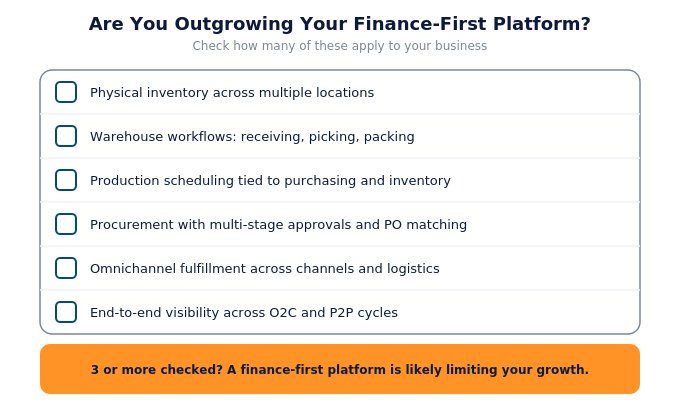
There are clear trigger points that signal a company is limiting its growth and operational visibility by relying on a finance-led platform. Watch for these signs:
- Physical inventory across multiple locations that requires real-time tracking and movement management
- Warehouse workflows, such as receiving, put-away, picking, and packing, that need system support
- Production scheduling and manufacturing execution that connect to purchasing and inventory
- Procurement complexity, including multi-stage approvals, supplier management, and purchase order matching
- Omnichannel fulfillment that ties sales channels, inventory, and logistics together
- End-to-end operational visibility across the full order-to-cash and procure-to-pay cycles
Acumatica, as an example of an integrated ERP solution, is built to address exactly these scenarios. Acumatica’s distribution management ERP system connects purchasing, inventory, warehouse management, and order fulfillment in one platform. Its inventory management software supports real-time stock tracking, multi-warehouse operations, and replenishment automation. And its manufacturing management software natively handles production scheduling, bills of materials, and shop floor execution.
Is a Finance-First Platform Enough for a Company with Physical Inventory?
The honest answer depends on the complexity of your inventory needs. If you’re managing a small product catalog with straightforward purchasing and no warehouse execution requirements, Sage Intacct’s inventory features may cover you for now.
If your business involves warehouse management across multiple sites, distribution to multiple channels, or manufacturing with material requirements planning, the finance-first model starts to create gaps. You end up either running a separate warehouse or operations system alongside Sage Intacct, which introduces integration overhead, or you look for a platform that handles both finance and operations natively.
The key purchasing question is therefore not whether Sage Intacct offers any inventory or manufacturing functionality. Buyers should determine:
- Which capabilities are included in Sage Intacct Core Financials.
- Which require separately licensed Sage products or extended capabilities.
- Which depend on marketplace applications or custom integrations.
- Whether the combined solution supports the required workflow depth.
- Whether financial and operational data share the expected user experience and data model.
- How the combined licensing and implementation costs compare with a broader ERP suite.
A company with relatively straightforward inventory requirements may find Sage Intacct’s available capabilities sufficient. A manufacturer, distributor, or multi-location warehouse operator should conduct a detailed requirements-based comparison before selecting a platform.
How an Integrated ERP Solution Differs from Finance-Led Software
The primary difference is not whether financial and operational capabilities exist somewhere in the vendor’s portfolio. It is how those capabilities are packaged, implemented, connected, and maintained.
A finance-led platform begins with accounting and financial management and extends into operational processes through additional modules, products, or integrations. A broader operational ERP is designed to manage finance and processes such as inventory, purchasing, warehousing, manufacturing, projects, field service, and order fulfillment within a common platform.
Finance-First vs. Integrated ERP: How the Architecture Differs
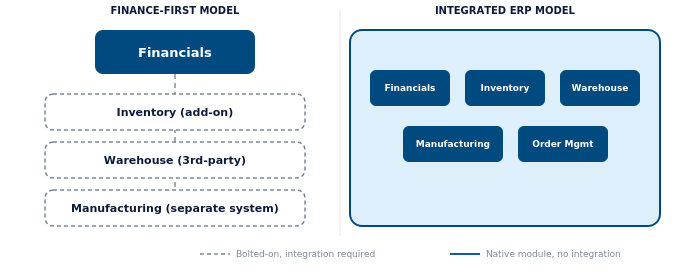
Acumatica takes the latter approach. Its industry editions connect financial management with operational capabilities such as inventory, order management, warehouse management, distribution, construction, and manufacturing. The appropriate comparison should examine the complete solution required by the buyer rather than comparing isolated feature lists.
For buyers evaluating Acumatica vs. Sage Intacct directly, the core question isn’t which platform has better accounting. It’s whether you just need accounting alone, or accounting plus operations, in a single system. They should evaluate:
- Required products and modules.
- Native and integrated workflows.
- Data synchronization requirements.
- Industry-specific functionality.
- User licensing and consumption models.
- Implementation and customization requirements.
- Integration maintenance.
- Total cost over the expected life of the system.
The decision is not simply “accounting versus ERP.” It is whether each proposed solution can support the company’s required financial and operational processes with an acceptable level of complexity and cost.
Final Takeaway for ERP-Minded Decision Makers
Sage Intacct is a solid but limited platform. For finance teams that need multi-entity accounting, advanced reporting, AP automation, and revenue recognition, it delivers targeted capabilities and an adequate user experience.
The honest category label, though, is finance-first. Sage Intacct is ERP-adjacent for accounting and reporting purposes, but it doesn’t carry the native operational depth, spanning warehouse, distribution, manufacturing, and supply chain, that a full ERP solution is expected to deliver.
If your evaluation includes physical inventory management, warehouse operations, or manufacturing, validate those requirements carefully against Sage Intacct’s current native capabilities before committing. For businesses that need finance and operations unified in a single platform, an integrated ERP solution built for operational breadth is worth putting on the shortlist.
Frequently Asked Questions
Is Sage Intacct considered a full ERP solution?
Sage Intacct is often marketed under the ERP solution category, but analysts and implementation partners consistently describe it as a finance-first or financial-management-led platform. It covers accounting, reporting, and financial operations very well, but it does not natively include the manufacturing, warehouse management, or supply chain depth associated with a full-scope ERP solution.
What does Sage Intacct do best?
Sage Intacct is built around the accounting and reporting layer. Its core strengths include multi-entity accounting, financial consolidations, AP automation, revenue recognition, project accounting, real-time dashboards, and period-close management. These capabilities make it a good fit for service-based businesses, nonprofits, and organizations where finance is the primary operational focus.
Does Sage Intacct handle inventory management?
Sage Intacct includes basic inventory and purchasing features, but it does not provide the deeper warehouse execution, multi-location inventory management, or supply chain functionality that a full ERP solution offers. Companies with simple stock needs may find it adequate; companies with warehouse workflows, distribution requirements, or manufacturing operations typically need a more operationally complete platform.
When should a business consider moving from a finance-first platform to a full ERP solution?
Key signals include managing physical inventory across multiple locations, running warehouse receiving and fulfillment workflows, scheduling production, handling complex procurement processes, or needing end-to-end visibility from order to fulfillment to financials. When those requirements emerge, a platform that natively connects finance and operations becomes more practical than integrating a finance-led tool with separate operational systems.
How does Acumatica differ from Sage Intacct?
Acumatica is designed as an integrated cloud ERP platform connecting financial management with industry-specific operational capabilities such as distribution, inventory, warehouse management, manufacturing, construction, retail, and field service. Sage Intacct begins with a finance-first foundation and extends into other processes through additional capabilities, Sage products, and integrations. The better fit depends on the complete requirements and configuration.
Can Sage Intacct integrate with other operational systems?
Yes, Sage Intacct supports integrations through its open API and a marketplace of third-party connectors. Many businesses pair it with separate inventory, warehouse, or operations tools. The tradeoff is that integration overhead adds complexity, and the real-time unified data picture that a single integrated ERP solution provides natively requires more effort to achieve through connected applications.
