
 Canada (English)
 Colombia
 Caribbean and Puerto Rico
 Ecuador
 India
India
 Indonesia
 Ireland
 Malaysia
 Mexico
 Panama
 Peru
Peru
 Philippines
 Singapore
 South Africa
 Sri Lanka
 Thailand
 United Kingdom
 United States
 AcumatiCares


The Law of Supply Explained: What It Means for Business Decisions
Today’s market can be described in one word: volatile. Fluctuating tariffs, geopolitical tensions, supply chain disruptions, and rising energy prices stoke the concerns of businesses and investors alike.
Though these challenges make profitability harder to come by, they are not precursors of failure if your business is built on the foundation of resiliency. A resilient business adapts to changing situations through a strong employee culture, an innovative mindset, and investment in a robust technological foundation, like a cloud-based ERP solution designed to help the business shift with market conditions based on data, not guesswork or emotions.
With verifiable, accurate, and real-time data in hand, you can make smart decisions about pricing, production capacity, inventory, and risk. But other factors beyond your data—like the law of supply—also impact your decision-making.
This guide will define the law of supply, cover how to read a supply curve, explain what causes movements and shifts along that curve, and highlight how all this can influence the practical operational and procurement decisions you make every day.
What Is the Law of Supply?
The law of supply is an economic principle stating that businesses supply more goods and services when prices rise and fewer goods and services when prices fall, assuming that all other supply-affecting variables stay the same (e.g., production costs, technology status, government regulations, etc.). Higher prices equal more potential revenue, which incentivizes producers to supply more products. Ultimately, profitability is the key driver.
Here’s an example. If a bakery sees that a higher-priced specialty cookie is flying out the door, they’ll increase their output of said cookie while simultaneously reducing their output of other cookies that aren’t performing as well—intending to make the most money as strategically as possible.
The law of supply is also grounded in two terms: “supply” and “quantity supplied.” According to Financial Pipeline, “Supply is the relationship between a range of prices and the quantities supplied at those different prices. It is visually represented by a supply curve. Quantity supplied is a point on the supply curve that indicates the number of units of a good or service [supplied] at a specific price. While supply is the entire supply curve, quantity supplied is a single point on the curve.”
Law of Supply in a Graph: Reading the Supply Curve
The following graph from Khan Academy shows the relationship between price and quantity supplied using the market for gasoline.
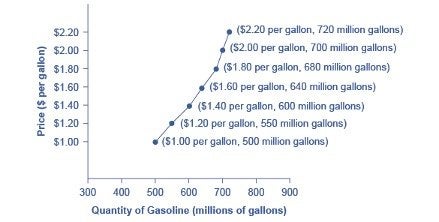
As Khan Academy explains, the “quantity [is] on the horizontal axis and the price per gallon [is] on the vertical axis. Note that this is an exception to the normal rule in mathematics that the independent variable goes on the horizontal axis and the dependent variable goes on the vertical.”
The curve slopes upward because incentives to produce more increase, and, when incentives increase, businesses work to expand their production capacity. It’s a symbiotic relationship that changes when prices move (up or down) and when non-price factors come into play.
What Causes a Movement vs. a Shift in Supply
The relationship between “supply” and “quantity supplied” determines the changes that happen along a supply curve. Quantity supplied informs “movements,” which are caused solely by price changes. In a movement, a product’s price changes, and that results in a different quantity of that product being supplied—meaning that a single “quantity supplied” point on the supply curve moves in response to the price change. Supply informs “shifts,” which are left or right shifts of the entire supply curve due to non-price factors. In a shift, producers offer different quantities of product at every point in the curve. In a movement, only one point changes in response to a specific price change.
The non-price factors leading to shifts can include:
- Production Costs: Producers must monitor production costs when considering their output. For instance, if the costs of raw materials or labor rise along with prices, the incentive to produce more is diminished. The potential profit will be swallowed up by the higher production costs. But if product costs stay the same or decrease while prices rise, the incentive to produce more increases as there are more profits to be had.
- Technology: The right technology helps businesses streamline and automate their processes, making them more efficient. This efficiency lowers costs and results in the ability to produce more for more profit.
- Government Policy and Regulations: Government taxes and subsidies also play a role in how much your business can produce. Taxes, such as excise or ad valorem (taxes based on the assessed fair market value of a product), increase costs and reduce supply, while subsidies, such as direct cash payments, tax credits, or production subsidies, lower production costs.
- Natural Factors: Severe weather events will affect a business’s ability to supply certain products, like agriculture products, and will impact logistics (e.g., their ability to receive vital raw materials or deliver finished products).
Types of Supply
There are five main types of supply:
- Market Supply is the total supply all producers are willing to sell at a specific price.
- Short-Run Supply is the amount of product that a business can make and sell in a short timeframe, while at least one production input (usually property, plant, and equipment [PP&E]) remains fixed.
- Long-Run Supply is the amount of product that a business can make and sell in a long timeframe, while all product inputs are variable.
- Joint Supply is created when the production of one product can automatically produce another (a byproduct). For instance, cattle can be raised for milk, beef, and leather.
- Composite Supply is the bundling of goods in one package, with one item being the principal supply. For instance, a hotel room (the principal supply) comes with breakfast.
How Does the Law of Supply Connect to Demand
The law of supply is inextricably linked to the law of demand. The law of demand states that, as the price of a product increases, consumers will demand less of that product. Conversely, as the price of a product decreases, consumers will demand more of it.
Together, these concepts make up “the law of supply and demand,” in which both supply and price are impacted by customer desire.
A product’s elasticity is also a part of the law of supply and demand. Essential products (e.g., medications, staple foods) are inelastic, and people will likely continue to purchase them despite price increases. Discretionary products (e.g., luxury items) are elastic, and demand will likely decrease as prices rise. A business’s main goal should be to find a price that makes a profit and keeps customers happy. This is known as the equilibrium price or market-clearing price.
Investopedia sums it up this way: “Higher prices cause supply to increase as demand drops. Lower prices boost demand while limiting supply. The market-clearing price is one at which supply and demand are balanced.”
Applying the Law of Supply to Pricing, Capacity, and Inventory Planning
Understanding the law of supply and demand increases your ability to translate it into practical pricing, capacity, and inventory strategies. And these strategies lead to:
- Pricing and profit maximization: You’ll be able to set your prices and justify increased output or updated sourcing by watching the law of supply and balancing it against demand.
- Capacity: You’ll know if you should expand or optimize how much you produce and how many people you hire by aligning your decisions with market signals.
- Inventory: Price changes and demand shifts will influence your purchasing and selling decisions.
The Role of Technology in Managing Supply
The law of supply and its pragmatic business applications are essential components of success. So, too, is your need for technology that will help you turn this economic principle into actionable business intelligence.
Why? Because it’s impossible to manually track the ongoing, evolving variables that make up the law of supply and demand. You must be able to store, analyze, and apply your data easily, and that is only possible if the data is unified and accessible within a comprehensive technology solution, like Acumatica Cloud ERP.
Acumatica provides real-time data and demand planning and forecasting capabilities that will help you accurately predict demand using market signals. Full visibility into your costs, production schedules, and inventory with our advanced inventory management features—from replenishment, location management, and pricing to inventory valuation, turnover inquiry, and more—will help you effectively balance your supply and demand in a marketplace that will never stand still.
Conclusion: Key Takeaways on the Law of Supply
The law of supply tells us that businesses will supply more products if prices increase, provided that no non-price factors change (e.g., production costs, government regulations, and weather-related issues). Production capacity, time constraints, perishability, fixed inventories, and supply disruptions along with the elasticity of the product or good also affect the law of supply and your response to it.
With Acumatica, you have the all-in-one tool that will give you the insights you need to run a highly efficient organization that corrects its supply levels due to price-driven demand changes—and does so quickly and accurately. To learn more about Acumatica’s innovative, intuitive cloud ERP solution, contact our experts, who are standing by to answer any questions or to schedule a custom demonstration.