
 Canada (English)
 Colombia
 Caribbean and Puerto Rico
 Ecuador
 India
India
 Indonesia
 Ireland
 Malaysia
 Mexico
 Panama
 Peru
Peru
 Philippines
 Singapore
 South Africa
 Sri Lanka
 Thailand
 United Kingdom
 United States
 AcumatiCares


Intro
A general ledger is the foundation of modern accounting and financial reporting. Businesses use the general ledger to record, organize, and track all financial transactions across assets, liabilities, equity, revenue, and expenses.
Whether you run a growing small business or a multi-entity enterprise, accurate general ledger accounting helps maintain compliance, improve financial visibility, support audits, and drive better business decisions.
Modern general ledger software and cloud ERP accounting software automate journal entries, account reconciliation, financial close processes, and reporting so finance teams can work more efficiently with real-time data.
It serves as the central repository for accounting data, connecting daily operations to financial statements and helping finance teams explain exactly what happened during a specific period.
For mid-sized businesses aiming to scale, maintaining an accurate GL is not just about compliance—it is about gaining the visibility needed to make strategic decisions. This guide covers the basics of the general ledger, its core account categories, and how ERP-based, cloud general ledger capabilities improve control and reporting speed.
What is a General Ledger in Accounting?
A general ledger is the central accounting record businesses use to organize financial transactions into accounts such as assets, liabilities, equity, revenue, and expenses. It supports double-entry accounting, reconciliation, audit trails, financial reporting, and compliance.
The general ledger acts as the primary source of financial truth for an organization. Every financial transaction recorded across subledgers—including Accounts Payable, Accounts Receivable, payroll, inventory, and fixed assets—ultimately posts to the general ledger.
Businesses use the general ledger to:
- Track financial activity
- Maintain accurate account balances
- Produce financial statements
- Support audits and compliance
- Monitor profitability and cash flow
- Improve financial decision-making
Modern general ledger ERP software centralizes these activities in one connected system, reducing manual accounting work while improving accuracy and visibility.
How General Ledger Accounting Works
General ledger accounting organizes transactions using a structured chart of accounts that groups financial activity into categories such as: assets, liabilities, equity, revenue, expenses. Each transaction is recorded through journal entries using the principles of double-entry accounting, where every debit has a corresponding credit.
For example:
A customer payment increases cash and decreases accounts receivable.
A vendor payment decreases cash and reduces accounts payable.
Payroll expenses increase expenses while reducing cash balances.
These transactions flow into the general ledger and contribute to key financial reports such as:
- Balance sheets
- Income statements
- Cash flow statements
- Trial balances
General Ledger Examples
Common general ledger accounts include:
- Cash
- Accounts Receivable
- Inventory
- Fixed Assets
- Accounts Payable
- Loans Payable
- Accrued Expenses
- Sales Revenue
- Cost of Goods Sold
- Payroll Expenses
- Utilities
- Rent
- Marketing Expenses
These accounts are organized within the chart of accounts and used to support financial reporting, reconciliation, budgeting, forecasting, and compliance.
How to use a general ledger?
To use a general ledger effectively, a business must systematically categorize, record, and reconcile every financial transaction. The general ledger functions as the central hub where all financial details converge.
Teams typically follow a four-step cycle to maintain the general ledger:
- Maintain the Chart of Accounts: Establish categories that match your reporting needs.
- Record Transactions: Log activity via subledgers and journal entries using debits and credits.
- Reconcile Accounts: Confirm that subledger totals align perfectly with the general ledger.
- Review the Trial Balance: Identify exceptions and correct errors before closing the period.
This workflow applies to any organization, but it is especially valuable for a small business general ledger that needs consistent visibility without adding manual reporting overhead.
Once validated, the data in the general ledger is used to produce essential financial statements and management reports.
Five Major Divisions in a General Ledger
Most general ledgers group accounts into five core categories used in financial statements: assets, liabilities, equity, revenue, and expenses.
Some charts of accounts also separate gains and losses for added reporting precision, depending on how the organization reports performance.
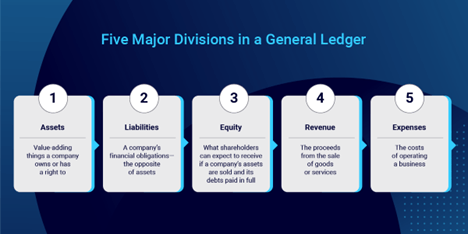
1. Assets
Assets represent resources the company owns or controls, such as cash, inventory, accounts receivable, and equipment. Asset accounts roll up to the Balance Sheet and are often tracked by department or location for granular reporting.
2. Liabilities
Liabilities are financial obligations the company owes to outsiders. This includes accounts payable, accrued expenses, deferred revenue, and loans. Accurate liability tracking is critical for audit readiness and cash flow management.
3. Equity
Equity represents the residual interest in the assets of the entity after deducting liabilities. It indicates the net value belonging to shareholders and is a key indicator of financial health on the Balance Sheet.
4. Revenue
Revenue, often called the “top line,” is the income generated from the sale of goods or services before expenses are deducted.
5. Expenses
Expenses are the costs incurred to operate the business. These are categorized on the Income Statement as either Cost of Goods Sold (COGS) or operating expenses like rent, utilities, and marketing (SG&A).
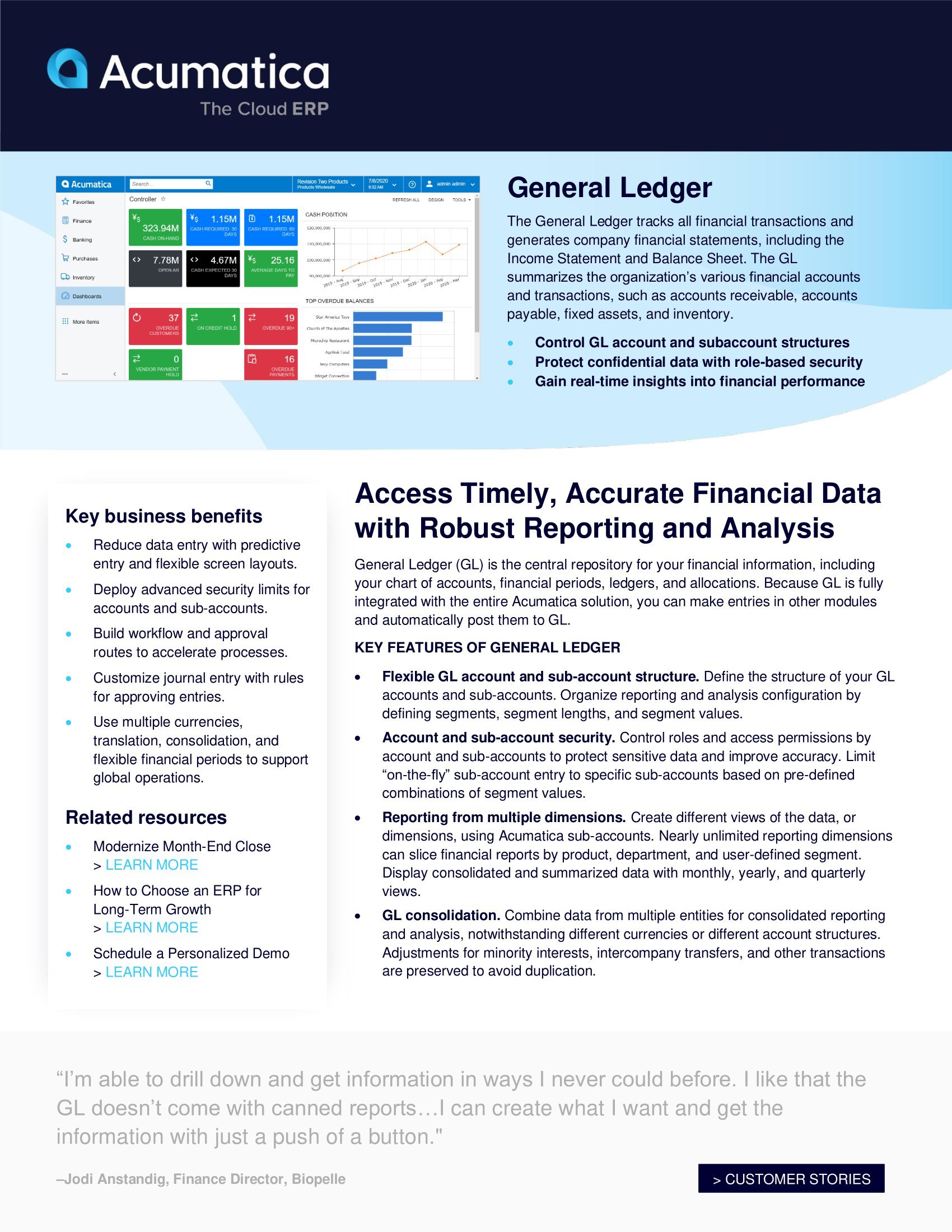
Download General Ledger Product Sheet
General Ledger vs. Financial Statements: What Is the Difference?
The general ledger is the source of data, while financial statements are the output. Businesses tap into the granular data recorded in the GL to generate three core reports:
- Balance Sheet: Summarizes assets, liabilities, and equity at a specific point in time.
- Income Statement: Reveals profit and loss (P&L) over a period by comparing revenue against expenses.
- Cash Flow Statement: Tracks the movement of cash in and out of the business to assess liquidity.
Without an accurate general ledger, these statements cannot provide a reliable view of financial well-being.
General Ledger vs. Chart of Accounts
The chart of accounts and general ledger work together, but they serve different purposes.
The chart of accounts provides the structure used to classify financial transactions into categories such as assets, liabilities, equity, revenue, and expenses.
The general ledger records the actual financial activity posted to those accounts, including debits, credits, balances, and transaction history over time.
In simple terms:
- The chart of accounts defines the categories.
- The general ledger stores the transactions.
Why the General Ledger Matters
A reliable general ledger is essential for:
- Accurate financial reporting
- Regulatory compliance
- Audit readiness
- Cash flow management
- Budgeting and forecasting
- Financial close processes
- Business performance analysis
Without accurate general ledger accounting, organizations risk:
- Reporting errors
- Duplicate entries
- Compliance violations
- Poor forecasting
- Delayed financial close
- Inaccurate decision-making
As organizations grow, maintaining financial accuracy becomes increasingly difficult without modern general ledger software and automation tools.
The Role of Subledgers in Financial Management
Subledgers store detailed transaction data for specific business functions such as: Accounts Payable, Accounts Receivable, Payroll, Inventory, Fixed Assets.
The summarized balances from these subledgers flow into the general ledger to support consolidated financial reporting.
Integrated ERP systems automate this process, helping finance teams improve account reconciliation, maintain audit trails, and reduce manual data entry.
Why Modern ERP Systems Are Critical for GL Management
Traditional accounting systems and spreadsheets often create disconnected financial data, delayed reporting, and manual reconciliation work.
Modern cloud general ledger software within an ERP platform connects accounting, purchasing, inventory, payroll, reporting, budgeting, and operations in one system.
General ledger ERP software helps finance teams:
- Automate recurring journal entries
- Accelerate financial close
- Improve account reconciliation
- Maintain stronger internal controls
- Support multi-entity accounting
- Access real-time financial visibility
- Improve audit readiness
- Reduce manual accounting work
Integrated ERP systems also improve collaboration between finance, operations, and leadership teams by ensuring everyone works from the same real-time financial data.
Benefits of Cloud General Ledger Software
Cloud-based general ledger systems provide several advantages over legacy accounting software, including:
Real-Time Financial Visibility
Access up-to-date financial information across departments, locations, and entities.
Faster Financial Close
Automate reconciliations, recurring entries, allocations, and approvals to reduce month-end close times.
Improved Compliance and Audit Trails
Maintain detailed transaction histories and stronger controls to support compliance requirements and audits.
Multi-Entity Accounting Support
Manage multiple companies, branches, currencies, and reporting structures within one ERP system.
Better Financial Reporting
Generate accurate financial statements, dashboards, and operational reports using centralized data.
Reduced Manual Work
Eliminate duplicate data entry and spreadsheet-based accounting processes through automation.
How ERP Improves Financial Reporting and Reconciliation
ERP systems improve financial reporting by connecting transactions across accounting, inventory, procurement, payroll, order management, and operations.
This integration allows organizations to:
-
<

