
 Canada (English)
 Colombia
 Caribbean and Puerto Rico
 Ecuador
 India
India
 Indonesia
 Ireland
 Malaysia
 Mexico
 Panama
 Peru
Peru
 Philippines
 Singapore
 South Africa
 Sri Lanka
 Thailand
 United Kingdom
 United States
 AcumatiCares


ERP pricing comparisons are essential for organizations evaluating modern cloud systems. Vendors use different pricing structures, most commonly per-user and consumption-based models, which directly influence cost, scalability, and budgeting. Understanding how these models work helps decision-makers align ERP investments with operational needs and long-term growth strategies.
Getting this decision right matters more than most companies realize. The licensing model you choose shapes not just your year-one costs but how those costs behave as your organization grows, adds users, or scales transaction volume. Two organizations using the same ERP solution can pay very different amounts, simply because of how their contracts are structured.
Overview of ERP Pricing Models in Modern Cloud Systems
ERP systems are typically offered through several different pricing structures: per-user licensing, consumption-based pricing, perpetual licensing, and subscription-based models.
Perpetual licensing, once the standard, requires a large upfront payment for indefinite software use.
Subscription-based pricing, by contrast, involves recurring fees and has become the dominant model in cloud ERP deployments.
Within the subscription category, per-user and consumption-based pricing represent two distinct approaches.
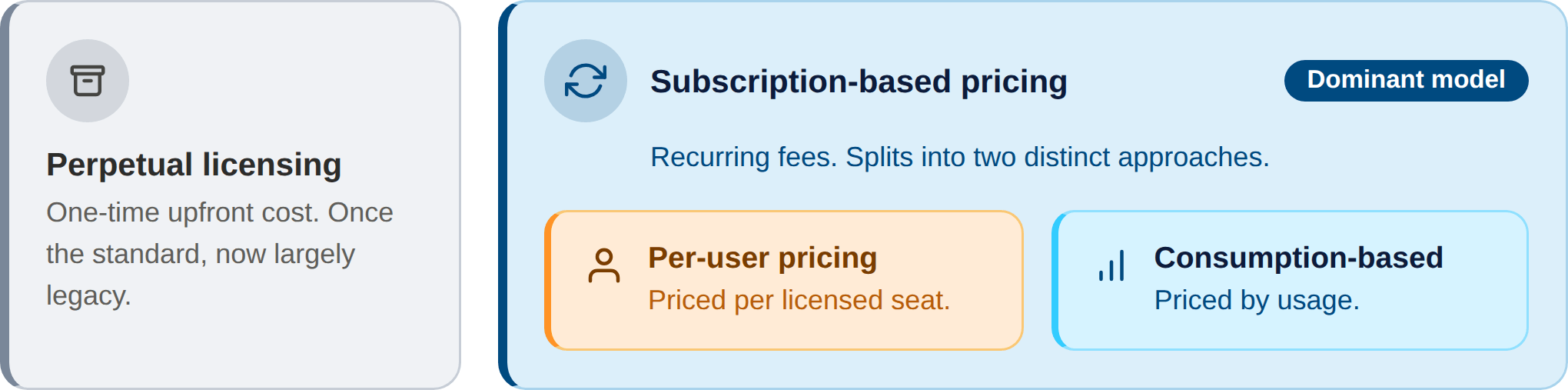
There is no standardized pricing model across ERP vendors, which means the structure you encounter depends entirely on the vendor and the solution. Understanding where each model fits within the broader ERP licensing landscape helps frame comparisons.
How ERP Licensing Models Influence Total Cost Outcomes
While licensing structure is one of the most significant factors in the total cost of an ERP system, it is not the only one. Implementation, customization, integrations, and ongoing support all contribute to the total cost of ownership. A lower license fee does not automatically translate to lower overall spend if implementation complexity is high.
Pricing models also shape long-term financial planning. A model that feels affordable at launch may become expensive as an organization scales, or vice versa. Decision-makers benefit from evaluating ERP pricing and cost factors across the full project lifecycle, not just the initial subscription rate.
What Is Per-User ERP Pricing, and How Does It Work?
Per-user pricing charges organizations a recurring fee for each licensed user who accesses the system. Vendors typically offer two variants: named user licenses, which are assigned to specific individuals, and concurrent user licenses, which allow a set number of users to be logged in simultaneously regardless of who they are.
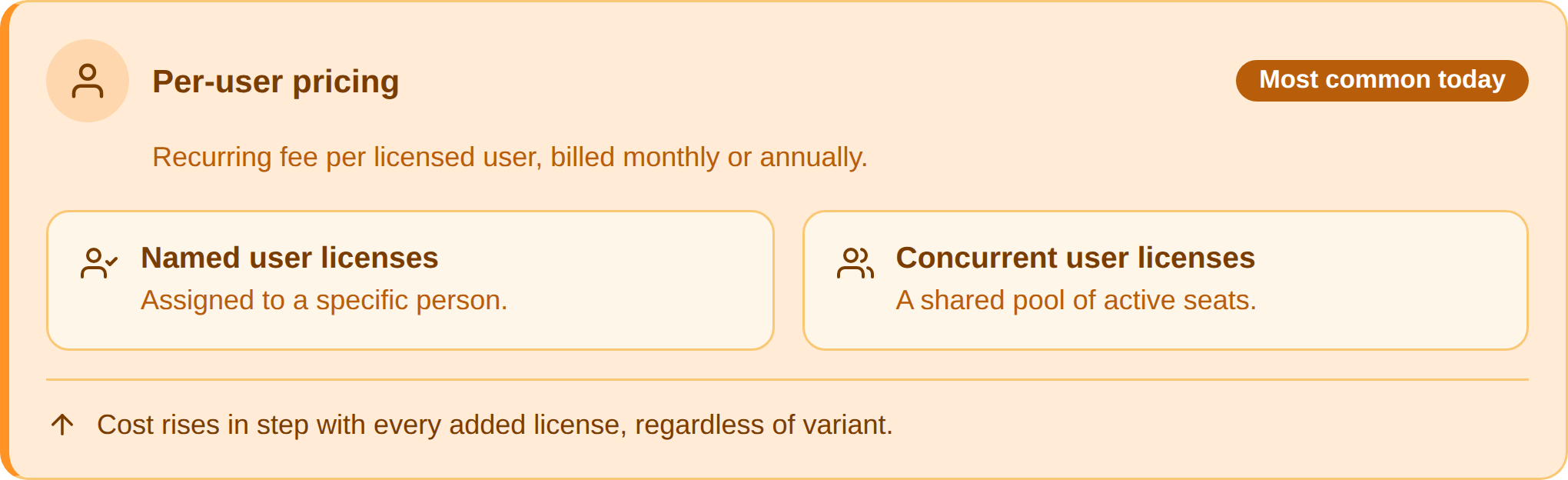
Costs are structured as recurring subscriptions, billed monthly or annually, with the total determined by the number of active licenses. As the organization adds users, the subscription cost increases proportionally. Per-user pricing is widely used across cloud ERP solutions and remains the most common ERP licensing model available today.
Benefits of Per-User ERP Pricing for Predictable Budgeting
The fixed-cost structure of per-user pricing makes budgeting straightforward. Finance teams can calculate recurring ERP costs simply by multiplying the per-user rate by the number of licensed seats. This predictability may be valuable for organizations that operate with stable headcounts and defined user roles that aren’t expected to change or evolve.
For organizations that do not anticipate significant workforce growth, per-user pricing delivers consistent, forecastable expenses. Annual renewals are easy to plan for, provided user counts remain steady.
Limitations of Per-User Pricing for Scaling Businesses
The predictability of per-user pricing comes with a trade-off: costs scale directly with headcount. Each new employee who needs system access adds to the recurring license bill. For growing organizations, this can create meaningful cost pressure over time.
License underutilization is another risk. If employees are licensed but do not use the system regularly, the organization pays for access that generates no operational value. Broader system access, such as granting visibility to staff outside core operational roles or to contractors who perform critical functions but operate outside the organization, becomes an expensive proposition under per-user pricing structures.
What Is Consumption-Based ERP Pricing, and How Does It Work?
Consumption-based ERP pricing charges organizations based on actual system usage rather than the number of licensed users. Usage is typically measured through transaction volume, the number of business processes executed, or computational resources consumed.
This model decouples cost from headcount. An organization can provide system access to a large number of users without incurring direct per-seat charges. Instead, the pricing reflects how actively the system is being used. Acumatica, a leading cloud ERP vendor, provides consumption-based ERP pricing that is structured around resource consumption, allowing unlimited users within a given usage tier.
Advantages of Consumption-Based ERP Pricing Models
The primary advantage of consumption-based pricing is cost alignment. Organizations pay in proportion to their actual operational activity, which means costs reflect real system value rather than a fixed headcount. This is particularly useful for businesses with large or variable user bases, such as those with seasonal staff or distributed teams.
Consumption-based models also support broader system adoption. Because adding users does not directly increase the license cost, organizations can extend ERP access across more departments and roles without significant cost penalties. This can improve data visibility and cross-functional collaboration.
Challenges of Consumption-Based ERP Cost Structures
Consumption-based pricing introduces some level of price variability. During periods of high transaction volume, such as peak seasons or rapid growth phases, costs can increase. Finance teams need to monitor system activity and model usage scenarios to avoid potential budget surprises.
While this model also requires a more nuanced approach to cost forecasting, organizations benefit from understanding their typical transaction volumes and working with their vendor to structure agreements that match expected usage patterns. Proactive planning reduces the likelihood of unexpected cost spikes.
Key Differences Between Per-User and Consumption-Based Models
The table below summarizes the core distinctions between the two ERP pricing models:
| Factor | Per-User Pricing | Consumption-Based Pricing |
|---|---|---|
|
Cost Driver |
Number of licensed users | System usage and transaction volume |
|
Scalability |
Costs increase with each new user | Costs scale with operational activity, not headcount |
|
Budget Predictability |
High, fixed recurring cost per user | Variable, depends on usage levels |
|
User Access |
Limited to licensed seats | Unlimited users |
|
Best Fit |
Stable teams with defined roles | Variable or growing user bases |
|
Cost Visibility |
Easy to calculate upfront | Requires usage monitoring |

