
 Canada (English)
 Colombia
 Caribbean and Puerto Rico
 Ecuador
 India
India
 Indonesia
 Ireland
 Malaysia
 Mexico
 Panama
 Peru
Peru
 Philippines
 Singapore
 South Africa
 Sri Lanka
 Thailand
 United Kingdom
 United States
 AcumatiCares


Acumatica Integrations: Unifying Your Business Systems
Running a modern business requires many different tools. You likely use specific apps for ecommerce, payroll, shipping, and sales. But if these apps do not integrate seamlessly, your team wastes time entering the same data twice. This can lead to errors, inefficiency, and frustration for both your team and your customers.
How can you address this challenge? The answer is robust ERP integrations.
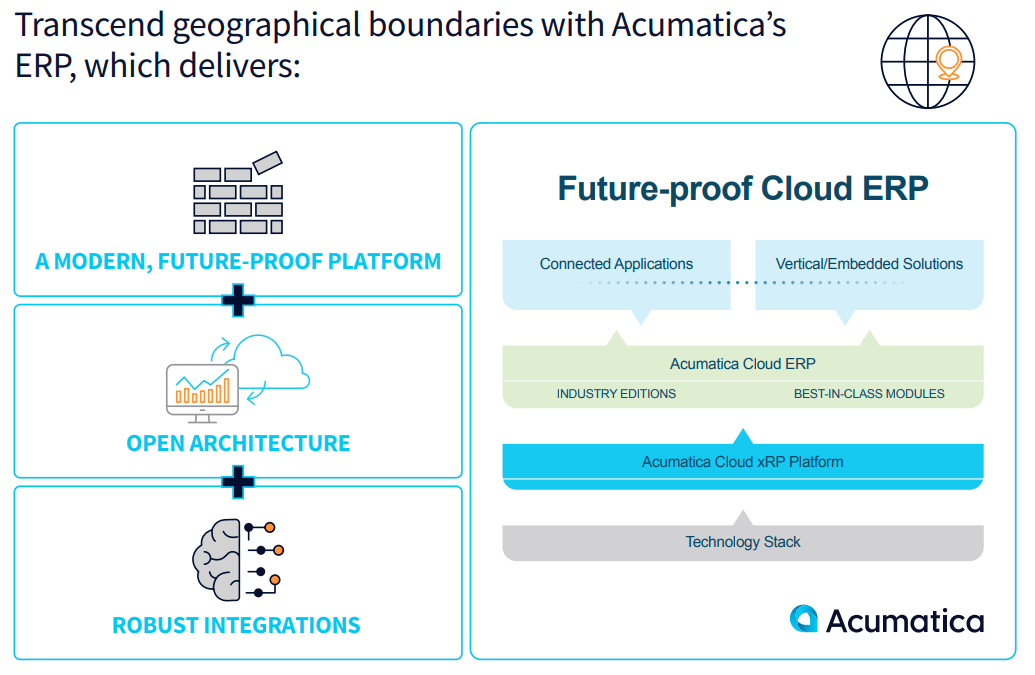
Acumatica Cloud ERP Solution connects all your important business applications. It offers strong integration features that unify your operations.
Today, we will explain why ERP solution integrations are important. They help you create a more efficient and agile business. This also leads to a better customer experience.
Why Do ERP Integrations Matter?
Small and mid-sized businesses face complex challenges, often using a mix of tools for different departments. Disconnected systems slow down processes and make it hard for your team to access information. When you isolate your software, employees find it hard to get the data they need. This makes it tough to make decisions and offer good customer support.
You cannot run a lean, efficient business without centralizing your data. Integrating CRM and ERP solutions is important.
It helps break down barriers between your teams. It also adds new capabilities to your ERP solution. An ERP solution like Acumatica acts as the “brain” of your business. It connects departments, shares insights, and keeps your team aligned.
When you leverage Acumatica API integrations across your business, you gain:
- Automation: Eliminate manual data entry and save valuable time.
- Visibility: Gain instant insight into the status of every part of your business.
- Accuracy: Remove duplicate data and reduce costly errors.
- Collaboration: Enable your team to access the information they need, when they need it.
- Customer Experience: Improve responsiveness and deliver a unified experience at every touchpoint.
How Acumatica Supports Integrations
To achieve these robust integration capabilities, how does Acumatica connect with other systems?
The answer lies in Acumatica’s open-platform design. Built on the world’s best cloud and mobile technology, Acumatica provides businesses in every industry with a flexible, scalable solution that allows them to easily configure the system to their unique needs and effortlessly incorporate the tools they use every day.
This unification of software platforms and third-party applications is a result of Acumatica’s rich API features, including OAuth 2.0 for secure integrations, along with a REST API and push notifications. Acumatica REST API examples can be found in Acumatica’s GitHub repository and Acumatica Open University.
Popular Integrations by Category
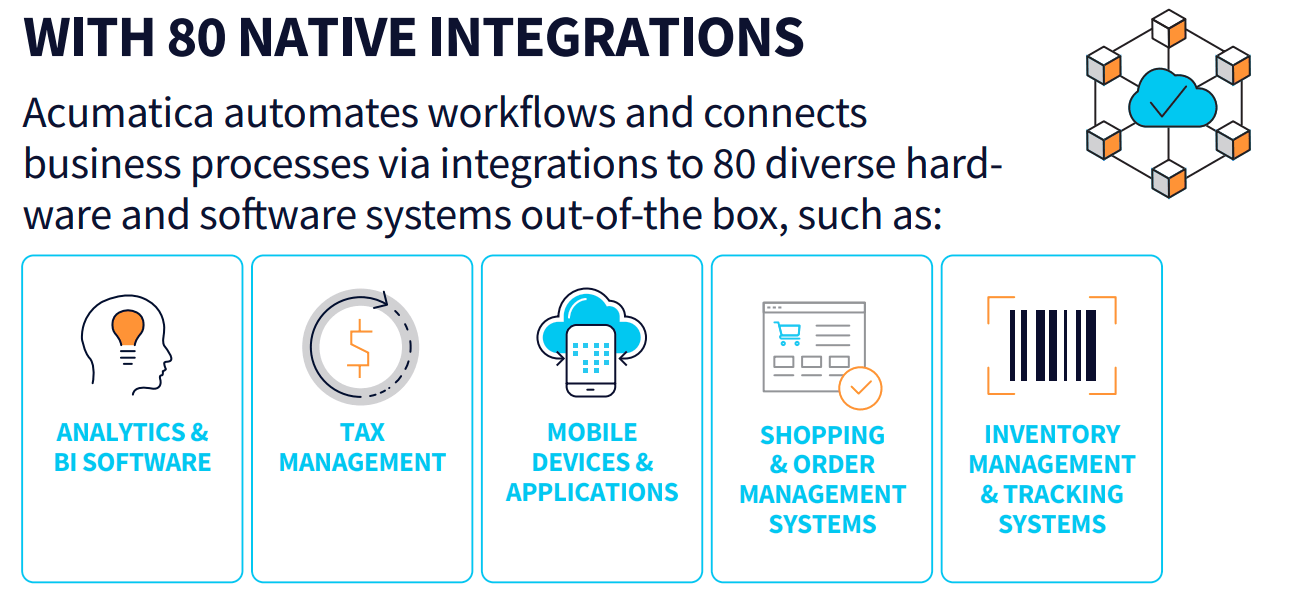
Acumatica offers native integrations, a wide range of CRM integration options, and partnerships with many integration partners. You can also find hundreds of specialized Acumatica third party integrations within the Acumatica Marketplace. Here are a few examples of how businesses benefit from seamlessly integrated systems:
Customer Relationship Management (CRM)
Customer Relationship Management (CRM) software houses all customer data, from contact information and sales leads to marketing campaigns and service interactions. Acumatica’s CRM software is built directly into its cloud platform and is available with all core ERP applications. This CRM ERP integration provides a 360° view of every customer interaction and helps make the management of the customer journey, from start to finish, a much simpler, more effective task.
But what if you’re already using your own CRM, like Salesforce, and want to keep it? You can connect Salesforce directly to Acumatica through an external integration platform, such as Celigo. Acumatica also delivers the Acumatica for HubSpot Connector, which integrates Acumatica’s unified CRM and ERP solution with HubSpot’s marketing automation solution to support comprehensive campaigns, consolidate marketing activities, optimize sales, increase productivity, and strengthen customer connections.
Ecommerce
Selling online calls for flexibility and speed. Integrating Acumatica with Shopify, Amazon, and BigCommerce empowers you to sync inventory, process orders, and manage shipping details without delay. The result is end-to-end, real-time accuracy for stock and sales data.
Acumatica’s Native Integration with Amazon Marketplace supports both Fulfilled by Amazon (FBA) and Fulfilled by Merchant (FBM) sales, lets you capture Amazon payments with their attendant fees, simplifies your Amazon statement reconciliation, and more. The “more” includes synchronizing orders and invoices, inventory levels, shipment, and tracking from Amazon to Acumatica’s modules (e.g., order management, inventory, financial, CRM, etc.).
Acumatica’s Native Integration with Shopify (Shopify POS and Shopify B2B) allows you to:
- Import Shopify orders (along with orders from other online channels).
- Automate stock allocations.
- Manage order, inventory, financial, and CRM modules.
- Handle the customer lifecycle inside Shopify’s platform with native connectivity to Acumatica apps.
And Acumatica’s Native Integration with BigCommerce connects your BigCommerce website with Acumatica’s financials, inventory, operations, and reporting functionalities, giving you end-to-end visibility, real-time communication, refund and exchange capabilities, and a streamlined buying process.
Finance and Payments
Seamless and secure payment processing is at the heart of business growth. Acumatica connects with payment gateways like PayPal and Tipalti. It also offers in-platform payment solutions.
These features help improve cash flow and automate reconciliation. Your finance team benefits from more accurate reporting and increased efficiency.
Reporting and BI
Smart, strategic business decisions require real-time, accurate data, customized reports, and AI-based analytical capabilities. With ERP Business Intelligence and Analytics in Acumatica, you have everything you need to succeed, and it’s all powered by intelligent tools, like Microsoft Power BI.
Microsoft Power BI takes the raw data from your system, as well as external systems, and helps that data make sense. You’ll spot trends, identify inefficiencies, and evaluate the health of your operation as you work to determine how best to move your business forward.
In addition to Microsoft Power BI, Acumatica also integrates with Dataself Analytics (through connectors, middleware, OData feeds, or pre-built solutions) so that you can visualize and understand your data via charts, graphs, and dashboards. Velixo also connects bi-directionally with Acumatica, so you can leverage Excel for real-time reporting and budgeting, use AI insights to drill down into transactions in Excel and Acumatica, and more.
HR and Payroll
Your employees deserve accuracy and simplicity in HR and robust payroll processes. Acumatica connects with specialized solutions such as Workforce Go!, with Acumatica third party integrations ensuring smooth data transfer across payroll, scheduling, and HR management.
Inventory and Manufacturing
Inventory accuracy drives profitability. Native connections and third-party Acumatica integrations with tools like Netstock give you the control you need. This helps you forecast, replenish, and manage manufacturing with more confidence and accuracy.
Real-World Examples
Successful integrations drive real business results. DiamondBack Truck Covers chose Acumatica because of its strong integration capabilities and the ease of connecting with other software.
IOC Construction gained from working with Acumatica integration partners. They connected their email marketing systems directly to the ERP solution. This streamlined communication efforts and improved their marketing strategy—demonstrating the value of a seamlessly integrated environment.
“The openness of Acumatica makes integrations possible that were completely out of the question before. Acumatica enabled us to build a bridge between our ecommerce platform that just runs without us having to touch it.”
How to Use Acumatica’s REST API for Custom Integrations
Some businesses need custom solutions beyond what native integrations offer. Acumatica’s modern web services framework and robust API allow you to create your own integration solutions.
With Acumatica API integrations, development teams can get, create, and update records. They can send and receive data securely and in real time. Acumatica supports push notifications, letting external applications react instantly when something changes. These features support tailor-made connections and a flexible foundation for your digital future.
Conclusion: Acumatica Integrations Unify and Strengthen Your Business
Disconnected systems hold your business back. By embracing Acumatica’s integration capabilities and working with integration partners, you can eliminate data silos, power collaboration, and unlock new innovation.
Acumatica’s open architecture is the integration platform you need to build a connected business.
Check out the Acumatica Marketplace. You can find third-party integrations and partners there. Discover new ways to improve productivity. Feel free to contact us to discuss your integration needs.
Acumatica Integrations FAQs
What is an ERP integration?
An ERP solution connects your Acumatica software to other applications. This creates a smooth flow of data and boosts efficiency.
Does Acumatica support third-party integrations?
Yes. Acumatica supports a wide range of Acumatica third party integrations through open APIs, native connectors, and Marketplace.
How does Acumatica integrate with Shopify?
Acumatica offers native and partner-built connectors for Shopify, enabling real-time sync of orders, inventory, and customer data.
Can I integrate Acumatica with my CRM system?
Absolutely. Acumatica provides many CRM and ERP solution integrations. It supports popular platforms like Salesforce and HubSpot. This gives your teams a complete view of all customer data.
What technology does Acumatica use for integration?
Acumatica uses standard REST APIs and secure authentication. It has a flexible framework. This allows you to customize your Acumatica API integrations to fit your business needs.
Are there pre-built Acumatica integrations available?
Yes, many pre-built integrations are available through the Acumatica Marketplace, covering ecommerce, finance, BI, and more.
What are Acumatica integration partners?
Integration partners are third-party vendors or developers who build and support connectors between Acumatica and other platforms.