Canada (English)
 Colombia
 Caribbean and Puerto Rico
 Ecuador
 India
 Indonesia
 Ireland
 Malaysia
 Mexico
 Panama
 Peru
 Philippines
 Singapore
 South Africa
 Sri Lanka
 Thailand
 United Kingdom
 United States

ACUMATICA STAYS ON COURSE DELIVERING INNOVATIVE TECHNOLOGY FOR EVERYONE
STILL COLLABORATING, INNOVATING AND ACCELERATING
If you have been following Acumatica and its Cloud ERP for the past several years you might have noticed a level of consistency that is rare in the world of Enterprise Resource Planning (ERP). While many of its competitors feel compelled to come up with a new mantra every year, Acumatica has stayed on course, steadfastly delivering on its promise of an open technology platform, practical business and industry functionality, and ethical business practices. Through the years we’ve seen threads of collaboration, innovation, and acceleration of digital transformation woven throughout the fabric of its strategy, with attributes like “open”, “agile” and “future-proofed” strengthening the durability of both the product and the messaging. A strategy that has stood the test of time, combined with a proven ability to deliver continuous innovation that is new, fresh and useful, precludes the need to resort to a “message du jour” approach.
Evidence of this durability was visible at the company’s most recent annual customer conference, Acumatica Summit 2022. Unlike most events that remain virtual, this was more of a hybrid event. You could attend online through live streaming, but Acumatica went to extraordinary lengths to make its customers and partners, along with analysts and journalists, feel comfortable attending in person. Why? Because the overall theme for the Summit remains consistent: Collaborate, Innovate, Accelerate. While technology has come a long way in supporting connectivty, there really is no better way to strengthen relationships and foster open dialogue than in person. And the Acumatica community is engaged, strong and growing.
In this report, we’ll take a look back to see how Acumatica’s strategy has matured over the past five years. And then we’ll explore how it continues to be guided by the three underlying pillars of that strategy:
• Technology and platform leadership
• Business and industry-specific functionality that is both useful and practical
• Ethical business practices, moving beyond its customer bill of rights, flexible deployment options, and growth-friendly licensing to include sustainability.
For those who might not be familiar with Acumatica’s ability to deliver continuous innovation: Buckle up!
A QUICK LOOK BACK
Perhaps the best way to track how Acumatica’s message and strategy has evolved and matured is to look back on the headlines, along with some key excerpts from the Mint Jutras reports published after each of the last five Summits leading up to the most recent in 2022.
2017: WHAT ACUMATICA CUSTOMERS WANT … AND GET
Openness, Collaboration, Innovation, Acceleration
While many ERP providers today try to be “one stop shops,” the downside of this is added complexity and cost. Acumatica instead chooses to provide an open platform and take a collaborative approach to accelerate innovation, collaborating with customers to plot a product roadmap and with partners to fill gaps and provide specialized functionality. While Acumatica customers don’t necessarily expect ERP to satisfy all their needs, they also don’t want to wind up with a hodge podge of disparate, disconnected solutions. In fact, that is what many are replacing. They turn to Acumatica to facilitate easy integration and connectivity.
2018: WHAT MAKES ACUMATICA DIFFERENT?
The Power of a Platform and the “Little Things” That Make a Big Difference
So amidst the backdrop of apparent “sameness” [across enterprise application vendors] we take a look at what one ERP vendor – Acumatica – is doing to stand out in this competitive landscape. Acumatica will tell you its core differentiators are:
- The ability to access the solution from anywhere, on any device
- A flexible deployment model, allowing the customer to choose public cloud, private cloud or a license on premise
- Modern consumption-based licensing meant to be affordable and inclusive of all designated employees as well as key customers and partners
- A connected cloud platform that aids in extending the solution without creating islands of automation
No one of these is unique in of itself. For each differentiator there is at least one other vendor that can make a similar claim. But if we combine all four, Acumatica is indeed in a class all by itself.
2019: THE PUSH AND PULL OF ACUMATICA’S CLOUD ERP INNOVATION
Collaborate – Innovate – Accelerate
Technology vendors, particularly those that offer Enterprise Resource Planning (ERP) solutions, must walk a fine line in terms of innovation. On the one hand, they must listen carefully to their customers. Responding to customer requests is crucial to keeping existing customers happy as they push for more features and functions. But today, that just isn’t enough. The most successful vendors also pull the customers along in many ways, including applying advanced technologies. While customers may not be asking for them, these technologies can improve efficiencies and provide a competitive edge.
Like many vendors, cloud ERP provider Acumatica has an “idea” website where it encourages customers to log feature requests and vote for those they feel will produce the most value. Many of those ideas make their way into the product. But Acumatica goes a few steps further. In addition to partner advisory boards and customer focus groups, executives, product managers and developers go on-site to observe how the cloud ERP is being used. They then combine their objective outsider’s view with their intimate knowledge of tools and technologies to come up with new ideas for enhancing productivity.
Sometimes those ideas result in what appear on the surface to be small changes, but result in innovation that makes the customers say, “Wow! That’s huge! Why I didn’t I think of that?”
2020: INNOVATION FUELS ACUMATICA’S ACCELERATED GROWTH
An Innovative Approach to Business, Coupled with Continual Product Innovation
Given the growing acceptance of cloud and Software as a Service (SaaS) in recent years, Mint Jutras has been expecting (hoping) to see at least one of the native cloud solution providers enter a period of explosive growth. Thus far we have been disappointed, but now Acumatica appears to be doing just that. How has Acumatica been able to achieve what others have strived but failed to do? We see several factors combining synergistically to create a perfect storm to drive growth. The common theme across all these contributing factors is Acumatica’s ability to continually innovate, not just in terms of the product, but in terms of its own business model.
2021: ACUMATICA DELIVERS ON SOME COMMON THEMES, IN AN
UNCOMMON WAY
“Future Proof” Cloud ERP Fosters Resiliency, Supports Digital Transformation
If you attend any enterprise software event these days, the vast majority of which remain virtual, you are likely to hear some common themes. Software executives are quite articulate in talking about the need for resiliency, digital transformation and future-proofing your business. You’ll also hear a lot about cloud, the user experience, industry focus, automation, artificial intelligence (AI) and machine learning (ML). Innovation through low-code/no code development is quite common as well. These software executives are very good at painting the big picture, but in doing so, they talk at such a high level of abstraction that they all start to sound the same. And all too often, when you start to scratch the surface… you get more surface.
If you recently attended Acumatica’s Summit 2021, you heard all these themes. But that’s where the similarity ends…. When you scratch the surface with Acumatica, you find the deeper you dig, the better the story becomes.
[Acumatica Cloud ERP] is a cloud-native, technology-enabled, feature-rich suite, and the feature set of the application, as well as the technology platform, are growing at an impressive rate. Acumatica listens carefully to its customers and delivers innovation that is practical and useful. It’s never about delivering technology in search of a problem. And even some of the simplest features can have an enormous impact on productivity and efficiency.
At Acumatica Summit 2022 the themes of Collaborate, Innovate and Accelerate were (are) back. Acumatica’s CEO, Jon Roskill warns against viewing digital transformation as a “one and done” kind of process. According to Mr.
Roskill, “There is no digital transformation fairy that will wave its magic wand or sprinkle digital fairy dust across your business. Transforming your business to thrive in today’s global, digital economy is a continuum, a journey to business agility that allows you to take advantage of new and different opportunities.” These opportunities can emerge quickly but can also disappear just as rapidly.
Mr. Roskill takes Acumatica’s role in helping customers in this journey very seriously and has built the company’s strategy on three pillars he proposes to be essential:
- Technology and platform leadership with open architecture, scalability, ease of use, and practical new applications of artificial intelligence and machine learning (AI/ML), Natural Language Processing (NLP), and Robotic Process Automation (RPA)
- Best-in-class business and industry functionality through core module features and depth, industry-specific innovations, and ISV solutions
- Ethical Business Practices, such as flexible deployment options, modern, growth-friendly licensing, data ownership, and dual layers of support… and now sustainability
TECHNOLOGY AND PLATFORM
Acumatica has always presented itself more as a technology and platform player than exclusively as an enterprise application vendor. This is rather unconventional given its focus on small to mid-size enterprises (SMEs). SMEs tend not to seek out technology, but rather solutions that satisfy a business need. And so, Acumatica has been careful to select and develop technology that serves a purpose, and to embed that same technology in the features and functions it ultimately delivers with ERP. What kind of technology are we talking about? Microservices architectures, artificial intelligence (AI), machine learning (ML), natural language processing (NLP), robotic process automation (RPA), and radio frequency identification (RFID) are just a few examples.
SMEs don’t view any of these technologies as an end goal and therefore they don’t necessarily set out to “buy” any of them. They might however view them as a means to an end. And therefore, even as a technology company, Acumatica doesn’t market and “sell” them, but instead embeds these technologies to add more value to the enterprise applications that solve business problems. And making its platform open and freely available to its partner network serves to amplify the technology available to its customers and prospects.
Several years of developing and embedding technology in its platform has led Acumatica down a path to delivering technology, not just to technologists and large companies with deep pockets, but to everyone.
THE DEMOCRATIZATION OF TECHNOLOGY
Acumatica’s Chief Technology Officer (CTO), Ali Jani refers to this as the democratization of technology. His stated goal is to have every employee of every Acumatica customer thinking like a technologist. That doesn’t mean he wants to turn people into “techies.” It simply means he wants every end user of Acumatica empowered to take full advantage of what he calls the “combinatorial effect” of blending all these technologies together with ERP.
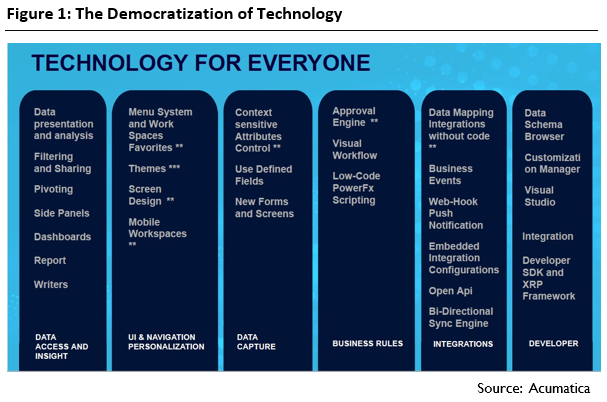
You might have to zoom into Figure 1 to appreciate the full impact on this “technology for everyone” approach, but it really all boils down to connecting end users to all the data they need in an easy to use, visually appealing, personalized fashion, and then leveraging it in new, different and innovative ways. And that personalization extends beyond visualization to include customizing and automating processes. There is literally something for everyone, from business users to developers.
MODERNIZATION
Some of this technology is buried deep within the platform and may not even be visible to those same end users Mr. Jani wants to empower. This type of innovation falls into the category of “modernization.” While some vendors, particularly those that once operated exclusively in the on-premises world, might think of modernization as a “one and done” event, Acumatica treats it as a continuous process.
One recent example of this “under the covers” modernization is a project to move the core to a Microsoft .NET environment. While what end users see and do with the software might not change, there is a more subtle impact. They might notice an improvement in performance as screens refresh faster. And they might benefit from more rapid application development from Acumatica and its partners, as restrictions imposed by the “Acumatica way” are removed and it becomes easier to incorporate other technology from partners like Microsoft, Adobe, Autodesk, Shopify, BigCommerce, Amazon and UiPath. Acumatica selectively works with partners it feels are quite pervasive in the markets it serves.
EASE OF INTEGRATION
Easy integration is an important pillar of “technology for everyone” and Acumatica did not disappoint in that regard at its latest Summit. One key announcement at the event was native integration with Amazon Business. Its new Amazon Connector retrieves orders in real time and in turn keeps inventory levels current and up to date on Amazon’s marketplace. This has been the number one request from customers that are also Amazon merchants, and it works either in a “ship from Amazon” or “ship from merchant” environment.
Acumatica also announced an Autodesk integration between Acumatica and Autodesk Build that allows customers to track construction project costs and project planning documents including drawings and building information modeling (BIM). The new integration builds on the existing Acumatica and ProEst (an Autodesk Company) integration that many Acumatica customers already use.
And finally, Acumatica also announced Acumatica Document Cloud in partnership with Adobe. This enhances its prior partnership with Adobe, adding an Adobe eSign capability along with its (existing) PDF Annotator in one bundle. This bundled solution streamlines document management with an embedded experience within Acumatica, while eliminating complex licensing for customers.
MICROSERVICES
While all this embedded technology is great, the single “technology” that is probably the most important in delivering this combinatorial effect is Acumatica’s underlying microservices architecture.
While early ERP solutions were rigid, monolithic structures, Acumatica solutions are more component-based. Every technologist in our audience knows a microservice architecture is defined as an architectural style that structures an application as a collection of loosely coupled services. For those nontechnical readers, think of it as constructing a solution from a set of Lego building blocks. Purists hate this analogy, and yes, it is an over-simplification. But it is an effective analogy that resonates with most business users that don’t have the interest or inclination to dive deep into technical jargon.
Think about how you build a structure from Legos. Each Lego block is made of the same kind of material and is attached (connected) to the other Lego blocks the same way. In many ways they are interchangeable. But by choosing different colors and sizes, and connecting them with a different design, you can make a structure that is very unique. And once constructed, if you want to change it, decoupling some of the blocks and replacing them doesn’t destroy the parts that are not affected. There is far less disruption introduced than if you had constructed it with a hammer, timber and nails.
This architectural style, combined with Acumatica’s ability and willingness to partner effectively, is the reason it is able to deliver innovation as rapidly as it does. It is also the reason it can deliver industry-specific functionality across several vertical and micro-vertical industries without adding the kind of complexity that makes life difficult for a typical SME. The fact that Acumatica does not suffer from an aversion to “not invented here,” also contributes to Acumatica’s success in operating as a technology company and not just an ERP solution provider.
INTEGRATED SUITE OR BEST OF BREED? HOW ABOUT BEST OF BOTH WORLDS?
For many years now, ERP vendors have been promoting the concept of an integrated suite. Some even go so far as to call it a “Suite in a Box” – a complete end-to-end solution that is pre-integrated and ready right “out of the box.” Others tout a more “Best of Breed” approach. Common consensus has always been that smaller companies would prefer the Suite in a Box approach, while large enterprises, with comparably large IT staffs, would prefer to assemble their own, highly customized solution from best of breed components.
Three years ago (in 2019), Mint Jutras conducted some survey-based research that disputed this belief. We found all companies, large and small, preferred more of a best of breed approach, but this preference was based on the premise of a strong core, coupled with the ability to purchase or develop
additional functionality and easily (this is key!) connect it back to the core. We also discovered a strong desire for the ability to add new features and functions without touching the core of the application. Both preferences are best supported by a microservices architecture and further strengthened by so-call “low code/no code” features.
When solutions are rigid, monolithic structures, adding industry-specific functionality also adds enormous complexity to solutions. In the past, solution providers that made the mistake of trying to be all things to all prospects created a nightmare for themselves and slowed innovation. Plus, if specialized features are embedded in the mainline code, that code became a burden to all, even those not using it. Componentizing new features and functions and adding them as optional “services” is the key to simplifying “last mile” functionality without adding complexity.
This is Acumatica’s strong suit and is furthered enhanced by its business model of selling exclusively through a network of partners. Acumatica operates with 3 different go-to-market models:
- Acumatica branded resellers: Acumatica Cloud ERP is 100% sold through channel partners
- Private label (OEM) business: Visma, and MYOB, Acceo, Senior Software and LexWare give Acumatica expanded international reach
- xRP Cloud Platform for vertical ISVs (e.g. hotel or property management, non-profit fundraising, public housing, )
While other vendors suffer from what might be called the “not invented here” syndrome, Acumatica embraces its partner network, actively encouraging partners to extend the solution. Acumatica requires no fees to use the platform (unique in the world of enterprise applications) and offers partners free in-house use of the software and demo platform. Partners with specialized expertise offer extensions to Acumatica ERP that are so seamlessly integrated, users might think they are part of the core product. This is truly the best of both worlds resulting in a seamlessly integrated suite with best of breed functionality.
BEST-IN-CLASS BUSINESS AND INDUSTRY-SPECIFIC FUNCTIONALITY
While the core functionality of Acumatica Cloud ERP has been developed to address fairly universal needs horizontally, its industry editions address more vertical, and sometimes micro-vertical business requirements. Eighty-five percent (85%) of Acumatica customers also use one of its four industry editions:
- Manufacturing Edition
- Distribution Edition
- Construction Edition
- Commerce EditionAll four are quite broad industries, but Acumatica and its partners continue to dive more deeply into industry specific features and functions, sometimes targeting much more specialized sub-verticals.The Construction Edition is the perfect example. This edition is used by a broad range of companies in the building trades, ranging from manufacturers supplying the construction industry (think window and door manufacturers) to smaller building contractors, to large enterprises that build and maintain extensive properties (think apartment or condominium complexes or shopping malls). These companies have business requirements unique to construction, ranging from the way materials are scheduled for delivery to the way they are cut and stored (think width and lengths), to the way they invoice and manage cash.One of the key announcements of Acumatica Summit 2022 was the acquisition of property management system IBS Imperium. This acquisition specifically targets property managers, developers, and owner-operators and is a perfect example of the power of Acumatica’s channel strategy at its best. Imperium was originally offered by Acumatica’s partner IBS and was built on Acumatica’s xRP platform, designed specifically for construction companies.
This acquisition follows the model created when Acumatica acquired JAAS Systems in 2020 to further advance the capabilities of its Manufacturing Edition. JAAS too was previously an Acumatica partner and had developed the functionality on which the Manufacturing Edition was and is based. It too was developed on the xRP platform.
Acumatica’s product and company strategy combines internal development, partnerships and acquisitions. The choice between these different approaches is based on how well each serves the needs of customers. The recently announced partnership with Autodesk took the partnership route. It too specifically targets the construction market, although Acumatica sees it expanding to encompass the needs of manufacturers in the future.
Enhancements included in Acumatica’s upcoming 2022 R1 release (Acumatica follows a cadence of two releases per year) for the core application and the Manufacturing and Distribution editions reflect Acumatica’s internal development efforts. While the release is quite extensive (the release notes are 170 pages!), some highlights include:
- a new enhanced user experience in its mobile solution
- investment in machine learning and artificial intelligence for general ledger anomaly prediction
- a Global Financials Module as part of its ongoing success in serving the global market. The new module will allow multinational companies to conduct business in multiple base currencies.
- extended global reach with Canadian Payroll and localization packages for the UK and Mexico
- blanket sales orders in the Distribution Edition, to support multiple ship-to locations from a single order
- newly constructed dashboard for the Manufacturing Edition to support (daily) production meetings
the Amazon Connector for the Commerce Edition combines internal development with its partnership with Amazon.
These are just a few of the announced innovations, but clearly represent a mix of horizontal and industry-specific features and functions, as well as a good blend of internal development, partnerships, and acquisition.
ETHICAL BUSINESS PRACTICES
While “customer first” and “focus on the customer” are common messages across the enterprise application space, all too often these are just that: marketing messages. Sure, these vendors might have customer advisory panels and focus groups to help them define the content of the next release or even the longer-term roadmap for product development. But are they fully transparent in terms of licensing and subscriptions or does it take a law degree to decipher their contracts and pricing? Are there hidden fees or unreasonable price hikes? Do they protect your rights as a customer as fiercely as they protect their intellectual property rights?
Acumatica is unique in that it publishes and honors a “Customer Bill of Rights.” It has openly challenged other vendors and the software industry at large to match it, if not item by item, at least in spirit. Mint Jutras hasn’t noticed any takers. Other ERP vendors don’t seem quite so willing to document and declare the extent of their customer advocacy.
Despite being born in the cloud, Acumatica offers flexible deployment options: on-premises, private and public (multi-tenant) cloud. Most customers today opt for the most cost-effective, which is multi-tenant cloud. Acumatica has a unique pricing model that is based on the actual use and resources consumed. It supports growth-friendly licensing, which also allows a customer to scale back its subscription if its business takes a turn in the wrong direction.
All these elements have been part of Acumatica’s operating model for years now. But more recently Acumatica has added a new dimension: Sustainability. There are three focus areas in Acumatica’s sustainability efforts: its product, its own operational footprint, and its annual Summit.
And Acumatica Summit? Come to find out, its annual partner and customer event is the single largest contributor (by far) to Acumatica’s carbon footprint. Starting last year, Acumatica was committed to reducing that footprint. In 2021 98.98% of total event waste was diverted from the landfill, recovered event materials were donated and single use catered bottled water was eliminated. In 2022 Acumatica worked with the Wynn Hotel in Las Vegas to donate surplus food and it purchased enough carbon credits to offset all flights to and from the event.
So, is this more than just something Acumatica (and perhaps its customers) can feel good about? Do prospects and customers of ERP care about this? They do in Europe where regulations are becoming more stringent. Many companies simply won’t do business with a company that has not made a commitment to sustainability. The United States lags, but millennials are pushing corporate executives to care more. But regardless, of public demand, sustainability efforts today fall into the category of ethical business practices.
““At Acumatica, sustainability is a mindset. We are proud to say we produce net-zero carbon emissions—a goal achieved, in part, by transitioning to a mixed remote and on-premises workforce in 2020. We are also pleased that, on average, we reduce our customers’ carbon output by 72% when they switch from a legacy system to our cloud ERP software. Climate Neutral—a nonprofit organization working with brands and consumers to decrease global greenhouse gas emissions—recognized Acumatica as a climate neutral organization in July 2021.””
SUMMARY
While other ERP vendors work hard to come up with a new mantra each year to describe their focus and strategy, Acumatica works hard to stay on course to deliver on its promise of an open technology platform, practical business and industry functionality, and ethical business practices. Through the years it has woven threads of collaboration, innovation, and acceleration of digital transformation throughout the fabric of its messaging, with attributes like “open”, “agile” and “future-proofed” strengthening the durability of both the product and the missive.
Acumatica is as much a technology company as it is a provider of enterprise applications. It takes an open approach and makes its platform available to all its partners, thereby having a multiplier effect on innovation delivered.
Through the years Acumatica has delivered continuous innovation through its internal development, partnerships, and acquisition. Both of its two releases each year are driven by a keen focus on what customers want and need and are always filled with new features and functions that are practical and useful. Oftentimes the smallest innovations have the greatest impact.
And throughout its history, Acumatica has prided itself on its ethical business practices. Combining transparency with its Customer Bill of Rights, its flexible deployment options, and clear, usage-based pricing, it sets itself apart. Now it adds Sustainability to its product and operations, for more differentiation.
Most importantly Acumatica has made a commitment to its customers and prospects to continue to collaborate, innovate and accelerate on the continuous journey of digital transformation.