Canada (English)
 Colombia
 Caribbean and Puerto Rico
 Ecuador
 India
 Indonesia
 Ireland
 Malaysia
 Mexico
 Panama
 Peru
 Philippines
 Singapore
 South Africa
 Sri Lanka
 Thailand
 United Kingdom
 United States

A N A L Y S T
Isaac Gould, Samuel Hamway
SMB ERP TECHNOLOGY VALUE MATRIX 2022
In Nucleus’ inaugural Small and Midsize Business (SMB) ERP Value Matrix, we ranked ERP vendors with a proven track record of servicing organizations between $10M to $499M in annual revenue on the functionality and usability of their solutions, as described by their customers. In the SMB market, cloud ERP adoption and vendor competition have risen across the board for virtually every industry and region year-over-year. SMBs contend with greater budget constraints, employee expertise and bandwidth limitations, and tighter timetables than large enterprises. Therefore, software providers aim to improve the overall
value of their ERP solutions to attract prospects. In addition to providing advanced industryspecific functionality, ERP vendors for SMBs focus on improving platform extensibility, accelerating implementations, and reducing complexity for administrators and users.
For the first time, Nucleus split its annual ERP Value Matrix into two editions: The Enterprise ERP Value Matrix and SMB ERP Value Matrix. This report highlights ERP vendors that target small to midsized organizations. Nucleus defines the SMB as organizations that generate less than $500M in annual revenue. While we recognize that the complexity and scale of a business goes beyond revenue and depends on its business model, number of employees, region, and industry, under the $500M mark is where organizations typically consider ERP systems positioned as best for midmarket rather than the large enterprise.
Compared to large global conglomerates, SMBs contend with greater budgetary and employee bandwidth constraints and technical and IT limitations. Midmarket businesses bear the brunt of the labor shortage, supply chain disruptions, and rising inflation. Cashstrapped companies in a competitive market cannot entertain long-tailed implementation projects with ballooning consultant costs, but they still require modern technology to remain agile and competitive. Therefore, in considering an ERP system, SMBs prioritize ease of adoption and implementation, time-to-value, extensibility, and a manageable Total Cost of
Ownership (TCO). A contingent of interviewed end-users even prioritized ERP systems that would allow them to operate without an IT department. For companies in a consolidating market, a cloud ERP system can quickly onboard and merge acquired companies’ financial and operational data to support an M&A growth strategy.
ERP vendors have largely adopted a platform approach, offering a host of applications outside core ERP that can be managed from a central location. Many service-centric ERP vendors natively host CRM, HCM, and PSA applications on their platforms, and product-centric ERP vendors may also offer CPQ, MES, and WMS solutions. By offering ERP-adjacent solutions native to the platform, vendors attract SMBs that only require core capabilities in those functional areas since the tools are faster and cheaper to deploy and offer greater automation than a third-party application. Strategic partnerships make vendor’s ERP products more assessable to users of other technology platforms, and out-of-the-box connectors further reduce the technical and cost barriers to integration. In this regard, a marketplace of ISV solutions and user-created automations, templates, and connectors is a
differentiator.
In addition to offering industry-specific functionality and add-on modules, ERP vendors targeting the midmarket compete to make their solutions faster to deploy and more accessible to non-technical users. Over the past few years, ERP vendors have increasingly integrated iPaaS and RPA functionality into their platforms. ERP vendors rolled integration and automation tools into their platforms to help organizations build connections and automate processes across their tech stacks without needing consultants or additional middleware. Low and no-code capabilities are a priority for ERP development. Virtually all vendors offer low/no-code configuration and query options that allow users to personalize dashboards and reports without burdening their IT departments. Going a step further, some vendors offer low/no-code workflow design and application development tools to drive
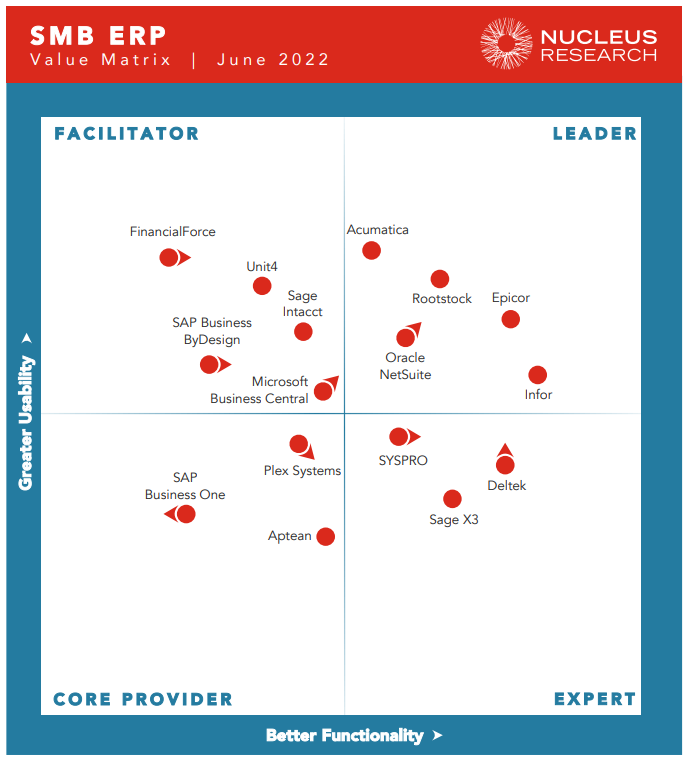
operational efficiencies and avoid additional applications. In this Technology Value Matrix, Nucleus assesses the ERP market based on the value customers realize from the product usability and functionality that vendors are delivering with their solutions (Nucleus Research V67 – Understanding the Value Matrix, April 2021).
The Matrix is a snapshot of the market designed to help customers and prospects understand where vendors are differentiating in how they deliver value and where vendors are making significant product investments.
LEADERS
Leaders in the ERP Technology Value Matrix include Acumatica, Epicor, Infor, Oracle NetSuite, and Rootstock.
ACUMATICA
Acumatica is a leader in this year’s SMB ERP Technology Value Matrix. The ERP specialist primarily serves mid-market companies in the construction, distribution, retail-commerce, services, and manufacturing sectors. The cloud ERP provider combines financial management, project accounting, customer management, field service management, and payroll capabilities in one unified platform. Acumatica’s core value proposition lies in its modular architecture, which empowers developers and citizen developers alike to configure business logic, integrate third-party applications, and create new report types with the help of low-code/no-code technology.
Acumatica has made significant product enhancements over the last year, which provide customers with self-service capabilities and productivity improvements.
- Acumatica announced the release of Acumatica 2022 R1 in March 2022. The update’s key themes include enhanced mobile features, including adding KPIs and setting favorites, increased localization expanding multi-country customer support,
and new industry-specific capabilities. - The new General Ledger Anomaly Detection feature leverages machine learning capabilities to calculate predictions of errors in posted general ledger transactions; included is the GL Anomalies Dashboard which displays KPIs, tables, and charts
related to the feature’s data. - Updates include bank transaction processing enhancements, mobile app workspaces, industry edition enhancements, blanket sales orders, final paycheck generation, search flexibility improvements, and the ability to merge duplicates in
CRM. - New machine learning and artificial intelligence features, AP Automation, Expense Recognition, and business card recognition. Customers will benefit from automation and predictive capabilities leveraged by these features to streamline workflows.
- The vendor introduced integration with Shopify, BigCommerce, and Amazon, enabling commerce organizations to support additional sales channels.
- New native integration with Microsoft Teams supports the chat and video calls within the platform. Customers will benefit from this feature through the convenience of communication and the ability to track activity.
With Acumatica’s continued improvements in self-service and integration capabilities, customers can expect to manage their API ecosystem more efficiently and launch analytics projects at an accelerated pace. Nucleus believes the recent developments solidified the vendor’s positioning in high usability.
EPICOR
Epicor is a leader in this year’s SMB ERP Technology Value Matrix. Epicor specializes primarily in the mid-market companies in the automotive, distribution, building supply, manufacturing, and retail industries. The Epicor Industry ERP Cloud platform combines financial, supply chain management, planning, CRM, product management, project management, business intelligence, and analytics capabilities into one integrated system. One of Epicor’s core value propositions lies in its configurable infrastructure, offering various industry-specific ERP packages. With low-code/no-code functionality, pre-built API connectors, and extensive library add-on modules, businesses can set up their Epicor ERP system to meet their organization’s unique requirements.
In the past year, Epicor has announced notable product changes, including:
- With the acquisition of KBMax, Epicor has launched Epicor CPQ, a 2D/3D platform equipped with AR (Augmented Reality). The service integrates Epicor Industry ERP cloud, Kinetic, Prophet 21, and BisTrack, allowing customers to visualize end
products being designed, thereby increasing sales and streamlining manufacturing for their custom products. - Epicor Commerce Connect service saw several improvements, including CPQ integration and support for multi-page CMS for smaller customers. The former expands customers’ self-service capabilities, enabling them to choose designs and
other attributes, build products on the fly, and add them to quotes and orders. The latter enables Epicor Commerce Connect Express customers to establish a web presence without the requirements of a full eCommerce platform; they can build
home and informational pages and add social posts, blogs, and newsletters. - Epicor now offers cloud implementation services for Epicor Quick Ship to Epicor Kinetic and Epicor Profit21 customers. Government Cloud now supports Quick Ship for Epicor Kinetic customers in the United States.
- Epicor EDI saw several functionality enhancements, notably new Epicor eCommerce connectors that let manufacturers and distributors connect their Epicor ERP systems to Amazon and eBay marketplaces and the Epicor Supplier Portal helping
manufacturers and distributors link with their suppliers. Customers will benefit from the ability to automate order processing, accelerate order entry and fullfillment, provide real-time stock availability, and improve supplier preparation and prediction ability. - In March 2022, Epicor announced the acquisition of Grow Inc., a full-stack, low-code business intelligence (BI) software that combines data integrations, data warehousing, and visualization into a single platform. The move will grant Epicor customers greater access to analytic tools and resources.
- This year’s Epicor Kinetic updates include the Epicor Cloud Enterprise Services package for large manufacturers, integration of Epicor CPQ (formerly KBMax), UX upgrades, connection to the SecturaFAB estimating and quoting tool, integration
with ETQ, integration of Epicor Advanced MES to Sage Clarity, the introduction of Application Studio, planning BOM and MRP improvements, automated fulfilment, and dynamic documents with country-specific features and retrofits for Saudi Arabia, Mexico, UK, amongst others. - This year’s Epicor Prophet 21 updates include adoption of the Epicor Design System, enhanced functionality around regulatory requirements and tax changes, particularly in the UK and Mexico, improved reporting capabilities in Report Studio, enhanced security features utilizing Epicor’s Security Suite, and integration to Smart Software.
The vendor also formed strategic partnerships with AutoCrib, and Parcel Pending. - This year’s Epicor BisTrack developments include the integration of Epicor CPQ, the Epicor Enterprise Content Management AP Automation module, and two new strategic independent software vendor partnerships with Geotab and Buildxact.
INFOR
Infor is a leader in this year’s SMB ERP Technology Value Matrix, recognized for its industryspecific ERP solutions deployed on the cloud through its CloudSuite platform. The vendor’s targeted industries include healthcare, industrial machinery, heavy equipment, automotive, fashion, distribution, manufacturing, aerospace and defense, food and beverage, and public
services. For these industries, Infor’s modular CloudSuite platform offers SCM, CRM, human resources planning, product lifecycle management, warehouse management, and asset management capabilities in addition to financial and accounting functionality. Built on infrastructure services from AWS and the Infor OS cloud platform, Infor’s ERP solutions offer flexibility in deployment options, including cloud, hybrid, and on-premise. Solutions withInfor LN and Infor M3 at the core primarily target large enterprises and Infor Systeline and Infor SXe suit small and mid-market businesses. The combination of this flexibility and
industry-specific ERP functionality positions Infor as a highly competitive solution within the ERP space.
In the past year, Infor has announced notable product enhancements, including:
- In October 2021, Infor announced the acquisition of Lighthouse Systems, a provider of manufacturing execution system (MES) software for smart manufacturing capabilities. Customers of Infor CloudSuite ERP solutions will benefit from the full
integration of this full ISA95 scope MES solution into the CloudSuite platform. This will shorten the time to value for customers looking to simultaneously implement both ERP and MES and will enable Infor to address the customer requirement of 24- 7 manufacturing operations. - In January 2022, Infor launched the Infor Marketplace, designed to showcase industry and micro-vertical solutions that augment and directly integrate with Infor investments. CloudSuite ERP customers will benefit from potential ERP enhancing extensions on the marketplace, including pre-integrated solutions and platform-built technologies from niche industry functionality to extensions and reusable widgets.
- Infor has implemented deeper integration into the Infor Nexus for CloudSuite. Customers will enjoy full supplier network integration for CloudSuite systems, extending notably beyond traditional order integration.
- The vendor introduced an equipment self-service portal for CloudSuite systems customers. This will enable effective access to equipment information updates, rental requests, and service history and demands.
- Infor launched a new retrospective trade agreement module for CloudSuite systems. Customers will benefit from unified management of agreements, including rebates bonuses, trade promotions, and commissions.
- Earlier this year, variable-driven CFO dashboards were introduced to enable analytics for CloudSuite systems. This technology enables customers to organize financial and operational data centrally and glean insights from fiscal intelligence
using analytical tools. - Infor announced the support of multiple books and valuation methods for corporate accounting and reporting. Global company customers will now have support in reporting under multiple rules such as local GAAP, IFRS, and others.
- The vendor announced new grower contract support features. CloudSuite customers will be empowered with additional settlement options allowing for self-billing as well as requests for supplier invoicing based on grade-based pricing.
ORACLE NETSUITE
Oracle NetSuite is a leader in this year’s SMB ERP Technology Value Matrix. NetSuite provides a comprehensive ERP system capable of handling the operational and financial processes necessary to run service and product-centric businesses. Although NetSuite typically targets organizations with revenues up to $250M, enterprise customers are not uncommon, demonstrating the platform’s scalability as an organization expands. To better serve select customers, NetSuite offers various industry solutions including advertising and digital marketing, education, financial services, healthcare, hospitality, manufacturing high
tech, retail, and wholesale distribution. Beyond this functional depth, NetSuite differentiates its ERP platform by pairing solutions for CRM, eCommerce and HCM among others, allowing customers to consolidate their technology stack and easily undergo large-scale digital transformation initiatives. NetSuite is also a contender among international organizations with capabilities for currency conversion, and tax compliance, alongside support for financial reporting standards in 27 languages, 190 currencies, and over 217 countries and territories.
Recent product updates and announcements for Oracle NetSuite include:
- In January 2022, the vendor announced the acquisition of Verenia’s NetSuite CPQ business. NetSuite customers can leverage streamlined quoting and selling processes with a native configure, price and quote solution.
- In January 2022, Oracle announced the NetSuite Cash 360 dashboard release. Significant features include a real-time view of the customer’s cash position and nearterm forecasting. Additionally, the tool simplifies cash management through a
configurable dashboard that includes links to crucial cash management activities: task notifications, current cash balance, accounts payable and accounts receivable balances, cash flow trends, and a rolling six-month cash flow forecast. - SuiteBanking. A new solution that imparts greater cash flow control and insights into the cash requirements of users by delivering greater automation for Accounts Payable and Accounts Receivable. Additionally, integration with banking partners such as HSBC enables simultaneous access to payment card services and a global digital wallet. Customers will benefit from an increased ease of bill paying and invoice sending, as well as increased control over how their customers and trading partners make and receive payments.
- NetSuite Project 360. A new solution that provides a unified, project-centric control panel. The tool enables the pulling of data from across the entire Suite, presenting it in a customizable workspace to meet the specific needs of project managers.
- Built on Oracle Analytics Cloud and Oracle Autonomous Data Warehouse, the vendor announced NetSuite Analytics Warehouse. An easy to access repository of analytics, visualizations, and insights from NetSuite and third-party applications,
enabling customers to make informed decisions. - The introduction of NetSuite Connector will enable organizations to arrange data mappings between NetSuite and their online marketplaces, point-of-sale systems, ecommerce storefronts, and third-party logistics providers
ROOTSTOCK
Rootstock is a leader in this year’s SMB ERP Technology Value Matrix. The ERP specialist in the manufacturing space primarily serves mid-sized companies in the aerospace & defense, cannabusiness, high-tech & electronics, industrial equipment, medical device, and project manufacturing sectors. The cloud ERP provider combines sales, engineering, supply chain, production, inventory, logistics, financials, analytics, collaboration, and customer service capabilities. Rootstock is built natively on the Salesforce Platform giving organizations a unified data model and user experience for CRM, ERP, and other business data to be
leveraged with the latest Salesforce Platform capabilities.
Rootstock has made significant investments to its Rootstock Cloud ERP offering and benefited from Salesforce Platform updates including:
- The updated no-code Lightning Experience. The Lightning Toolkit allows customers to configure a Lightning page, introduce client-side validations, and serve new experiences, including a configurable grid. Customers can access over 6000 out-ofthe-box UI operations, the ability to configure specific user experiences (UX) with Lightning pages, and the capability to enforce business validations through a nocode UX.
- The ability to leverage Digital HQ in Salesforce following the Slack acquisition. Users will benefit from both instant collaboration tools and a direct connection with platform data enabling data referencing through Slack.
- The ability to use Natural Language Processing (NLP) in Einstein Search—in conjunction with contextual search—to provide improved user queries.
- Einstein Bots can now leverage Rootstock data to enable self-service capabilities. As part of the Salesforce Cloud, Einstein Bots interact with customers without human service, enabling 24/7 service on the customer’s website.
- Rootstock announced the ability to record the movement of materials back and forth from third-party service providers mid-production. This allows outside operations, which are very common in manufacturing, to be treated like any operation with the same in-system visibility.
- Financial statements in Rootstock are now more interactive. Users can “drill-down” from financial statements to verify and understand deviations. This update improves Rootstock’s audit capabilities.
- Direct integration between Rootstock Service and Salesforce Field Service is now available and will benefit customers by increasing visibility of both supply availability and demand planning, as well as adding reordering capability, which improves the maintenance of service stock.
EXPERTS
Experts in the ERP Technology Value Matrix include Deltek, Sage X3, and SYSPRO.
DELTEK
Deltek is an expert in this year’s SMB ERP Technology Value Matrix. The ERP vendor serves companies of all sizes in the accounting, architecture, engineering, construction, consulting, energy, oil, gas, IT, aerospace, defense, marketing, and government contracting sectors. Deltek provides business intelligence, contract management, human capital management,
procurement, accounting, manufacturing, and project management capabilities through its Costpoint, Vantagepoint, Maconomy, Ajera, WorkBook, and ComputerEase solutions. The platform’s modular architecture and low-code customization features enable organizations to meet the unique requirements of individual projects and scale operations as needed.
In the past year, Deltek has announced notable product enhancements, including:
- Deltek has asserted its compliance with ITAR and CMMC, following new cybersecurity compliance requirements released by the US Federal Government. Deltek’s recently launched Cloud offering will empower firms in the cloud to meet these cybersecurity requirements, which can traditionally be highly expensive and time-consuming. Additionally, Deltek will continue to pursue CMMC 2.0 certification at Maturity Level (ML) 2.
- Deltek continues to implement UI enhancements, improving Vantagepoint’s user experience. Newly added navigation banners simplify daily functions and reduce click requirements, in-app learning aids have been introduced, and accessibility has been improved. For the customer, these changes will result in more time spent doing work of value, eliminating monotonous tasks.
- Deltek has implemented innovative artificial intelligence optimizations that drive value. Enhanced Smart AI features improve visibility into current performance measures while simultaneously providing insights into future performance.
Furthermore, new out-of-the-box AI-powered dashboards enable the accessible gleaning and visualization of data insights by executive leadership, project managers, human resources managers, and procurement managers. - This year, Deltek introduced an offering that meets integration needs through its API stack, as well as the out-of-the-box integrations offered in many of their products. With integrations being challenging, costly, and complex in the past, customers will benefit from the ability to connect to a complete solution for all integration needs to build, deploy, and manage cloud-based integrations to and from Deltek solutions.
- Deltek has continued to expand its partner ecosystem over the past year. Customers benefit from more than a hundred best-in-class partners, integrations, and bots in the Deltek Partner Marketplace, which support the project lifecycle to accelerate
operations and improve profitability.
SAGE X3
Sage X3 is an expert in this year’s SMB ERP Technology Value Matrix. The ERP specialist primarily serves SMBs within the discrete manufacturing, process manufacturing, wholesale distribution, and business service sectors. Sage X3, the vendor’s flagship product-centric ERP platform, combing financial management, CRM, supply chain management, and
product management capabilities into one unified platform. Sage X3’s core value proposition lies in its industry-specific out-of-box functionalities, which enable customers to achieve a quick go live and time-to-value.
Sage has made some significant product enhancements over the last year, including:
- The vendor has introduced the delivery of configurable Frameworks for electronic invoicing, banking and cash management, regulatory business reporting, and tax and VAT management.
- New mobile automation, automated billing, production chain synchronization, and additional modules were introduced, enabling manufacturers to bring products into the market more efficiently, and web scheduling to help customers manage their throughput and capacity.
- Sage introduced the GraphQL API Framework, a functional Web API service capable of building synchronous application integrations compatible with all deployment types.
- The vendor implemented patch management optimization, with current capabilities now featuring a 50-minute installation for a 12-month cumulation of patches in a typical implementation.
- Sage X3 has improved its platform enablement capabilities, updating cumulative and delta patching and safety in extensibility with customization management tools. Data management, performance, compliance, and security functionalities have also received updates.
- The vendor has introduced the ability to automate test scripts, assisting with their internal and external change management requirements and reducing significantly the labor required to run manual tests. This will help customers meet controlled industry requirements with the ability to schedule tests and report on test results.
- Sage has announced two cloud improvement tools: Sage Partner Cloud and Sage Provisioning Portal. The former enables historic customization and integration from within the cloud experience. The latter facilitates the provisioning of Sage X3
securely into an AWS account within minutes.
SYSPRO
SYSPRO is an expert in this year’s SMB ERP Technology Value Matrix. The ERP vendor serves SMBs in the manufacturing and distribution industries. The SYSPRO platform offers a wide range of features, such as order management, supply chain, production control, inventory management, cost control, business operations, financial management, procurement management, warehouse management, and process improvement. SYSPRO’s core value lies in its deep industry expertise by offering manufacturing and distribution specific functionalities, including workflow automation and pre-configured standard
performance metrics to optimize operations.
Recent product announcements and enhancements include:
▪ Improved collaboration through the SYSPRO Supply Chain Portal. SYSPRO’s selfservice portals centralize communication, enabling suppliers and customers to engage directly with each other. Customer and order information can be made available in real-time, ensuring business continuity and quality engagements.
▪ Guided inventory picking solutions with missions and tasks features & mobile app support. SYSPRO is bolstering its warehouse and logistics management functionality by increasing last-mile capabilities to improve inventory management, visibility, and
control. The “Missions and Tasks” solution has improved inventory control capabilities that will enable SYSPRO to push inventory movement instructions to relevant teams, allowing a secondary level of control at the operator or warehouse level. The solution will support cycle counts, sales order picking, and material putaway transactions.
▪ Revised pricing engine for complex order pricing rules. Increased configuration options of sales pricing structures will support businesses to create their own pricing mechanisms and solutions based on the unique requirements of individual customers
or groups of customers. All types of price lists can be maintained from a central location, and prices can be updated in mass, simplifying price configuration processes.
FACILITATORS
Facilitators in the ERP Technology Value Matrix include FinancialForce, Microsoft Dynamics 365 Business Central, Sage Intacct, SAP Business ByDesign, and Unit4.
FINANCIALFORCE
FinancialForce is a facilitator in this year’s SMB ERP Technology Value Matrix. The ERP specialist primarily serves SMBs in the business services, health & lifestyle sciences, media & digital communications, professional services & consulting software, high-tech & IT services, and telecommunications sectors. The cloud ERP provider combines accounting, finance, subscription & usage billing, revenue management, financial planning & analysis, procurement, order & inventory management, and analytics capabilities. One of FinancialForce’s core value propositions lies in its native Salesforce integration, which incorporates Salesforce’s CPQ and AI engines to streamline financial workflows. FinancialForce has made some significant product enhancements over the last year, including:
▪ An updated release cadence, aligning their updates with the schedule of Salesforce: Spring (April), Summer (August), and Winter (December). This will enable customers to coordinate the incorporation of Salesforce releases, helping them stay up to date
with releases from FinancialForce.
▪ Launch of a new FP&A offering: FinancialForce Planning. The service integrates core financials, planning, reporting, and analytics, leveraging datasets on a singular platform. FP&A teams within customer organizations will benefit from greater control
over budget processes and produce more accurate forecasts through pre-built templates, workflow management, and version control features.
▪ In Spring 2021, FinancialForce introduced its new financial reporting tool, Financial Report Builder. Enhancements include supporting multi-entity reporting with consolidation group structure and out-of-the-box financial statements for the French
and Spanish markets.
▪ The vendor announced several new capabilities under “Multi-X Enhancements.” These include e-support for intercompany tax transactions, multi-company sales invoices, multi-company journals, advanced consolidations, and automatic write-offs.
▪ FinancialForce expanded business operations in Germany and Australia and introduced localization support for Switzerland, Denmark, Finland, and Austria. Additional support for Norway, Sweden, and Belgium and additional withholding tax
support have also been implemented. These announcements improve the product’s ability to operate globally, improving service to users operating in these countries.
▪ The vendor is continuing its deployment of the Salesforce Lightning Experience, including UX upgrades, new Sales Invoice and Revenue Management interfaces, and improvements to action queues, payable invoices, and bank reconciliation.
▪ Enhancements to FinancialForce’s Customer Engagement offering include an Inventory Sales Orders tool and the ability to expedite the creation of multi-element revenue contracts in accordance with ASC 606.
▪ Starting this year, customers will be able to group procurement spending into specific purchase categories with Category Based Purchasing and leverage additional features, including e-Outbound Payments Support and e-Invoicing.
MICROSOFT DYNAMICS 365 BUSINESS CENTRAL
Microsoft is a facilitator in this year’s SMB ERP Technology Value Matrix. The vendor’s SMBfocused ERP, Dynamics 365 Business Central, serves organizations across a wide range of industries via an on-premises, cloud, or hybrid infrastructure. The ERP provider combines customer relations, accounting, financial, sales, inventory, supply chain, service, and project
management capabilities into one integrated platform. Dynamics 365 Business Central offers comprehensive pre-built compliance functionalities, such as financial reporting standards, local functionality, and GDPR that support global compliance requirements in over 25 languages.
Recent product announcements and updates over the past year include:
▪ The Wave 1 releases for Dynamics 365 Business Central include customer onboarding simplification through a new Help pane that provides both learning guidance and optimizations for process adaption, the addition of 13 new supported
countries and regions, improved data collaboration between Teams and Business Central, connector capabilities for Microsoft Power Platform, and improved ease of Power Automate flow triggering.
▪ The Wave 2 for Dynamics 365 Business Central expanded built-in tours to cover more standard entities and investment into the Better with Microsoft 365 initiative, expanding both Teams and Business Central capabilities. Customers will benefit from improved integration with Excel, improved onboarding of additional business roles, and global availability for Argentina, Bulgaria, Chile, Puerto Rico, Slovakia, and Ukraine.
▪ In April 2022, the vendor announced its 2022 release wave 1 plan, including increased reporting investment, supply chain area improvements, improved integration with Excel and Teams, strengthened AL language functionality, improved admin and governance capabilities, enhanced integration between Microsoft Dataverse and Microsoft Power Platform, optimized onboarding, and the addition of more countries to a total of over 70 countries.
SAGE INTACCT
Sage Intacct is a facilitator in this year’s SMB ERP Technology Value Matrix. Sage Intacct, Sage’s accounting-centric solution, primarily serves professional services, construction, and real estate businesses with project-based accounting requirements. The platform streamlines the AP/AR and the monthly closing process by consolidating data from multiple resources and automatically formatting the currency of individual reports based on location. In addition to core ERP functionality, the Intacct platform drives value through its real-time dashboard and reporting technology, which enable customers to drill down into revenue and expenses for specific projects, saving valuable time in reviewing outstanding tasks and performance.
Sage Intacct has made some significant product enhancements recently, including:
▪ In May 2022, the vendor announced the release of Sage Intacct Real Estate, a new solution adding property management capabilities to the Sage Intacct cloud financial management platform. Accessible in-browser, the module brings the functionality of Sage 300 CRE Property Management to the Intacct cloud, designed to support multiple tenants in one space or multiple locations for one tenant. Customers looking to sublease space will be enabled to track the original lease signee and a
new tenant who may now be occupying the space.
▪ In April 2022, Sage announced the acquisition of Mateo cloud savings and loan software from MAS Integrated Solutions, a leading provider of financial digitization for Roman Catholic diocesan organizations. Customers in the nonprofit sector will benefit from industry-specific process automation and insight-gleaning for their savings and loan programs.
▪ In February 2022, the vendor announced Sage Intacct 2022 Release 1, notably augmenting artificial intelligence and machine learning capabilities for the platform. Customers will benefit from these capabilities through the automation of central
processes and anomaly detection.
▪ In January 2022, Sage announced the acquisition of Brightpearl, a cloud-native multichannel retail operating system for wholesalers and retailers. Customers will benefit from an extended Sage Intacct value proposition, offering an end-to-end
retail eCommerce solution with automation, B2B/DTC/B2B compatibility, and a singular data source across orders, finance, customers, and stock availability.
SAP BUSINESS BYDESIGN
SAP Business ByDesign is a facilitator in this year’s SMB ERP Technology Value Matrix. The ERP specialist primarily serves mid-market companies in the energy & natural resources, service, consumer, discrete manufacturing, financial services, and public services sectors. The cloud ERP provider offers a wide range of capabilities from finance to product management functionalities. One of the core value propositions lies in its integrated infrastructure, consisting of over 40 built-in business processes, such as embedded analytics, which enable organizations to streamline workflows and collaborate across functional
departments.
Recent product announcements and enhancements include:
▪ In May 2022, SAP announced two new finance automation bots for the platform. The first, Creation of Closing Cockpit (2F1), automatically takes required configuration parameters and generates entries in a New Period-End Close screen. The second,
Automation of Open and Close Periods (2F2), allows customers to automate the opening and closing of existing periods, normally a time-consuming and repetitive task.
▪ In May 2022, the vendor announced SAP Business ByDesign 22.05. The update includes the enablement of manual creation of a production order, creation of physical inventory count documents with Microsoft Excel, maintaining of a product
specification on the BOM item level, retaining of manager assignments, a dispatching board for services owners, API executed bots, and the use of templates in document recognition service.
▪ In November 2021, SAP announced improvements to Cash Flow for Business ByDesign. Newly developed features include the ability to read sales and purchasing documents, the creation of Forecast Planning Items for Customer Invoice Schedule
Milestones and Supplier Delivery Schedule Items, and the configuration of the default payment terms, house bank, and language. These features benefit customers looking to enhance the current report view and avoid tracking Cash Flow outside the system with third-party tools.
UNIT4
Unit4 is a facilitator in this year’s SMB ERP Technology Value Matrix. The ERP vendor serves companies primarily in the higher education, nonprofit, professional services, and public sectors. The flagship ERPx platform combines financial, procurement, project, operational, HR, and payroll capabilities to provide customers with a unified user experience. Unit4’s core value proposition lies in its modular micro-service architecture, which empowers organizations to customize their ERP system by natively integrating additional functional modules, such as FP&A and HCM, without external consultants.
Recent product updates and announcements include:
▪ In November 2021, the vendor announced the acquisition of Compright, a compensation planning provider serving customers in life sciences, technology, and media across 40 countries. This acquisition augments the functionality of Unit4’s ERPx platform, enabling organizations to automate the end-to-end compensation process through incorporated analytics and data integration.
▪ Unit4 introduced the Unit4 Industry Mesh service in November 2021. The multitenant cloud service delivers industry-specific ERP and packaged integrations for mid-market organizations. Customers will enjoy increased agility to handle growth
targets and market disruptions with industry-fit models and pre-built data flows between data sources, applications, and industry ecosystems. The service’s data flow providers include Salesforce and Microsoft Dynamics CRM for finance users, Oanda for exchange rates, Dun & Bradstreet for customer credit ratings, U.S. government for watch list checking, Microsoft Outlook for user calendar integration, and Slack and Microsoft Teams for collaboration.
CORE PROVIDERS
Core Providers in the ERP Technology Value Matrix include Aptean, Plex Systems, and SAP Business One.
APTEAN
Aptean is recognized as a core provider in the 2022 SMB ERP Technology Value Matrix. Aptean offers various industry-tailored cloud ERP solutions to ensure customers can address the functional gaps of generalized ERP systems. By building specialized solutions to support key verticals, Aptean gives customers the appropriate tools to fit their needs out-of-the-box, accelerating time to value. Industries served by Aptean include biotech and life sciences, food and beverage, process manufacturing, industrial manufacturing, distribution and retail, and financial services. Aptean also features adjacent solutions for Enterprise Asset
Management, Transport Management, Warehouse Management, Manufacturing Execution, and Product Lifecycle Management, enabling customers to further improve operational efficiency and extend visibility.
Recent product announcements and enhancements include:
▪ In May 2022, Aptean announced the acquisition of RLM Apparel Software Systems (RLM), a provider of cloud-based business software for the fashion and apparel industry. Customers in the fashion and apparel industry will benefit from RLM’s
industry-specific cloud-based software products, including 40+ modules for end-toend fashion product lifestyle management.
▪ In March 2022, the vendor announced its new Cloud-based Enterprise Asset Management Solution with CMMS for manufacturers. Named Aptean EAM, the solution unifies asset maintenance and management functions into a single platform.
Small to mid-sized manufacturing customers will be empowered to manage work orders, automate approvals, track spare parts inventory, schedule preventative maintenance, assign appropriately skilled labor, and conduct mobile compliance
inspections.
▪ In February 2022, Aptean announced the expansion of its North America Alliance Partner Program. Existing Microsoft customers will be enabled to leverage Aptean’s sales and support team for industry-specific food and beverage support.
PLEX SYSTEMS
Plex Systems is a core provider in this year’s SMB ERP Technology Value Matrix. The ERP specialist primarily serves SMBs in the automotive, food & beverages, precision & rubber, industrial manufacturing, high tech & electronics, and aerospace sectors. The cloud ERP provider combines accounting & consolidation, financial management, human capital management, suppliers & purchasing management capabilities into one unified platform. Plex’s ERP platform is built from the ground up with a focus on manufacturing and provides industry-specific functionalities, such as industry compliance templates, pre-built workflow
automation capabilities, and IoT integrations.
Recent product announcements and enhancements include:
▪ In December 2021, the vendor announced its Smart manufacturing platform has achieved the ISO/IEC 27001:2013 certification audit for its Smart Manufacturing Platform. ISO 27001 auditing validates data security practices; customers will benefit
from external validation of a standardized assessment of security standards regarding data.
▪ In November 2021, Plex Systems announced a production monitoring solution Plex Production Monitoring. Evolved from the acquisition of Kors Engineering’s Plex Mach2, the solution connects to plant floor machines through an edge device or a
PLC. Customers will be empowered to create scoreboards and customizable views for supervisors, operators, and the front office, showing measurements such as quality, downtime, scrap, and production cycles.
▪ In September 2021, Plex Systems was acquired by digital transformation and industrial automation company Rockwell Automation. Notably, the integration of the Plex Smart Manufacturing Platform with Rockwell’s FactoryTalk suite will bring further flexibility to manufacturing deployment choices. Additionally, Plex Systems customers will benefit from access to Rockwell’s global reach and industry-specific tools.
SAP BUSINESS ONE
SAP Business One is a core provider in this year’s SMB ERP Technology Value Matrix. The Business One platform primarily serves small businesses in the healthcare, financial services, manufacturing, higher education, agriculture, and professional services industries. SAP combines accounting, financials, purchasing, inventory, sales, CRM, and business intelligence (BI) capabilities into one unified platform. Business One’s core value proposition lies in its international design, which offers comprehensive tax and legal compliance functionalities, including automated multi-currency translation, local tax policy audits, and cross-border capabilities for tax compliance across 50 countries. Another differentiated factor for SAP Business One is that it supports the deployment to on-premises, private cloud, or SAP’s public cloud environments in over 170 countries, delivering deployment
flexibility to fit specific business needs.