Canada (English)
 Colombia
 Caribbean and Puerto Rico
 Ecuador
 India
 Indonesia
 Ireland
 Malaysia
 Mexico
 Panama
 Peru
 Philippines
 Singapore
 South Africa
 Sri Lanka
 Thailand
 United Kingdom
 United States

The Bottom Line
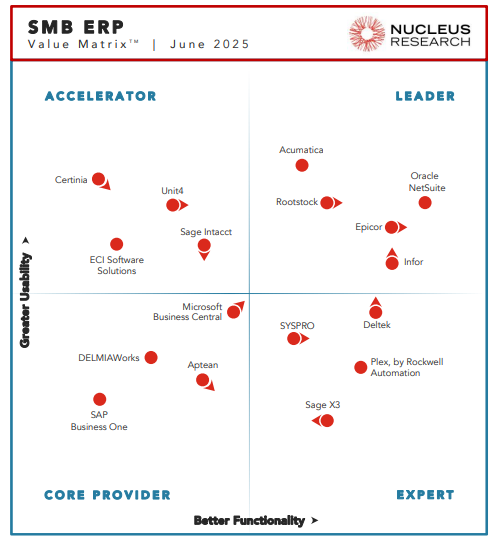
Small and mid-sized businesses (SMBs) face growing operational pressures heading into 2025, from geopolitical and trade disruptions to labor shortages and rising customer expectations. To compete effectively with leaner teams and tighter margins, SMBs accelerate ERP modernization, driving demand for systems that deliver actionable insights and support faster decision-making. In response, ERP vendors embed generative AI, machine learning, and AI agents into core workflows, empowering users to automate routine tasks, surface real-time recommendations, and close the gap between insight and action. These advancements enhance data-driven operations and elevate human productivity, enabling SMB teams to operate with greater agility and resilience. As the market matures, flexibility, usability, and vertical alignment emerge as key differentiators, with successful vendors offering out-of-the-box capabilities that can scale and evolve with diverse SMB needs. The SMB ERP Value Matrix leaders include Acumatica, Epicor, Infor, Oracle NetSuite, and Rootstock. The SMB ERP Technology Value Matrix experts are Deltek, Plex, by Rockwell Automation, Sage X3, and SYSPRO. Accelerators in the SMB ERP Technology Value Matrix are Certinia, ECI Software Solutions, Sage Intacct, and Unit4. Core Providers in the SMB ERP Technology Value Matrix are Aptean, DELMIAWorks, Microsoft Business Central, and SAP Business One.
Market Overview
SMBs are heading into 2025 under a unique set of pressures. Geopolitical uncertainty, shifting trade policies, and regional disruptions are forcing SMBs to reevaluate how they operate and compete. With leaner teams and tighter margins than their enterprise counterparts, these organizations seek ways to improve efficiency while building greater resilience. Many are reassessing inventory strategies by balancing lean operations with selective inventory buffers and diversifying supplier relationships to mitigate risk. At the same time, ongoing labor shortages and rising customer expectations are pushing SMBs to reduce manual dependencies and accelerate decision-making, all without the benefit of large IT departments or complex infrastructure.
In response, ERP vendors serving the SMB market have evolved their approach. In 2024, the market shifted beyond basic operational tools and dashboards toward more intelligent, data-driven functionality. Increased investments in generative AI and machine learning are now delivering practical process enhancements that improve productivity within existing workflows. Vendors are embedding natural language processing and analytics capabilities that enable users to query financial data, automate day-to-day tasks, and enhance reporting without requiring deep technical expertise. Rather than forcing SMBs to reinvent processes, these tools are designed to augment them, giving users faster insights and greater agility.
Building on this foundation, 2025 marks a new phase as SMB ERP evolves from a system of record into a system of action. Vendors are embedding AI agents directly into core workflows, enabling users to take action in real time, for example, by automating payables, surfacing revenue anomalies, or optimizing order flows based on current demand. AI agents in this context act as embedded modules that trigger alerts, surface recommendations, or initiate actions based on live data conditions. Critically, these tools do more than enhance data visibility; they enable faster, more confident decision-making by the human users. By accelerating task execution and surfacing next-best actions, AI agents empower lean teams to operate at a higher level of productivity and agility, closing the gap between insight and action. This human enablement is becoming a key competitive differentiator for SMBs, where decision cycles are short and staff often wear multiple hats. For this reason, accessibility remains the top priority. SMBs want tools that work out of the box but offer enough flexibility to evolve alongside their business. Some prioritize plug-and-play simplicity, while others seek customization to handle specific regulatory requirements, complex manufacturing needs, or multi-channel distribution.
Clear lines of differentiation are now emerging. While most vendors have AI on their roadmaps, the leaders are those with generally available functionality today. SMBs are pragmatic buyers who prioritize functionality they can leverage immediately. Vendors with real-world, vertically aligned use cases are gaining a competitive edge. As the SMB ERP market matures, the most successful vendors will be those who understand the diverse range of SMB needs. A one-size-fits-all model is no longer sufficient. Some customers aim to standardize and streamline operations, while others seek to differentiate through more advanced capabilities. In both cases, the ability to adapt quickly and scale efficiently will define long-term success in the SMB ERP market.
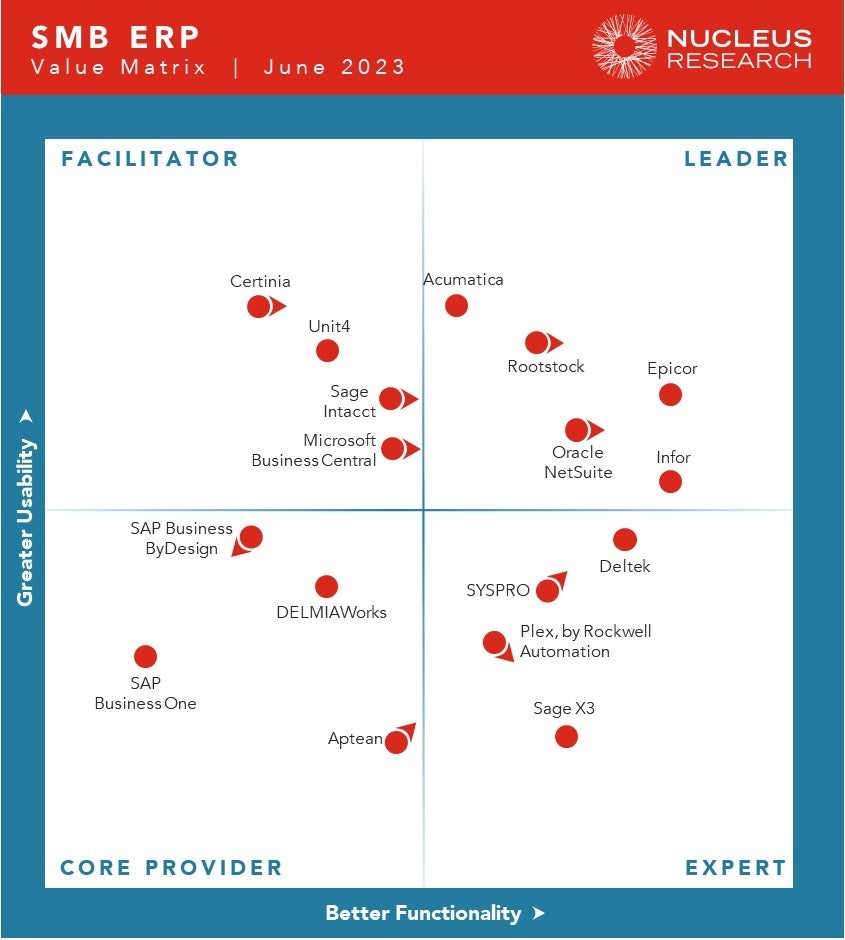
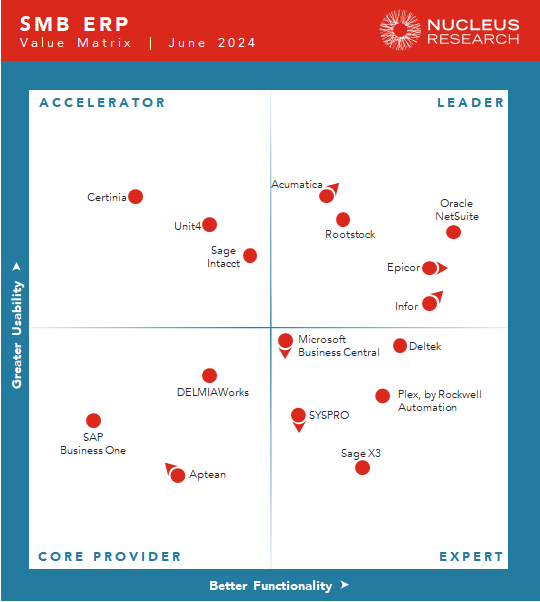
The Nucleus Research SMB ERP Technology Value Matrix provides an assessment of the market based on how vendors deliver value to customers through the usability and functionality of their solutions (Nucleus Research x222 – Understanding the Value Matrix, December 2023). The research is intended to deliver a relevant snapshot of the Marketing Automation technology market, rather than serve as an empirical ranking of the vendors. The arrows indicate each vendor’s perceived momentum and are informed through conversations with end users, recently released capabilities, features, and other areas of investment.
The Leaders
Leaders in the SMB ERP Value Matrix include Acumatica, Epicor, Infor, Oracle NetSuite, and Rootstock.
Acumatica
Acumatica is a leader in the 2025 SMB ERP Technology Value Matrix. Acumatica delivers a cloud-native ERP platform built for mid-sized businesses, offering a wide range of integrated applications across financials, sales, inventory, warehouse management, customer relationship management, project oversight, and shop floor execution. The platform runs on a secure, open cloud infrastructure that supports 24/7 access, remote collaboration, and strong data protection. Acumatica allows businesses to choose between public or private cloud deployment, depending on their operational and compliance needs. Unlike traditional user-based pricing, Acumatica uses a consumption-based licensing model that allows unlimited users and scales with business activity rather than headcount. The solution uses a single codebase across all its Industry Editions, which are purpose-built for the manufacturing, distribution, construction, professional service, and retail sectors. Each edition includes tailored capabilities, regulatory support, and workflow automation to fit the unique needs of each industry. The company also offers a General Business Edition, which provides the same scalable platform to support growth and efficiency across various business models.
Recent updates and announcements include:
► 2025 R1 Usability Updates.
Acumatica added a centralized view of all modified forms, allowing users to quickly track system customizations and reduce administrative overhead. Users can now identify whether workflow changes apply to any form, making customization management more intuitive and improving governance. The release features a modernized user interface with faster performance, drag-and-drop screen personalization, and the ability to hide or rearrange fields without coding. Enhanced filters, saved settings, and user-defined fields across forms further streamline navigation and data access. These updates and Acumatica’s emphasis on low-code/no-code tools help users to work more efficiently across roles and departments.
► Manufacturing 2025 R1 Updates.
Targeted improvements for manufacturers emphasize production efficiency and scheduling visibility. The new Production Orders by Build Capability feature enhances visibility into material shortages, streamlines inventory validation, and helps reduce production delays. Additionally, new scheduling views offer a more precise visualization of production timelines, assisting manufacturers in identifying and resolving bottlenecks more effectively. These updates promote better planning, faster decision-making, and improved operational agility.
► Distribution 2025 R1 Updates.
Inventory has been enhanced to track specific lot or serial attributes with improved searchability during sales. Warehouse operations now feature a mobile-first approach for transfer receipts and concurrent put-away workflows, while DeviceHub introduces automated scale integration for simplified shipping workflows. Purchase order management now supports post-release corrections with automated transaction reversals, maintaining accurate inventory values without requiring returns. The improved Fulfilled by Amazon (FBA) integration automates inventory reconciliation between physical warehouses and Amazon locations through automated shipment transactions and transfer orders, providing real-time variance tracking through customizable dashboards, and reducing manual reconciliation work through computerized updates. Shopify integration enhancements include support for default store currency imports for orders, payments, and refunds and advanced catalog controls that sync products based on active pricing and customer segments.
► Construction 2025 R1 Updates.
To enhance billing accuracy and flexibility, contractors can include time and materials (T&M) line items in AIA reports. Improved AP/AR reporting and time-sensitive cost projections provide better financial visibility, while new workflows facilitate multi-project transactions within a single document. Additional updates feature enhanced project inventory management, mobile access to project quotes, and advanced project financial reporting with rate-of-spend analysis.
► Professional Services 2025 R1 Updates.
Acumatica recently introduced a new edition tailored for professional services firms such as AEC, consulting, and IT companies. The edition provides comprehensive resource planning and project scheduling support, helping service-based firms manage time, resources, and budgets more effectively.
► 2025 AI Updates.
Acumatica AI Studio introduced advanced automation and insight tools that help users streamline operations and gain predictive insights with minimal technical expertise. The vendor improved anomaly detection to identify transaction irregularities, supporting cleaner data and proactive issue resolution. Enhanced Accounts Payable (AP) document recognition reduces manual invoice processing, improving AP efficiency and financial accuracy. The vendor’s newly built-in AI security controls help organizations safeguard sensitive data while leveraging AI tools to ensure compliance and data protection.
► Manufacturing 2024 R2 Updates.
New manufacturing enhancements include an estimate worksheet that helps create competitive quotes by spreading one-time costs across multiple quantities. Production order linking with relational IDs improves visibility into order dependencies for better reporting and scheduling.
► Distribution 2024 R2 Updates.
Sales order margin anomaly detection uses advanced AI algorithms to identify pricing and margin anomalies that traditional rule-based systems often miss, helping distributors catch errors earlier and protect margins.
► Construction 2024 R2 Updates.
Acumatica introduced on-demand ProForma invoice creation and substantiated billing to automate the collection and inclusion of specific costs.
► Retail 2024 R2 Updates.
Acumatica added streamlined support for Amazon returns, exchanges, and refunds and enhanced its Shopify integration with volume pricing and quantity rule capabilities, helping retailers streamline eCommerce operations.
► General Business R2 Updates.
New direct bank integration automates bank reconciliation and expense management, saving time, reducing manual work, and increasing financial accuracy. Additionally, AI-powered inquiries simplify the detection of transaction exceptions and anomalies, improving financial oversight and efficiency.
Epicor
Epicor is recognized as a leader in the 2025 SMB ERP Technology Value Matrix. The vendor’s comprehensive ERP system serves midmarket to enterprise-sized organizations in complex automotive, distribution, building supply, manufacturing, and retail industries. The solution integrates finance, supply chain management and planning, CRM, product management, project management, business intelligence, and analytics functionality. Additionally, the vendor continues to differentiate through the configurability of its platform, with industry-specific ERP solutions that include low-code/no-code capabilities, pre-built API connectors, and a range of composable add-on modules. Customers can fine-tune their Epicor ERP deployment to specific requirements with these options.
Recent updates and announcements include:
► Epicor Prism.
In January 2025, the vendor announced the launch of Epicor Prism, a network of vertical AI agents built for supply chain industries. With Prism, Epicor customers can use AI-driven, conversational agents to simplify daily work and solve complex business needs more easily. It connects to an Agentic AI Network, where agents collaborate to automate supply chain actions based on predefined rules and approvals.
► Grow Data Platform.
Epicor launched the Grow Data Platform, a full-stack no-code solution that centralizes enterprise data into a scalable data lake and structured warehouse tables, enabling high-performance queries for analytics. In May 2025, Epicor introduced the first Grow AI use case for the Grow Data Platform, allowing users to apply AI to structured data for predictive insights and operational efficiency.
► Ascend.
Epicor announced Ascend with Epicor, a cloud migration program that uses AI-driven tools and proven methodologies to accelerate transitions from on-premises and competitor systems to the Epicor cloud platform. Ascend automates critical migration tasks such as scoping, data conversion, and configuration setup to reduce time and value for both existing and new customers.
► Prophet 21 Updates.
Epicor’s move to a Continuous Integration/Continuous Delivery (CI/CD) model allowed the company to accelerate product innovation for Prophet 21, delivering 19 enhancements in the 2024.2 release alone. The 2025.1 release introduced several powerful features, including improved DynaChange Rules for automating workflows, reducing manual intervention, and increasing operational efficiency. Enhancements to Report Studio introduced dynamic time-based tokens, enabling more precise, timely reporting for better planning and decision-making. The KYKLO acquisition added PIM and B2B eCommerce tools that help distributors improve product data quality and boost online sales. The introduction of Grow AI Item Advisor, powered by Epicor’s Grow platform, allows companies to make smarter inventory decisions, reducing overstock and minimizing missed sales.
The integration of Epicor Prism into Prophet 21 brings embedded AI into everyday operations, helping users automate tasks and gain actionable insights. Additional updates included new pricing features for managing special orders and direct shipments, enhancements to operational controls such as audit trails and task scheduling, and new capabilities in Epicor Business Applications, including Quick Ship and Elite EXTRA, giving customers access to more streamlined logistics and fulfillment tools.
► Kinetic Updates.
CO₂e tracking was expanded to the part level for purchase orders, job tables, and quotes, supporting detailed Scope 3 emissions reporting and helping manufacturers align with ESG requirements. The embedded Knowledge Agent, part of Epicor’s AI network, now provides real-time, contextual support to cloud users, reducing support tickets and accelerating task execution. Epicor also continued its browser-first UX strategy, phasing out its legacy interface and introducing tools like funnel filtering, SQL-to-BAQ conversion, and performance safeguards that make the system more intuitive and faster. Many features were sourced directly from customer feedback via the Epicor Ideas portal, including improvements to MRP accuracy, dynamic inventory movement, intercompany order management, and enhanced RFQ tools.
Epicor introduced cloud self-service administration via the Cloud Management Portal, allowing users to manage updates, restart services, and regenerate data models without IT intervention. Finally, Epicor improved data access with new reportable fields, dynamic attribute support, and enhanced dashboards, enabling manufacturers to make data-driven decisions faster.
Epicor formed a new integration partnership with Sovos to enhance the Epicor Financials Suite by providing a reliable, automated global tax compliance solution covering tax determination, reporting, and regulatory adherence. Epicor also partnered with ADP to offer enhanced integration between the Epicor General Ledger, time collection systems, and ADP Workforce Now, streamlining payroll and HCM operations.
► Predictive Analytics Solutions.
Epicor introduced two industry-first predictive analytics solutions to support smarter decision-making in the automotive aftermarket. The Predictive Inventory Assistant (PIA) uses machine learning to identify stocking opportunities based on financial and performance data from comparable stores, recommending high-performing parts that a business doesn’t yet carry but should. This allows automotive distributors to reduce guesswork, improve inventory turnover, and capture missed revenue opportunities. Meanwhile, the Predictive Maintenance Assistant (PMA) helps service and repair shops anticipate future repairs for common vehicles by analyzing trends in real-time. This enables service writers and technicians to prepare more accurate estimates, advise customers proactively, and reduce downtime from unexpected part shortages. Together, these tools deliver a competitive edge by embedding AI-driven forecasting directly into everyday workflows, helping businesses boost profitability, increase customer satisfaction, and strengthen long-term planning across inventory and service operations.
► KYKLO Acquisition.
In June 2024, Epicor announced its acquisition of KYKLO, a Product Information Management (PIM) software provider and content-driven lead generation solutions, to add capabilities to its Epicor Commerce offering.
► Solenium Group Inc. And Visual Skus Inc. Acquisition.
In October 2024, the vendor announced its acquisition of Solenium Group Inc. and its sister company, Visual SKUs Inc. The two providers of PIM and Digital Asset Management solutions for the automotive aftermarket are long-term Epicor partners, and the move is expected to strengthen Epicor’s positioning in this vertical.
► Acadia Software Acquisition.
In October 2024, Epicor announced it had acquired Acadia Software. Acadia Software provides Connected Worker solutions that deliver real-time insight and guidance to frontline workers in manufacturing and other supply chain industries. The integration of these capabilities will enable Epicor customers to improve task execution across frontline teams.
► Smart Software Acquisition.
Epicor announced the acquisition of Smart Software, now Epicor IP&O. Smart Software provides AI-driven demand forecasting and inventory optimization, helping customers lower excess inventory, reduce stockouts, and optimize service levels.
Infor
Infor is a leader in the 2025 SMB ERP Technology Value Matrix. The software vendor serves various industries, including healthcare, industrial manufacturing, automotive, fashion, distribution, aerospace and defense, food and beverage, and the public sector. Infor CloudSuite is a set of composable industry-focused ERP solutions built with a modular structure. It includes capabilities for supply chain, CRM, HR, product lifecycle, warehouse, asset, and financial management. Each CloudSuite is embedded with proven best practices and processes tailored to specific industries out of the box, helping customers avoid heavy customization or third-party integrations. These capabilities are built on the Infor OS Platform and delivered on Amazon Web Services (AWS). Infor serves large enterprises and small- to mid-sized companies with ERP systems that align closely with the needs of targeted verticals.
Recent updates and announcements include:
► Infor Velocity Suite.
Infor launched the Velocity Suite to help customers accelerate process innovation using process mining, robotic process automation, and generative AI to diagnose inefficiencies, automate improvements, and optimize operations through a robust library of pre-built industry-specific use cases. With Infor Process Mining integrated into the Velocity Suite, users can analyze operational workflows in real time, identify bottlenecks or deviations from standard processes, and uncover business improvement areas.
► Infor GenAI Assistant.
Infor introduced the GenAI Assistant to provide conversational, role-specific guidance that helps users manage tasks like manufacturing project updates, requisition analysis, and product tracking more efficiently. This enables faster decision-making directly within CloudSuite applications. The GenAI Assistant, available in limited release, is part of Infor’s broader Industry AI strategy and is designed to enhance productivity by embedding intelligent, industry-aware support into users’ daily workflows.
► Infor Process Mining.
The launch of Infor Process Mining in late 2024 gives users a built-in platform to visualize, analyze, and optimize their business processes. It delivers faster insights through simplified data access, loading, and analysis. With Infor Process Mining, organizations can gain end-to-end process visibility and rapidly identify inefficiencies or bottlenecks, improving operational agility and supporting data-driven decision-making.
► April 2025 Product Updates.
Customers can use Infor Value+ solutions to automate tasks identified during the process mining phase, leveraging generative AI and RPA to eliminate manual work, increase speed, and enable consistent execution. Infor continued to scale its Industry AI portfolio, embedding generative AI directly into applications like Process Mining, Document Processor, CloudSuite Distribution, and Infor M3 to deliver one-click insights and increased process efficiency.
The Infor GenAI Assistant received a major enhancement with the launch of the Infor GenAI Knowledge Hub, which enables users to upload and query private documents for personalized, conversational support within their workflows. Infor expanded its Augmented Intelligence Service (AIS) with eight new AI use cases focused on predictive and prescriptive analytics, including capabilities for warehouse inventory management and ingredient optimization across industries such as distribution, food and beverage, and manufacturing.
The April 2025 update made Infor GenAI generally available across multiple touchpoints, including Process Mining, Document Processor, CloudSuite Distribution, and Infor M3. This update embeds AI experiences directly into core business processes for faster decision-making. With the expansion of Infor GenAI, users can now experience more intelligent and context-aware automation throughout their daily tasks, enabling greater productivity without leaving the CloudSuite environment.
► October 2024 Product Updates.
The launch of Infor Process Mining gives users a built-in platform to visualize, analyze, and optimize their business processes. It delivers faster insights through simplified data access, loading, and analysis. With Infor Process Mining, organizations can gain end-to-end process visibility and rapidly identify inefficiencies or bottlenecks, improving operational agility and supporting data-driven decision-making.
Infor released a new ESG Strategy, Planning, and Execution module that allows organizations to set, monitor, and report on environmental, social, and governance goals, embedding ESG data and processes directly into business operations. The ESG module helps organizations meet their sustainability goals and emerging regulatory requirements while promoting continuous improvement by integrating sustainability efforts into everyday workflows. Infor added supply chain management enhancements specific to verticals like healthcare, embedding AI-driven tools that increase forecast accuracy, reduce manual interventions, and accelerate value realization from planning to distribution.
One notable supply chain update includes embedding procedure supply planning and distribution management in healthcare ERP, making Infor the only provider offering this natively within a CloudSuite. The release also introduced Infor Value+, a set of pre-built tools and templates powered by Infor OS, designed to help customers configure CloudSuite solutions more quickly and realize business value faster. Infor Value+ enables users to automate routine processes, tailor workflows to specific roles, and surface high-impact opportunities for revenue growth and performance improvement in their industry. Through a central, role-based interface, Infor Value+ improves productivity by allowing users to view relevant insights and take action without switching between applications.
Oracle Netsuite
Oracle NetSuite is recognized as a leader in the 2025 SMB ERP Technology Value Matrix. It offers a unified cloud platform that manages operational and financial processes for small and medium-sized businesses and select large enterprises. NetSuite is built on a centralized data model, enabling real-time visibility and seamless data flow across business functions.
The suite spans a broad range of enterprise applications, including billing, revenue recognition, accounting, budgeting and planning, professional services automation (PSA), supply chain management (SCM), manufacturing execution (MES), warehouse management (WMS), human capital management (HCM), customer relationship management (CRM), commerce (B2B, B2C, POS), and business intelligence (BI). This end-to-end coverage reduces the need for multiple systems and promotes consistency across departments. NetSuite’s extensibility is further enhanced through its ecosystem of Built for NetSuite partner applications, which provide pre-integrated solutions tailored to specific workflows or industry needs.
While initially designed for SMBs, NetSuite’s scalability and vertical-specific capabilities have made it a compelling choice for larger organizations, particularly in software, financial services, construction, nonprofit, hospitality, high-tech manufacturing, retail, and wholesale distribution. Its global capabilities include multi-currency support, tax compliance, and alignment with international financial reporting standards, with services offered in 27 languages, 190 currencies, and more than 219 countries and territories.
Recent updates and announcements include:
► 2025 AI Updates.
NetSuite released AI solutions to automate report writing, generate data-driven narratives, and answer user questions using natural language. These include tools like NetSuite Narrative Reporting, part of its NetSuite Enterprise Performance Management offering, and NetSuite Expert for SuiteAnswers.
► Various 2025 ERP Updates.
SuiteProcurement expanded into a full procurement management solution, streamlining purchasing processes with punchout catalogs, automated approvals, and purchase order generation. The NetSuite Customer 360 dashboard was enhanced with new charts, performance metrics, and an AI-powered item recommendation portlet to support deeper customer engagement strategies. Three new NetSuite Connectors were introduced in 2025.1 to streamline data integration with Salesforce, Shopify B2B, and Microsoft Outlook. This reduces manual work and keeps systems aligned in real time.
NetSuite Field Service Management added features to automatically generate time bills based on job times, improving visibility and billing accuracy for field operations. In addition, field technicians using the mobile app can now upload files in bulk, such as job site photos, reducing time spent documenting completed tasks. A new Manufacturing Scheduler SuiteApp helps production managers allocate work efficiently by factoring in constraints like operation durations, dependencies, and work center calendars. The Auto Serial Numbering SuiteApp automates serial number creation for different item types, improving traceability, compliance, and inventory accuracy.
New specialized user roles were introduced with lower-cost licenses for users with limited access to NetSuite CRM, WMS, or approval-only functionality. Enhancements in NetSuite Ship Central allow users to apply flat, discounted, or markup shipping rates, compare rates during order creation, and capture pallet weight using integrated scales. NetSuite WMS now supports task breakdowns, multi-bin replenishment with carts, and bulk bin transfers via CSV import, improving warehouse task execution and flexibility. SCM Mobile app updates now allow offline printing from device storage and configuration of process-specific buttons to enhance usability and field operations.
NetSuite Quality Management added a statistical sampling method for inspections and improved return workflows by automatically creating return authorizations for failed lots or serials. Quality inspectors now have greater visibility into inventory conditions, including expiration dates and operational context for items under review. SuiteCommerce received a UI theme refresh in 2025.1 to improve visual clarity and accessibility for users navigating online storefronts. The Rebates and Trade Promotions SuiteApp was enhanced to support rebate calculations on SuiteCommerce transactions and enable agreement-level general ledger settings and custom rebate scripts.
► Redwood Design System.
NetSuite announced it was leveraging Oracle’s Redwood Design System in 2024 to modernize its user interface, improving navigation and reducing dropdown reliance while allowing users to switch between the legacy and Redwood UI.
► Various 2024 ERP Updates.
The Ask Oracle and SuiteAnalytics Assistant tools were unveiled, letting users generate reports and surface data insights using natural language, reducing the need for technical expertise. NetSuite Prompt Studio was introduced to allow businesses to customize AI prompts according to internal processes, acronyms, and preferred terminology. New Oracle Code Assist helps accelerate SuiteScript development by enabling developers to describe desired outcomes and receive optimized code output.
NetSuite released a financial exception management tool that uses AI to detect anomalies in transactions and journal entries, although user control over configurations is currently limited. NetSuite SuiteProjects Pro – previously called NetSuite OpenAir – includes a new user experience and AI-powered capabilities to help customers monitor the health of projects and accelerate project planning. The SuiteProcurement tool was added to automate purchasing with vendors like Amazon Business and Staples, streamlining procurement processes and reducing manual entry. Subscription management received updates with prepayment functionality and CPQ integration, enabling companies to manage consumption-based billing and offer subscription bundles more effectively.
NetSuite’s HR solution, SuitePeople, is integrated with SimplyInsured to let employees enroll in health benefits directly through NetSuite, automating payroll deductions and improving benefits cost tracking. SuitePeople Workforce Management added mobile enhancements, including break reminders and new timesheet fields for location, job, project, and task, providing better detail for resource planning. A new task management feature in NetSuite Account Reconciliation was added to help accounting teams assign, track, and complete close tasks efficiently, improving visibility and accuracy during period-end processes.
Enhancements to NetSuite Bill Capture improved matching accuracy using AI, enabled support for multi-page bill uploads, and added custom segment filtering for better control. Two new subject areas, Order-to-Cash and Procure-to-Pay, were introduced in NetSuite Analytics Warehouse to help finance teams visualize end-to-end cash flow processes and uncover inefficiencies. A new customizable account analysis subject area allowed users to aggregate and analyze financial data for regulatory reporting and performance tracking across subsidiaries.
The Transaction Line Distribution SuiteApp was expanded to include accounts receivable transactions, enabling flexible revenue allocation to subsidiaries and departments. SuiteTax enhancements allowed companies to record tax transactions between subsidiaries and track payments to tax authorities more efficiently. NetSuite Cash 360 added installment schedule support to improve forecasting accuracy for accounts receivable and accounts payable based on invoice and bill terms. The Rebates and Trade Promotions SuiteApp was enhanced with forecast-based tiered accruals and expanded to support rebate calculations on purchase transactions. NetSuite Compliance 360 was updated to include additional forms, support for file attachments, exportable audit records, and customizable portlets for better audit trail documentation.
NetSuite announced key SCM updates surrounding warehouse management. With the new WMS update, warehouse managers can more efficiently highlight urgent orders with the WMS digital assistant, allowing them to proactively manage ‘orders at risk’ and ensure timely fulfillment to meet customer expectations. Customers now have functionality that allows customizing shipping labels with logos, supporting better brand visibility. Wave planning functionality enhancement will enable users to configure optimized picking workflows based on travel path algorithms. Additionally, users can implement custom logic for pallet building and allocation within the wave planning process. These updates aim to improve warehouse efficiency by minimizing travel time and maximizing pallet utilization.
Rootstock
Rootstock is positioned as a leader in the 2025 SMB ERP Technology Value Matrix, with a strong focus on manufacturing-driven mid-sized companies. It serves industries such as aerospace and defense, high-tech and electronics, industrial equipment, medical devices, cannabis, and project-based manufacturing. The platform includes functionality for managing sales, engineering, production, inventory, supply chain, finance, analytics, customer service, and collaboration, all within a single system. Built natively on the Salesforce Platform, Rootstock provides a consistent user interface and shared data model, making integrating ERP with Salesforce CRM and other business tools easy. This unified foundation gives companies full visibility across departments from marketing and sales to operations, service, and finance, helping improve operational control, agility, and customer responsiveness.
Recent updates and announcements include:
► Tariff Management Central Release.
On April 17th, 2025, Rootstock launched Tariff Management Central to help manufacturers manage the financial and operational impact of changing global tariffs faster and more accurately. The module includes Landed Cost Tracking, allowing businesses to calculate actual input costs, including freight, duties, and tariffs, using weighted average costing, enabling more informed pricing and sourcing decisions. For quicker deployment, the QuickStart Tariff Tracking option lets manufacturers apply known tariff percentages via material overhead, streamlining setup and reducing complexity for finance teams. Built on the Salesforce Platform, Tariff Management Central ensures that changes in cost or availability automatically reflect across quoting, pricing, and customer communications, maintaining consistency and transparency across teams.
A Supplier Rebalancing and Sourcing Optimization feature enables procurement teams to analyze tariff-adjusted supplier costs across regions and pivot to lower-cost suppliers in response to global trade shifts. Teams can use Tariff Simulation and Pricing Strategy tools to model cost scenarios and proactively adjust product pricing or sourcing strategies before tariff changes take effect. The module provides real-time profitability monitoring, issuing alerts when tariffs erode margins, empowering leadership to take corrective action quickly.
Inventory Timing and Holding Strategies support pre-emptive buying or postponement based on tariff exposure, giving manufacturers an edge in cost management and inventory planning. Integration with Avalara’s AvaTax Cross-Border automates customs duty calculations and HS code assignments, reducing compliance risks and avoiding overpayments or shipment delays.
A future release will include an AI-powered tariff agent, currently in development, that will offer intelligent recommendations and adaptive workflows for even greater automation and agility in tariff management.
► Spring ’25 Updates.
Rootstock’s Spring ’25 Release on April 2nd, 2025, introduced a modern UX uplift across 200 Lightning pages, improving usability with cleaner layouts, reduced clicks, and faster data entry to drive measurable productivity gains. New 360-Degree Pages consolidate key customer, order, and invoice data into single views, improving visibility, decision-making, and reducing the need for cross-navigation.
The release includes real-time inventory sync with field service workflows, closing visibility gaps, and helping technicians fulfill tasks faster and more accurately. Rootstock embedded its AI engine, AIRS, into Quick Entry and Quick Orders, enabling predictive product recommendations based on customer buying behavior to streamline sales processes.
Financial enhancements include PO/AP Match Workbench 2.0, replacing the legacy interface with a more efficient, redesigned experience for matching purchase orders to payables. Rootstock Financial Analytics now supports custom filter saving, improving reporting efficiency and personalization for finance teams. New control over posting to future periods gives finance teams greater governance over transaction timing.
Manufacturing updates include DRP support for alternate items, enhancing supply chain adaptability, and note carry-forward functionality from requisitions to PO lines for improved procurement traceability.
► Winter ’24 Update.
Rootstock launched the Idea Factory on December 3rd, 2024, a customer feedback portal that allows users to submit, vote on, and track enhancement requests. This demonstrates its customer-driven product strategy. This release delivered the first customer-submitted feature: enhanced navigation in the Lightning Console, which simplified user workflows and boosted efficiency.
A new Sales Order Quick Entry screen streamlines sales processing, reducing time spent on order input and improving the order-to-cash cycle. Enhanced Data Grids now support direct workflow actions and live refreshes, giving users better control and a more seamless user experience. Sales order processing was improved with features like repricing, inventory validation, credit checks, and intercompany sales handling, giving users more flexibility and accuracy in managing complex sales scenarios.
Financial updates include improved AR posting controls, customizable VAT configurations, and enhanced support for entity consolidation during M&A events, all contributing to more precise and flexible financial operations. New financial analytics capabilities enable prior-year variance analysis, improved inventory valuation visibility, and automated service item processing, helping finance teams deliver more actionable insights.
Integration with leading PLM systems improves cross-functional visibility between engineering, production, and finance, strengthening product lifecycle coordination. Rootstock enhanced transactional automation, allowing users to automate labor postings, choose from multiple order templates, and execute MRP workflows more flexibly. The release included MRP++ proof of concept, which uses AI to predict lead times, flag bottlenecks, and dynamically adjust procurement, bringing predictive intelligence into supply chain planning.
Finally, Rootstock introduced early ERP Agent prototypes, combining ERP and CRM data to manage tasks like procurement and scheduling autonomously. These agents reduce manual effort, improve decision-making, and embed domain expertise directly into processes, helping manufacturers respond to labor gaps and increase operational agility.
Experts
Experts in the SMB ERP Technology Value Matrix are Deltek, Plex, by Rockwell Automation, Sage X3, and SYSPRO.
Deltek
In the 2025 SMB ERP Technology Value Matrix report, Deltek is recognized as an expert for its range of project-based ERP solutions for a diverse clientele, including sectors like government contracting, aerospace and defense, architecture and engineering, management and IT consulting, accounting, construction, and marketing agencies. Its suite of products includes Costpoint, Vantagepoint, Ajera, Maconomy, ComputerEase, and WorkBook, each offering tailored functionalities to meet the specific needs of various industries.
Costpoint is built for government contractors in verticals like aerospace and defense, manufacturing, and IT consulting, covering everything from finding new opportunities to capture and contract management to billing. Vantagepoint supports architecture, engineering, and management consulting firms, while Maconomy serves larger professional services firms and marketing agencies. Ajera is geared toward small A&E companies, WorkBook focuses on mid-sized marketing agencies, and ComputerEase supports construction firms of all sizes. These platforms include features for CRM, project accounting, human resources, procurement, project and resource management, business intelligence, and financials. A scalable, modular architecture that supports low-code customization enhances Deltek’s offerings.
Recent updates and announcements include:
► FedRAMP Status.
In April 2024, Deltek Costpoint GCCM achieved FedRAMP Moderate Ready status, confirming it supports DFARS 252.204-7012 as well as CMMC Level 2&3 compliance as a cloud service provider, and is now listed in the FedRAMP Marketplace. In April 2025, Deltek Costpoint GovCon Cloud Moderate (GCCM) completed its assessment for FedRAMP Moderate Equivalency – a key component to supporting cybersecurity compliance requirements for government contractors. Deltek’s GCCM offering for Deltek Costpoint now meets the FedRAMP Moderate Equivalency standard set by the Department of Defense.
► Dela.
Deltek launched Dela, its AI-powered business companion, which helps users generate content, predict project outcomes, explore data, and automate tasks across the project lifecycle. Dela is now embedded across Deltek’s product suite, delivering over 30 AI-powered features to identify best-fit opportunities, automate project summaries, optimize hiring, improve time and expense collection, and streamline back-office processes. In August 2024, Deltek expanded Dela’s capabilities in Costpoint, added a Microsoft Teams integration, and redesigned time and expense entry for better accuracy and ease of use. Looking ahead, Deltek will continue expanding Dela’s capabilities, including autonomous agents, predictive forecasting, complex data analysis, and contract automation to reduce manual effort across the business.
► Deltek Harmony.
In November 2024, Deltek introduced Deltek Harmony, a new unified user experience built on simplicity, context, versatility, and consistency. In July 2025, Costpoint will be the first Deltek product to leverage the new UI.
► ERP Product Updates.
Deltek added Smart Summaries in Vantagepoint and GovWin IQ, using generative AI to distill complex project data and opportunity research into concise, actionable insights. In 2024, ProPricer added direct integration with SAP S/4HANA, allowing users to import actuals directly from ERP systems for faster, more accurate estimates. In March 2025, Vantagepoint users gained the ability to embed insights from the Deltek Clarity A&E Study into dashboards, helping firms align operations with industry benchmarks (North America only).
Plex, by Rockwell Automation
Plex, by Rockwell Automation, is recognized as an expert in the 2025 SMB ERP Technology Value Matrix. The software vendor supports SMBs across the automotive, food and beverage, precision metal forming, plastics & rubber, industrial manufacturing, high tech & electronics, and aerospace industries. Its cloud-based ERP solution has modules such as accounting & consolidation, financial management, human capital management, and supplier & purchasing management. Plex’s ERP platform is tailored for manufacturing, featuring industry-specific compliance templates, pre-configured workflow automation, and IoT integrations. Plex supports advanced manufacturing processes with additional MES and QMS capabilities, making it a preferred choice for managing intricate manufacturing operations with minimal IT infrastructure.
Recent updates and announcements include:
► Connected Frontline Workforce Feature.
On September 19th, 2024, Plex, by Rockwell Automation, rolled out Connected Frontline Workforce (CFW) capabilities embedded within its Manufacturing Execution System (MES) to help manufacturers address labor shortages, improve productivity, and retain critical workforce knowledge. The new CFW application provides interactive work instructions, 2D/3D visual modeling, and Microsoft Teams integration, enabling frontline workers to perform complex tasks more confidently while capturing the expertise of veteran employees for future onboarding and training.
Sage X3
Sage X3 is recognized as an expert in the 2025 SMB ERP Technology Value Matrix. It offers a robust ERP solution tailored to small and midsize businesses across key verticals, including discrete manufacturing, food and beverage, chemicals, process manufacturing, wholesale distribution, and business services. The platform delivers a unified system that integrates financial management, customer relationship management (CRM), supply chain management, and production control, supporting rapid deployment through pre-configured, industry-specific capabilities.
Sage X3 is designed to support growing, multi-site, and multinational operations. Its financial management module handles core accounting, asset tracking, budgeting, depreciation planning, personnel cost allocation, and commitments. This ensures finance teams can manage operations across currencies, tax regimes, and regulatory environments from a single platform.
The production management functionality enables users to control and optimize manufacturing workflows. Features include multi-level bill of materials (BOM) support, change control, and mass maintenance capabilities, ensuring consistent product quality and traceability throughout the production lifecycle.
Sage X3’s supply chain management (SCM) capabilities span the complete procurement-to-payment cycle. It integrates inventory, purchasing, sales, finance, and manufacturing processes to streamline operations and enhance visibility. The procurement module includes support for supplier management, RFQ handling, product category control, purchase planning, and supplier invoice management. These tools help organizations maintain supply chain efficiency while improving responsiveness to shifting demand and supplier performance.
Updates from the last 12 months:
► Compliance & Regulatory Updates.
For France, legal printout requirements for AR invoices have been updated to comply with Decree No. 2022-1299, including tax notice wording and operation-type declarations.
For Spain, ongoing Verifactu and Non-Verifactu invoice tracking enhancements are updated to meet anti-fraud mandates, such as forms 303, 347, 349, etc., for SII.
For Portugal, SAF-T auto invoice generation and web service integration are now available for VAT compliance and forestry product declarations.
► Manufacturing Updates.
The Shop Floor Control (cloud-native) app enables real-time operation tracking; users can start, stop, and pause production tasks directly from the shop floor. The Web Scheduling UI and GraphQL APIs have been improved for easier installation and expanded access to planning components like BOMs and purchase orders. Weighing module improvements include touch interface optimization and enhanced lot selection views.
► Distribution Updates.
New Mobile Automation Enhancements allow identifier-based selection in intersite transfers, pick ticket allocations, and miscellaneous issues, improving stock accuracy and mobile efficiency. Enhanced support for default locations in purchase and intersite receipts simplifies inbound logistics workflows. Batch initialization of stock valuation records was introduced for greater scalability in cost tracking.
► Finance Updates.
VAT Reversal Logic improved: VAT dates align with reversal entries based on configurable parameters, ensuring accurate tax treatment. Users can delete simulated VAT returns to reduce clutter in VAT management.
► Platform & Architecture Updates.
Authentication via Sage account login is now supported, streamlining identity management across Sage services. MongoDB 7 is now mandatory, with automated upgrade support for standard deployments. Notification servers can now be configured at the company level for customized alert routing.
Significant Apache, Tomcat, and OpenSSL upgrades improve platform security and performance. Performance enhancements in log management, tree views, classic grids, and session lock cleanup reduce errors and boost user efficiency.
► Sage X3 Builder (Developer Experience) Updates.
Developers can now manage CLOBs and BLOBs in GraphQL mutations, improving flexibility in API payloads. New performance controls for mutation concurrency improve stability under load. Mobile Automation extensibility is enhanced via pre-loaded TypeScript pages to enable rapid customizations.
SYSPRO
SYSPRO is recognized as an expert in the 2025 SMB ERP Technology Value Matrix, focusing on serving small and medium-sized businesses in the manufacturing and distribution sectors. Designed for flexibility, SYSPRO supports on-premises, cloud, and privately hosted deployment models, allowing organizations to align the solution with their specific infrastructure and security requirements.
The platform delivers comprehensive functionality across order orchestration, production management, inventory control, procurement, warehouse management, financial operations, and supply chain management. This breadth supports the full operational lifecycle of manufacturers and distributors, from raw material sourcing to customer fulfillment and financial reconciliation. SYSPRO’s industry specialization is a core differentiator. The platform includes workflow automation tools and standardized performance metrics tailored to the manufacturing and distribution space.
Product updates over the last 12 months:
► QMS Module.
SYSPRO introduced an integrated QMS module that enables real-time quality control across the supply chain. It supports sampling, inspection, and approvals from raw material intake to final customer delivery while streamlining complaints and non-conformance management. This improves traceability, reduces risk, and ensures consistent product quality.
► EAM Module.
The software vendor launched a new EAM module that helps businesses maximize asset uptime and reduce maintenance costs. It allows organizations to assign and track maintenance activities by equipment code, manage cost centers through ledger linking, and ensure assets contribute effectively to operational goals through structured upkeep and visibility.
► Document Services Updates.
SYSPRO enhanced its Document Services with AI-powered invoice automation. The feature uses intelligent document capture to match AP invoices against GRNs and supports automated straight-through posting to financials.
► Dimension Analysis Updates.
Recently, SYSPRO has broadened its Dimension Analysis functionality, allowing users to tag transactions across business units such as region, department, or product line. This provides improved cost attribution and cross-functional reporting without changing the general ledger. Dimension-level budgeting is slated for release in 2025, extending planning capabilities across these dimensions.
Accelerators
Accelerators in the SMB ERP Technology Value Matrix are Certinia, ECI Software Solutions, Sage Intacct, and Unit4.
Certinia
Certinia is recognized as an accelerator in the 2025 SMB ERP Technology Value Matrix. The vendor’s capabilities are built for the needs of small and midsized organizations across verticals, including business services, health and life sciences, professional services, consulting, high-tech, IT services, and telecommunications. Features of the platform span accounting, finance, subscription and usage billing, revenue management, financial planning and analysis, procurement, order and inventory management, AI, and analytics. Certinia is built on the Salesforce platform, enabling seamless application interoperability. This allows for creating comprehensive workflows and automation across areas such as ERP, sales, marketing, and analytics, without building costly and brittle integrations. Certinia operates seamlessly with Salesforce CPQ, Report Builder, and CRM, supporting accounting, billing, and project management processes.
Recent updates and announcements include:
► Accounts Receivable Updates.
Certinia introduced significant enhancements across its Accounts Receivable functionality, giving users greater control and flexibility in cash application. New mass action capabilities allow users to process multiple cash receipts simultaneously, reducing manual effort and accelerating collections. Enhanced flexible cash matching supports matching receipts from one account to transactions in another, and now includes the ability to match against custom fields and handle intercompany cash matching. These improvements help finance teams streamline their receivables process and reduce time spent on reconciliation.
► General Ledger Updates.
In the General Ledger, Certinia has introduced close playbooks, designed to simplify and standardize both period-end and year-end closing activities. These playbooks serve as structured checklists that define tasks, track prerequisite completion, and enable task reassignment based on team availability. This creates a more transparent and agile close process, minimizing bottlenecks and ensuring procedural compliance.
► Cash and Bank Management Updates.
Certinia also made significant strides in Cash and Bank Management through a partnership with Envestnet, enabling users to automatically import bank statements from various financial institutions, particularly in the U.S. and ANZ regions, without manually managing files. Bank reconciliation is largely automated, with transactions matched and cash entries generated directly from imported statements. Users can also flag keywords to recognize bank charges or interest payments automatically. Users can begin a new reconciliation even if the previous one is still open, offering more flexibility and reducing workflow delays during the close process.
► Report Builder Updates.
Certinia enhanced its Report Builder with new report-level commentary features. Users can add formatted comments to any report, organize report packs, and export final versions for review. This improvement supports better collaboration and team communication by embedding insights directly within financial reports.
► Certinia joined the Agentforce Partner Network.
In September 2024, Certinia joined the Agentforce Partner Network with plans to develop AI agents, including a Certinia Customer Success Agent, built to help customer success managers (CSMs) automate complex processes and make more informed decisions.
ECI Software Solutions
ECI Software Solutions is placed as an accelerator in the 2025 SMB ERP Technology Value Matrix, delivering vertically focused ERP platforms designed to meet the specialized needs of small and medium-sized businesses worldwide. ECI serves a wide range of industries, including manufacturing, field service, distribution, building supply, office technology, and residential construction, offering comprehensive industry-specific solutions to accelerate time to value. ECI’s product strategy emphasizes tailored ERP platforms rather than a one-size-fits-all approach.
Its portfolio includes purpose-built solutions such as M1 for discrete manufacturers, JobBOSS2 for job shops, e-automate for office technology providers, Spruce for building supply companies, DDMSPLUS for distribution and business suppliers, Deacom for batch and process manufacturing with complex requirements, Ridder IQ for European manufacturers, and MarkSystems for residential homebuilders.
Each solution integrates core ERP functions like financials, inventory and warehouse management, ecommerce, order and payment processing, procurement, estimating and scheduling, project management and job costing, and domain-specific capabilities aligned with customer workflows. ECI Software Solutions offers its products via cloud or hybrid models to suit varying customer infrastructure needs.
Product updates over the last 12 months:
► Manufacturing Updates.
The vendor launched an AI-BOM Builder in manufacturing to help discrete manufacturers and job shops automatically generate and optimize materials bills. The product suite was expanded to include Manufacturing Execution Systems (MES) and Advanced Planning & Scheduling (APS), providing greater visibility and control over shop floor operations and production planning. Additionally, the vendor introduced E-commerce for Manufacturing, enabling manufacturers to support online sales channels and expand their reach to digital buyers.
► Distribution Updates.
In Distribution, the vendor acquired Khameleon, a project-based ERP solution purpose-built for furniture dealers, expanding its reach into this vertical. The vendor also introduced an enhanced e-commerce platform for business supply dealers to streamline online order management and customer experiences. Finally, the vendor expanded into new markets, including facilities maintenance, broadening its addressable market within the distribution sector.
► Construction Updates.
In Construction, the vendor released Bolt Enterprise, an end-to-end project and inventory management platform tailored for homebuilding trade contractors. It also acquired Avid Ratings, a leading customer experience platform explicitly designed for the homebuilding industry, further enhancing its construction portfolio. The vendor additionally launched AvidWarranty, an AI-powered warranty management platform that streamlines and automates new home warranty processes.
► Field Service Updates.
In Field Service, the vendor introduced e-commerce for field service and office technology businesses, enabling these companies to sell parts and services online. The acquisition of Davisware strengthened its presence in the field service market with an all-in-one business management platform. The vendor also enhanced integration between Service Tools, ERP systems, and Device Management solutions, allowing field service organizations to unify data better, optimize workflows, and improve service delivery.
Sage Intacct
Sage Intacct is positioned as an accelerator in this year’s SMB ERP Technology Value Matrix, with expertise serving verticals such as professional services, construction, manufacturing, and real estate. The platform’s capabilities support project-based accounting, with financial management tools that span accounts payable and receivable, cash management, billing, general ledger, purchasing, and order management. The solution’s data mesh enables customers to integrate diverse data sources to improve automation, reporting, and analytics. The vendor’s FP&A features allow for pre-population of financial statements, automatic currency conversion, and detailed data segmentation to accelerate monthly close processes while maintaining accuracy. In addition to its ERP functionality, Sage Intacct also provides real-time dashboards and reporting tools that enable detailed analysis of project-specific financial metrics to improve efficiency and evaluate project performance.
Sage Intacct Paperless, a newer addition by the vendor, is a cloud-based accounts payable workflow solution that can automate and simplify AP processes, specifically for customers in the construction industry. The solution integrates with Sage Intacct Construction, offering an alternative to the on-premises Sage Paperless Construction and providing customers with a hybrid solution that can cut down on manual tasks, paper, and printing costs. The solution manages the capturing, indexing, storing, and retrieval of documents securely in the cloud, with advanced document lifecycle management capabilities.
Recent updates and announcements include:
► Inventory Planner Essentials Launch.
In July 2024, Sage announced the launch of Inventory Planner Essentials, a tool within Inventory Planner built to meet the needs of small merchants.
► Anvyl Acquisition.
In October 2024, the vendor announced its acquisition of Anvyl, a supply chain management software provider. The move is expected to enable Sage to deliver a Supply Chain Execution (SCE) solution for its SMB clients, providing more visibility across their supply chain operations.
► April 2025 Updates.
In April 2025, the vendor announced it had expanded its healthcare capabilities through its partnership with Wipfli. New offerings include Sage Intacct Clinical eProcurement and Sage Intacct EMRConnect.
► December 2024 Updates.
The Sage Intacct Release 4 came out in December 2024, with new additions including Sage Copilot Variance Analysis, Sage Copilot Search Help, Sage Intelligent Time Enhancements, language accessibility improvements, expanded developer capabilities with REST API, and a new connector for Continental Utility Solutions, Inc. Sage also launched new cloud-native packages for submarkets within the construction industry, including Sage for Real Estate Developers, Sage for Home Builders, and Sage for General Contractors.
Unit4
Unit4 is recognized as an accelerator in the 2025 SMB ERP Technology Value Matrix. The vendor’s solutions best suit specific industries’ needs, such as professional services, public sector, nonprofit, and higher education. Unit4’s ERPx platform notably consolidates core business functions such as finance, procurement, project management, operations, HR, and payroll into a unified system, eliminating the challenges associated with integrating separate systems for each area. The platform is designed to handle critical processes across a business, thus enhancing operational efficiency. For example, the vendor offers Smart Automation Services, which can integrate AI and contextual awareness with ERPx and the vendor’s virtual assistant. It also integrates AppStudio, a tool that streamlines the development and automation of new application functionality within ERPx. The platform operates on a modular microservices architecture, enabling simple configuration and expansion of the ERP system by users within the organization. This architecture supports the integration of additional modules, including FP&A and HCM, allowing customers to modify their systems to meet unique needs and adapt to changes with more agility.
Updates over the last 12 months:
► Ava Virtual Assistant.
The new Ava Virtual Assistant is an AI-powered conversational interface that simplifies daily ERPx workflows by providing personalized insights, contextual guidance, and user task automation across finance, HR, and operations. Ava leverages GPT technology to automate repetitive tasks such as invoice tracking and resource updates, helping users save time and focus on higher-value activities. Ava improves decision-making and boosts productivity at both individual and organizational levels by delivering adaptive, role-specific support.
► Various ERP Product Updates.
The new Intelligent Accounting Prediction Service (APS) uses machine learning to predict accounting codes for non-PO invoices, reducing manual entry, increasing accuracy, and accelerating the accounts payable process.
The OCR-powered invoice data capture feature extracts and validates key invoice information, such as supplier, amount, and tax data, eliminating manual errors and enabling end-to-end AP digitization. The Inbound Invoice Tracking Interface provides real-time visibility into invoice status, highlights overdue items and discrepancies, and allows AP teams to manage exceptions and maintain strong supplier relationships proactively.
The new Optimized Resource Request System uses AI to match project staffing needs with available, qualified talent, replacing manual processes like spreadsheets with a centralized and transparent platform. This system offers real-time visibility into requests, facilitates collaboration between project and resource managers, and provides strategic insights for staffing, hiring, and training decisions. The system supports higher project margins and improved workforce engagement by improving alignment, reducing administrative effort, and enhancing resource utilization.
Recent App Studio enhancements include low-code and generative AI-driven development tools, allowing users to create and customize applications using natural input.
► Success4U Customer Model.
The Success4U Customer Model, introduced in June 2024, provides an outcome-focused support framework to guide customers through each phase of their ERP journey. Success4U follows a “Land, Adopt, Expand” strategy that accelerates time-to-value while aligning implementation with defined business outcomes. The model includes three service tiers: Essentials for standard support and self-service, Professional for dedicated success management and access to Success Points, and Advanced (introduced in March 2025) for mid-tier needs between basic and complete support. Success Catalogs offer modular service packages, including cloud migration, onboarding, integrations, and reporting, enabling customers to tailor support to specific outcomes. The model supports accelerated ERP implementation, with tools and frameworks designed to help customers go live in under 100 days.
Core Providers
Core Providers in the SMB ERP Technology Value Matrix are Aptean, DELMIAWorks, Microsoft Business Central, and SAP Business One.
Aptean
Aptean is recognized as a core provider in the 2025 SMB ERP Technology Value Matrix. The vendor offers several industry-specific cloud ERP solutions to solve the challenges associated with general, one-size-fits-all ERP systems. Industries commonly served by Aptean include food & beverage, industrial manufacturing, apparel, retail, distribution, and biotech & life sciences. In addition to its primary solutions and services, the vendor offers supplemental solutions for Manufacturing Execution, Transport Management, Enterprise Asset Management, Product Lifecycle Management, Customer Relationship Management, Supply Chain Planning, and Warehouse Management. These offerings give customers access to more comprehensive, extended functionality within their Aptean deployment that can drive improved operational efficiency, employee productivity, and insights into company performance.
Recent updates and announcements include:
► AppCentral Launch.
Aptean launched AppCentral, an AI-powered, cloud-based platform that unifies all Aptean applications into a single workspace, delivering embedded intelligence, integrated workflows, and self-service tools to streamline user operations.
The Made2Manage ERP solution for discrete manufacturing is now fully available within AppCentral. It provides users with pre-connected modules such as CRM, Shipping, and Asset Management, a unified login experience, and integrated analytics for a seamless experience across the Aptean ecosystem.
New AI-enabled enhancements introduced through AppCentral include embedded dashboards, context-aware guidance, and AI-powered automation features like AP Invoice Automation, all designed to reduce manual effort and increase productivity.
AppCentral includes expanded self-service and integration tools, such as the Apps workspace, Connect workspace, and Subscription Center, allowing users to manage applications, monitor integrations, and configure environments without IT support.
► Made2Manage Updates.
Within Made2Manage, inter-company operations have been streamlined through automation that creates a sales order in one company when a purchase order is issued in another, improving cross-company accuracy and reducing manual data entry. Within Made2Manage, a new revenue recognition visibility feature enables finance teams to analyze revenue by order and period, helping to identify discrepancies and improve compliance with financial reporting standards.
► AI Updates.
In August 2024, Aptean announced the launch of tailored Artificial Intelligence embedded within its Food and Beverage ERP. Examples include using natural language to instruct AI on building analyses to solve business problems, analyzing historical data to predict sales better and manage stock levels, and making predictions about future revenue and expenses based on historical data from receivables, payables, and taxes.
► Logility Acquisition.
Additionally, in Q1 of 2025, Aptean announced its acquisition of US-based SCP software provider Logility to expand its SCM coverage.
► TRASER Software Acquisition.
In January 2025, Aptean announced its acquisition of Germany-based TRASER Software, a provider of dealer management system solutions for industries including heavy equipment, agriculture, and construction machinery in the DACH market.
► JobRouter Acquisition.
In December 2024, the vendor announced its acquisition of JobRouter, expanding its process automation capabilities while providing JobRouter customers access to its ERP solutions.
► Indigo Software Acquisition.
In November 2024, Aptean announced its acquisition of Indigo Software, a warehouse management (WMS) and logistics software solutions provider, to add new capabilities to its existing WMS and supply chain management (SCM) offerings.
► SSG Insight Acquisition.
In August 2024, the vendor announced its acquisition of SSG Insight, an Enterprise Asset Management (EAM) solution provider. The move expands Aptean’s global footprint within the EAM space.
DELMIAWorks
DELMIAWorks is recognized as a core provider in this year’s SMB ERP Technology Value Matrix. The solution is built for small to mid-sized manufacturers’ unique needs, focusing on shopfloor operations. Given this, the vendor is well-versed in serving discrete manufacturers in micro verticals, including automotive, medical devices, industrial machinery, consumer products, packaging, and electronics.
The solution includes core ERP features, additional shop floor and production management modules, and supply chain operations. DELMIAWorks also offers a Real-Time MES module, improving visibility across machinery, production, inventory, and quality metrics. This has proven valuable for organizations with repetitive manufacturing processes.
DELMIAWorks continues to be most prevalent in the North American market, but continues to grow its customer base in Europe and APAC. The platform and its modules operate within the Dassault ecosystem and are available directly through Dassault’s partner networks. It can also be bundled with SOLIDWORKS, a 3D CAD design tool. DELMIAWorks supports on-premises deployments or cloud-hosted deployments via AWS or Dassault 3DS OUTSCALE. Additionally, customers report timely deployment and integration of the solution at manufacturing sites, helping to consolidate financial and operational data across multi-plant operations.
Recent updates and announcements include:
► Shopworks Release.
In 2025, DELMIAWorks launched the general release of Shopworks, a web-based, machine-side connected worker assistant designed to simplify and standardize shop floor operations. Shopworks provides machine operators with real-time access to work instructions, quality assurance guidelines, production data, and labeling tools—all from a unified interface. By delivering contextual information directly at the point of production, Shopworks reduces the need for extensive training or supervision, enabling faster onboarding and improved job accuracy. This digital assistant empowers operators to stay aligned with process standards and quality expectations, improving consistency and reducing production errors.
► Message Queuing Telemetry Transport (MQTT) Support.
The 2025 release also introduced Message Queuing Telemetry Transport (MQTT) support, expanding DELMIAWorks’ machine connectivity standards alongside its existing OPC UA capabilities. MQTT is a lightweight, publish-subscribe messaging protocol that is especially effective in environments with low bandwidth, high latency, or intermittent network connections. Its built-in delivery confirmation mechanisms ensure reliable and secure data transmission between equipment and systems. With this addition, DELMIAWorks strengthens its Industrial IoT foundation, enabling manufacturers to achieve more robust machine integration and data flow, even in challenging network conditions, while maintaining high cybersecurity and operational resilience standards.
Microsoft Dynamics 365 Business Central
Microsoft Dynamics 365 Business Central is highlighted as a core provider in the 2025 SMB ERP Technology Value Matrix, offering a comprehensive solution for small and mid-sized businesses across various industries. The platform supports core operations including finance, sales, inventory, manufacturing, supply chain, project management, shipping, and customer service, delivering an integrated system for managing day-to-day business processes. Business Central includes built-in support for financial compliance, local regulations, and GDPR, making it suitable for global operations and available in over 25 languages. Deployment is flexible, with options for cloud, on-premises, or hybrid setups, allowing businesses to choose the model that best fits their infrastructure and security needs.
Microsoft has also embedded Copilot, its generative AI assistant, into the Microsoft 365 ecosystem. This allows users to complete tasks such as preparing for meetings, evaluating product profitability, and drafting budget proposals directly within familiar apps, leveraging GPT-based technology to enhance productivity and decision-making.
Recent updates and announcements include:
► 2025 Product Updates.
Microsoft announced the first price increase for Dynamics 365 Business Central in over five years, effective October 1, 2025. The price adjustment reflects the substantial value added to Business Central through hundreds of enhancements across finance, analytics, supply chain, manufacturing, sustainability, and AI functionality. Key product advancements driving the price increase include Copilot integration, real-time AI-powered financial analysis, AI-driven account reconciliation, expanded manufacturing analytics, and deeper interoperability with Microsoft Power Platform.
As part of the pricing update, Microsoft is increasing the storage entitlements included with each user license to deliver added value for customers. Customers may continue to purchase licenses at current prices before the effective date and are encouraged to explore recent and upcoming features through the release planner. The new pricing will apply to new and existing subscriptions upon their first renewal on or after October 1, 2025: Business Central Essentials will increase from $70/month to $80/month, and storage will rise from 2GB to 3GB per user. Business Central Premium will increase from $100/month to $110/month, and storage will increase from 3GB to 5GB per user. The Business Central Device license will increase from $40/month to $45/month, with storage increasing from 1GB to 1.5 GB.
► Application Enhancements.
Users can now post warehouse entries in parallel, improving throughput and reducing bottlenecks in fulfillment-heavy environments. Subscription billing and revenue/expense recognition are integrated directly, streamlining contract accounting for recurring models.
Shopify connector updates include variant item sync, price and discount alignment, refunds with location support, and export of posted invoices, significantly boosting omnichannel operations. New Excel-based financial reporting tools and default quantity controls help simplify transactional accuracy. Users can now archive service management documents and replenish project items automatically, further integrating projects with operations.
► Copilot & AI Updates.
Copilot now helps create sales lines, bank reconciliations, and product data using natural language and predictive logic, reducing manual steps across core processes. Users can view errors and prompts directly in Copilot dialogs, improving context awareness during assisted actions. Copilot extensions now send usage telemetry and support “set up free” deployment, making adoption easier and faster. Enhancements to Analysis Assist expand Copilot’s value in exploring financial and project data through conversation-like queries.
► Legislative & Sustainability Updates.
Users can now record and report greenhouse gas emissions from purchase invoices and track sustainability certificates for vendors and items. Internal carbon fees, sustainability scorecards, and carbon credit purchases are now supported natively. Multiple VAT numbers per customer are allowed, aiding multinational compliance.
► Developer Enhancements.
Developers gain new language features, such as ternary operators, full-text indexes, and ‘this’ keyword support. Pipeline automation is improved with page script execution, GitHub integration, and better dependency management. Profiles can now be extended and customized across extensions, streamlining app personalization.
► Reporting & Data Analysis Updates.
Embedded Power BI reports are now available, alongside new Excel formulas and ad hoc analysis for fixed assets, projects, and services. Users can now configure advanced settings in the Power BI connector for greater reporting precision.
SAP Business One
SAP Business One is recognized as a core provider in this year’s SMB ERP Technology Value Matrix. The platform primarily serves smaller organizations in manufacturing, healthcare, higher education, financial services, agriculture, and professional services industries. Primary features of the solution span accounting, financial management, inventory control, sales, CRM, and business intelligence, all of which can be accessed within a single system. A continued differentiator for Business One is the breadth of its compliance capabilities. For example, the platform supports automated multi-currency conversion, local tax audits, and cross-border tax compliance across more than 50 countries. The vendor also has a presence in more than 170 countries, with flexible deployment options, including on-premises, private cloud, or SAP’s public cloud.
Recent updates and announcements include:
► General ERP Product Updates.
SAP Business One enhanced its Web Client experience with a new UI API framework that enables partners to bring popular desktop add-ons to the web environment. An interactive Chart of Accounts app was introduced to provide a clearer, hierarchical view of financial data.
Microsoft 365 integration allows users to create and manage Excel and Outlook documents directly within SAP. SAP accelerated its cloud-first strategy, ensuring that Business One can operate entirely in a browser-based, hosted environment. Browser-based operations eliminate the need for desktop clients, reducing IT overhead and simplifying access. SAP partners can now manage infrastructure, updates, and hosting as part of a new partner-managed deployment model.